Question 8
Under normal Pacific Ocean conditions, strong winds blow from east to west along the equator. Surface ocean water piles up on the western part of the Pacific due to these winds. This allows deeper, colder ocean water on the eastern rim of the Pacific to be pulled up (upwelling) to replace the warmer surface water that was pushed westward.
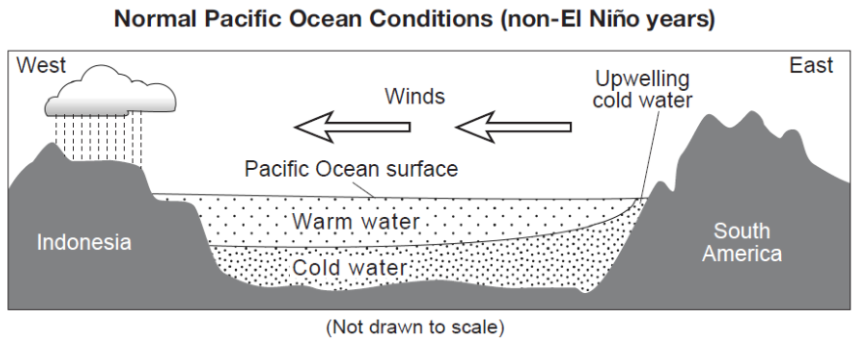
During an El Niño event, these westward-blowing winds get weaker. As a result, warmer water does not get pushed westward as much, and colder water in the east is not pulled toward the surface. This creates warmer surface ocean water temperatures in the east, allowing the thunderstorms that normally occur at the equator in the western Pacific to move eastward.
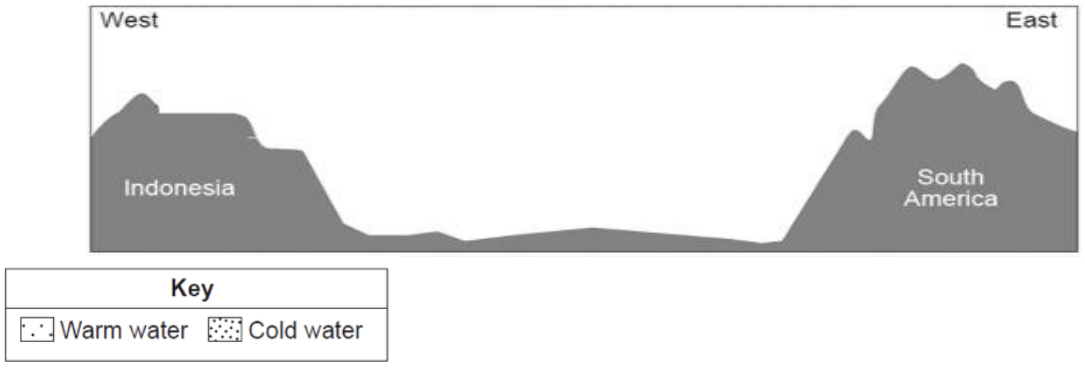
a. Draw the cross section that best represents the changed wind conditions and Pacific Ocean temperatures during an El Niño event. [1 point]
b. Compared to non-El Niño years, which climatic conditions exists near the equator on the western and eastern sides of the Pacific Ocean during an El Niño event? [3 points]
| | Colder or Warmer | Drier or Wetter |
| --- | --- | --- |
| Australia | | |
| Bolivian | | |
c. According to recent estimates, 8 out of 10 farmers have 40% reduced profits during El Niño years. What can farmers and government agencies do to minimize the effects of El Niño? [1 point]
During an El Niño event, these westward-blowing winds get weaker. As a result, warmer water does not get pushed westward as much, and colder water in the east is not pulled toward the surface. This creates warmer surface ocean water temperatures in the east, allowing the thunderstorms that normally occur at the equator in the western Pacific to move eastward.
a. Draw the cross section that best represents the changed wind conditions and Pacific Ocean temperatures during an El Niño event. [1 point]
b. Compared to non-El Niño years, which climatic conditions exists near the equator on the western and eastern sides of the Pacific Ocean during an El Niño event? [3 points]
| | Colder or Warmer | Drier or Wetter |
| --- | --- | --- |
| Australia | | |
| Bolivian | | |
c. According to recent estimates, 8 out of 10 farmers have 40% reduced profits during El Niño years. What can farmers and government agencies do to minimize the effects of El Niño? [1 point]