Question 2
On the evening of Saturday 29 October, as many as 100,000 people – mostly in their teens and 20s – poured into Itaewon’s narrow, sloping streets for one of the first major celebrations since Covid restrictions were lifted. Just after 10 pm, chaos erupted on a narrow, steep side street near Itaewon station that connects to a slew of bars and clubs from the main road. Witnesses reported seeing crowds surging in different directions and people losing their footing on the slope, causing a domino effect. People fell and knocked others down, piling one person onto another and trapping them. Others tried to scale the sides of the buildings to escape.
An excerpt from Crowd crushes: how disasters like Itaewon happen, how can they be prevented, and the ‘stampede’ myth. Source: https://www.theguardian.com/world/2022/nov/01/how-do-crowd-crushes-happen-stampede-myth-what-happened-in-the-seoul-itaewon-halloween-crush
a. The diagram below shows the directions of blood flow in some parts of the body. Encircle the part(s) immediately affected by the crowd crush. [2 points]
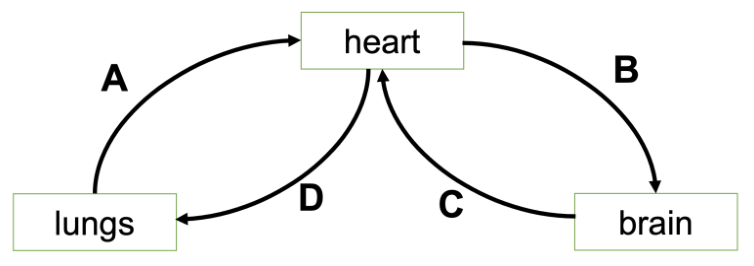
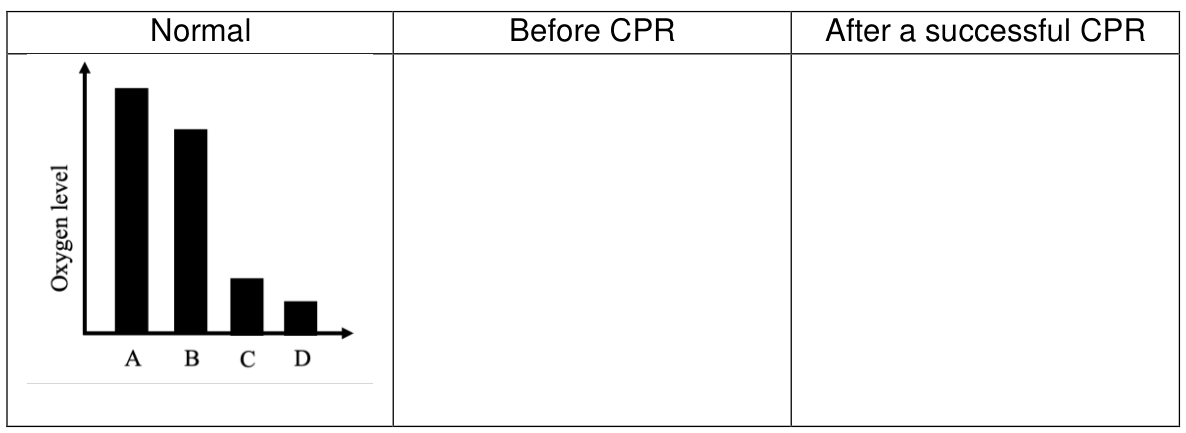
b. It is believed that there were people who experienced cardiac arrest during the crowd crush. Thus, a cardiopulmonary resuscitation was conducted by first responders and by-standers. Assuming that a same amount of blood was continuously drawn from A, B, C, and D during the entire CPR process, draw a graph showing the comparison of blood oxygen level drawn from each level on a normal condition, before and after a successful CPR. [3 points]
c. When oxygen is depleted, the brain instructs some organs to stop working. This illustrates our body’s inability to maintain _________________. [1 point]
An excerpt from Crowd crushes: how disasters like Itaewon happen, how can they be prevented, and the ‘stampede’ myth. Source: https://www.theguardian.com/world/2022/nov/01/how-do-crowd-crushes-happen-stampede-myth-what-happened-in-the-seoul-itaewon-halloween-crush
a. The diagram below shows the directions of blood flow in some parts of the body. Encircle the part(s) immediately affected by the crowd crush. [2 points]
b. It is believed that there were people who experienced cardiac arrest during the crowd crush. Thus, a cardiopulmonary resuscitation was conducted by first responders and by-standers. Assuming that a same amount of blood was continuously drawn from A, B, C, and D during the entire CPR process, draw a graph showing the comparison of blood oxygen level drawn from each level on a normal condition, before and after a successful CPR. [3 points]
c. When oxygen is depleted, the brain instructs some organs to stop working. This illustrates our body’s inability to maintain _________________. [1 point]