Question 1
Often called corpse plant, the Rafflesia blooms into the single largest individual flower in the world. When it blooms, it shows patches of red and white dots or stripes and an aroma similar to a rotten meat. Despite its bright appearance, Rafflesia is not capable producing its own food from the Sun, instead it attaches itself to a specific genus of vines called Tetrastigma via germination in response to stimulants coming from the host plant. The figure below shows a selected life history of a rafflesia plant.
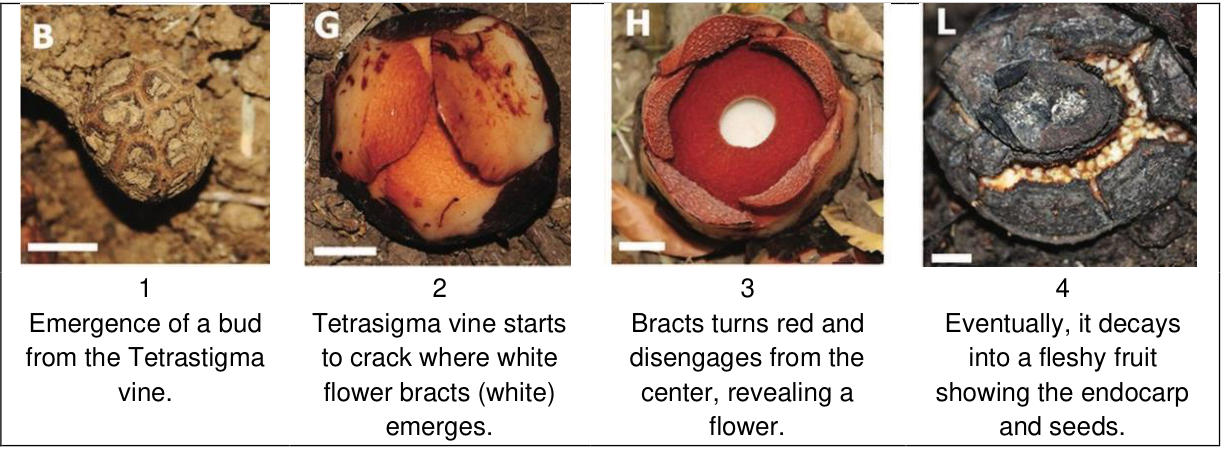
Source: Tolod, J.R., Galindon, J.M.M, Atienza, R.R., Duya, M.V., Fernando, E.S., and Ong, P.S. (2020). Flower and fruit development and life history of Rafflesia consueloae (Rafflesiaceae). Philippine Journal of Science 150(1), p. 321–332. DOI: 10.56899/150.S1.23
a. List down two (2) adaptations of rafflesia plant that allows it to survive in nature. [2 points]
| Adaptation | Answer |
| --- | --- |
| nutrient acquisition | |
| reproduction | |
b. At the end of its life cycle, the rafflesia rots into a fleshy fruit which contains seeds. State the method at which the fruit is dispersed and explain how this structure help in its dispersal. [1.5 points]
c. Rafflesia and Nepenthes both attract insects. Do they both have the same goal of attracting insects? Explain their similarity or difference. [1.5 points]