Question 9
(9) Sedimentary rocks are a combination of many things – small fragments of rocks, minerals, and soil even remnants of living organisms like bones, shells, and plant matters that dissolves in water. These particles accumulate and are deposited until such time it is turned into rocks through a process called lithification.
Since particles that accumulate varies in type, shape, and sizes, sedimentary rocks are often diverse in appearance and characteristics. That is why geologists often devise and use an identification flowchart (Figure 8) to ease the process of identifying sedimentary rocks.
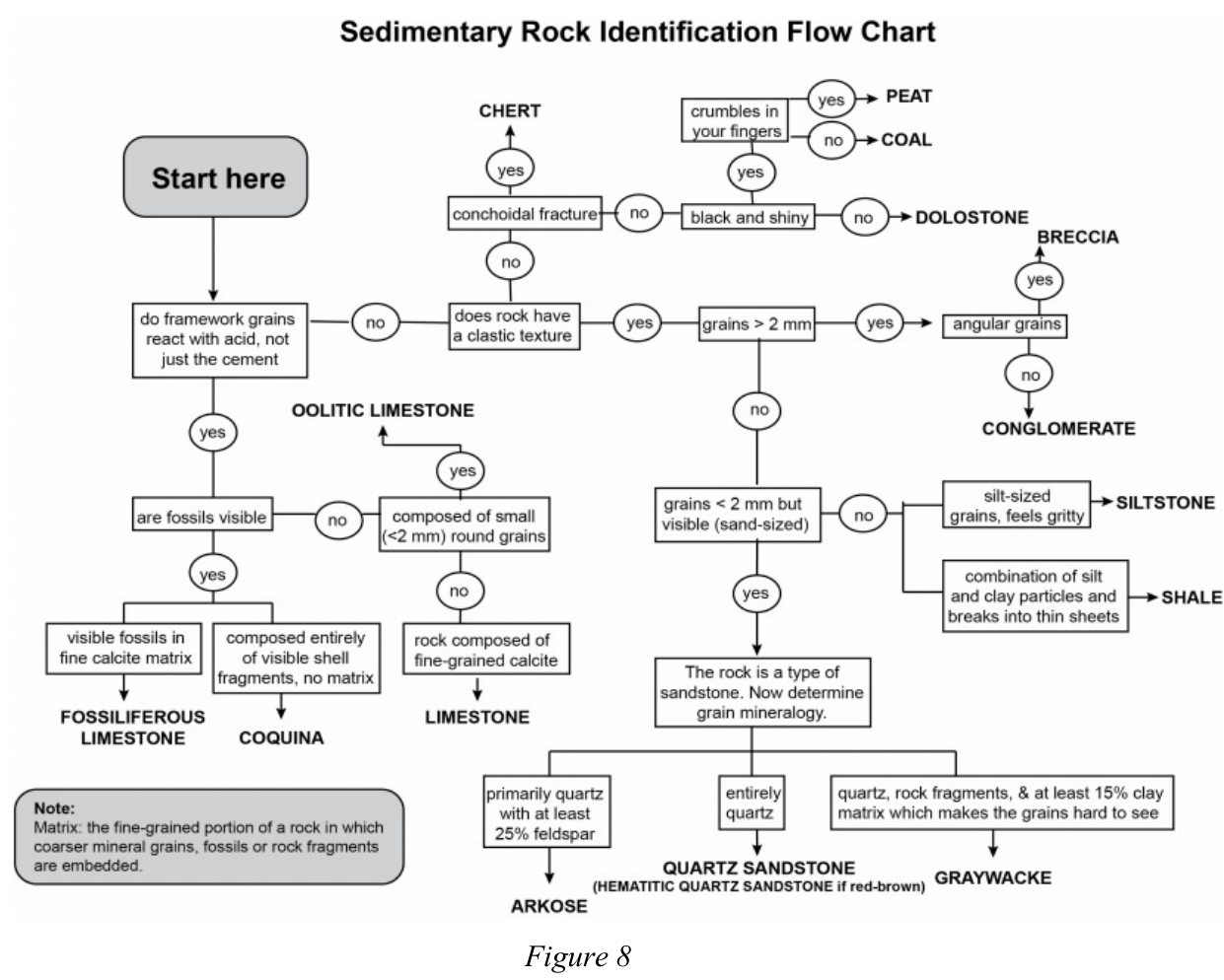
(i) A geologist wants to identify a white rock he found in a river. He added a few drops of hydrochloric acid on it and observed that bubbles formed. There were no traces of fossils and the grains are not visible with the naked eye. Using a microscope, he determined that the grains are 1 mm in diameter on average. Using Figure 8, identify the rock. [2 marks]
(ii) A small fragment of sedimentary rock consisting of siltstone, limestone and breccia. Devise a three-step plan to separate these rocks. [3 marks]
Since particles that accumulate varies in type, shape, and sizes, sedimentary rocks are often diverse in appearance and characteristics. That is why geologists often devise and use an identification flowchart (Figure 8) to ease the process of identifying sedimentary rocks.
(i) A geologist wants to identify a white rock he found in a river. He added a few drops of hydrochloric acid on it and observed that bubbles formed. There were no traces of fossils and the grains are not visible with the naked eye. Using a microscope, he determined that the grains are 1 mm in diameter on average. Using Figure 8, identify the rock. [2 marks]
(ii) A small fragment of sedimentary rock consisting of siltstone, limestone and breccia. Devise a three-step plan to separate these rocks. [3 marks]