Question 2
PART II: MAXIMUM VOLUME OF THE CARGO
Archimedes’ Principle has important applications to floating boats and ships and their maximum cargo. In general, the source gives:
Mass of boat and cargo ≤ mass of water displaced by the boat.
Design and conduct an experiment to determine the maximum volume of a precious sand that your small plastic boat can carry on fresh water (density 1.0 g/ml) before it sinks, in order to decide the storage space required. The sand must stay dry. Only a small sample of sand is supplied; it must not touch water because it takes an extremely long time to dry.
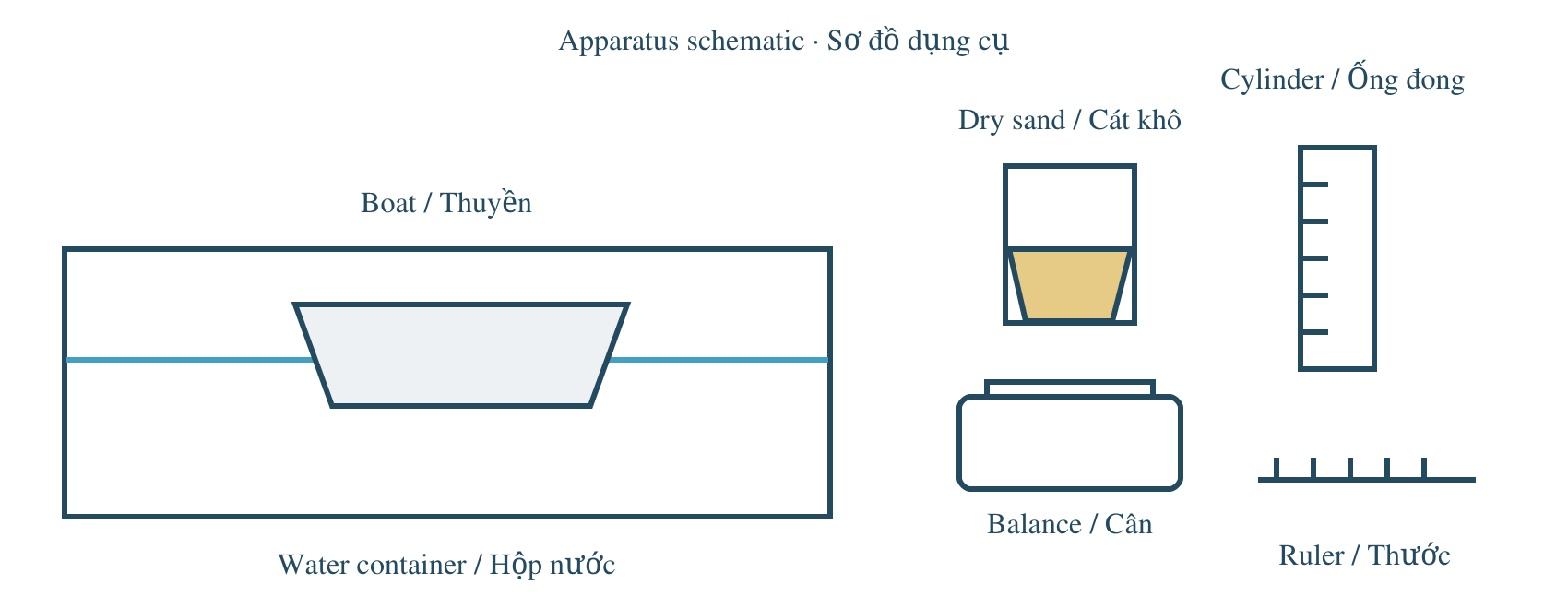
Available apparatus:
- Plastic cup containing a small sample of sand
- Boat (a plastic container that floats on water)
- Standard masses and paper clips
- Electronic mass balance
- 100 ml measuring cylinder and 250 ml measuring cylinder
- 250 ml beaker
- 30 cm ruler
- Water
- Plastic container for testing
- Cloth for drying
Aim: Design the procedure, conduct the experiment and determine the maximum volume of sand that the boat can carry. In your plan state clearly the measurements, apparatus and all necessary calculations. You need not use every item provided.
Design: __________________________________________________
_________________________________________________________
Results: __________________________________________________
_________________________________________________________
(a) Sea water has a slightly greater density than fresh water (about 1.03 g/ml, equivalently 1.03 g/cm³). Would you expect the volume of sand that can be carried to be smaller than, equal to or larger than the volume determined in your fresh-water experiment? Explain.
(b) Your boat will transport sand across the sea (salt water), but the harbors at both ports contain fresh water. Should you still test with fresh water, use salt water, or use both and determine the average? Explain briefly.
Answer (a): ______________________________________________
Answer (b): ______________________________________________
Optional blank recording aid (editorial; the original provides unstructured Design and Results spaces). Choose and label measurements suitable for your own method; leave missing observations blank.
| Measured quantity and apparatus | Value | Unit |
| --- | --- | --- |
| ____ | ____ | ____ |
| ____ | ____ | ____ |
| ____ | ____ | ____ |
| ____ | ____ | ____ |
| ____ | ____ | ____ |
| ____ | ____ | ____ |
Archimedes’ Principle has important applications to floating boats and ships and their maximum cargo. In general, the source gives:
Mass of boat and cargo ≤ mass of water displaced by the boat.
Design and conduct an experiment to determine the maximum volume of a precious sand that your small plastic boat can carry on fresh water (density 1.0 g/ml) before it sinks, in order to decide the storage space required. The sand must stay dry. Only a small sample of sand is supplied; it must not touch water because it takes an extremely long time to dry.
Available apparatus:
- Plastic cup containing a small sample of sand
- Boat (a plastic container that floats on water)
- Standard masses and paper clips
- Electronic mass balance
- 100 ml measuring cylinder and 250 ml measuring cylinder
- 250 ml beaker
- 30 cm ruler
- Water
- Plastic container for testing
- Cloth for drying
Aim: Design the procedure, conduct the experiment and determine the maximum volume of sand that the boat can carry. In your plan state clearly the measurements, apparatus and all necessary calculations. You need not use every item provided.
Design: __________________________________________________
_________________________________________________________
Results: __________________________________________________
_________________________________________________________
(a) Sea water has a slightly greater density than fresh water (about 1.03 g/ml, equivalently 1.03 g/cm³). Would you expect the volume of sand that can be carried to be smaller than, equal to or larger than the volume determined in your fresh-water experiment? Explain.
(b) Your boat will transport sand across the sea (salt water), but the harbors at both ports contain fresh water. Should you still test with fresh water, use salt water, or use both and determine the average? Explain briefly.
Answer (a): ______________________________________________
Answer (b): ______________________________________________
Optional blank recording aid (editorial; the original provides unstructured Design and Results spaces). Choose and label measurements suitable for your own method; leave missing observations blank.
| Measured quantity and apparatus | Value | Unit |
| --- | --- | --- |
| ____ | ____ | ____ |
| ____ | ____ | ____ |
| ____ | ____ | ____ |
| ____ | ____ | ____ |
| ____ | ____ | ____ |
| ____ | ____ | ____ |