Question 1
EXPERIMENT: Frog muscle twitch
INTRODUCTION
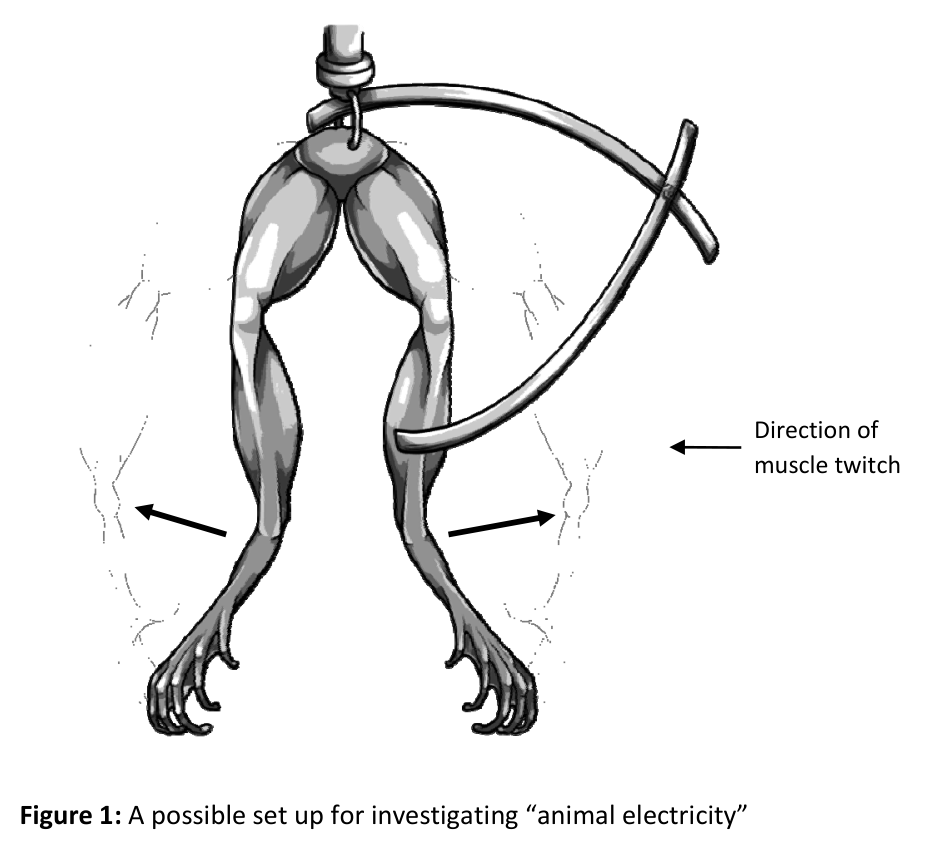
During the 1780s, biologist Luigi Galvani observed an interesting phenomenon while he was conducting experiments involving frogs. While cutting a frog’s leg, his steel scalpel touched a brass hook holding the leg in place. The leg of the dead frog twitched!
Galvani performed more experiments and was convinced that a life force within the muscles of the frog was the source of “animal electricity”. His colleague, Alessandro Volta could replicate Galvani’s experiment but was sceptical of his hypothesis.
What conditions present in the dead frog’s muscle during Galvani’s accidental discovery were responsible for his observations? Could it be the presence of two different metals? Or substances present in the muscle? Or substances found only in animals?
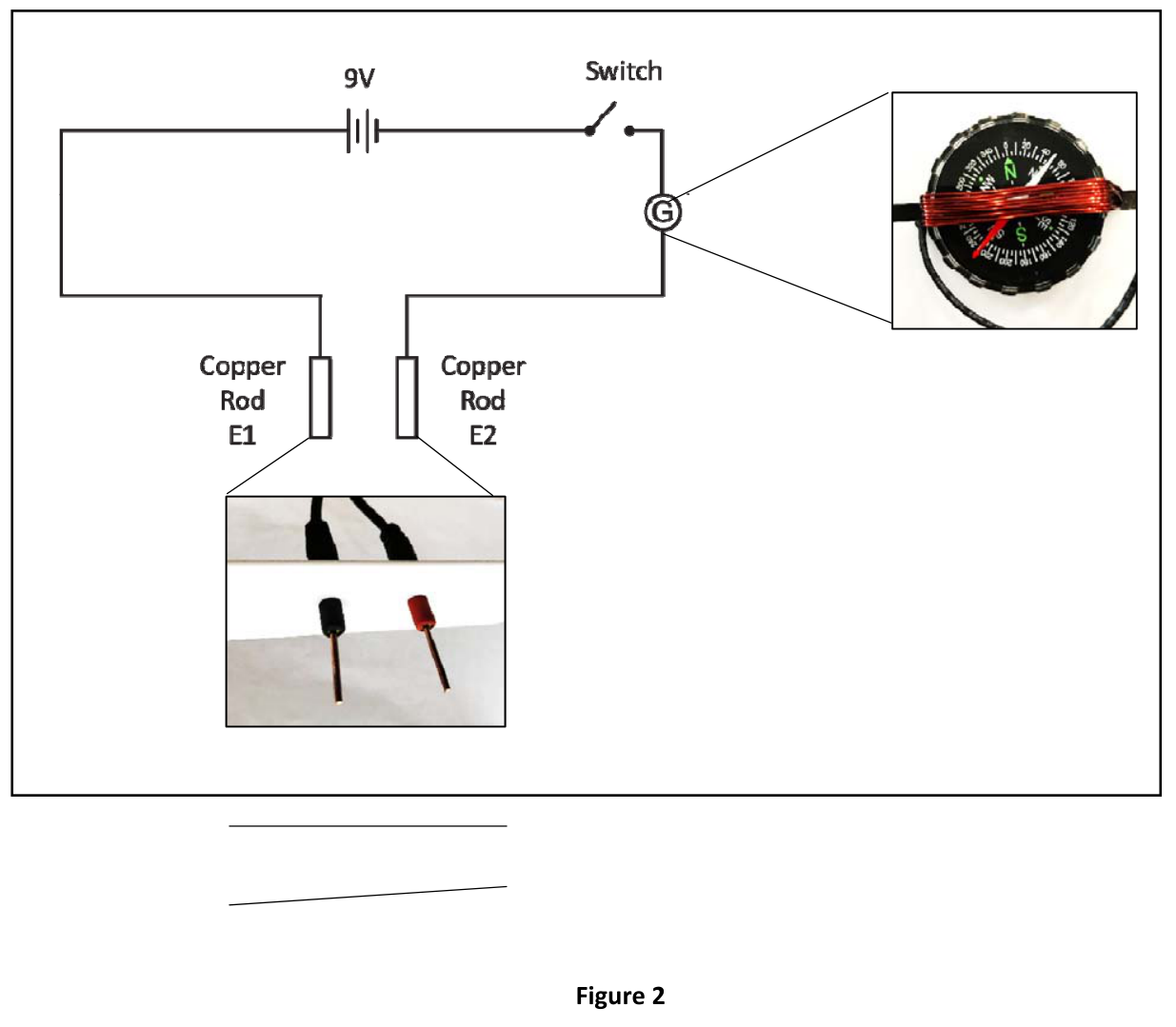
You will be conducting a simplified version of Galvani’s experiment with instrument G instead of frog muscle.
AIM OF EXPERIMENT
The aim of this experiment is to investigate the conditions that are necessary for the dead frog’s muscle to twitch. You will use instrument G instead of frog legs.
WHAT YOU WILL NEED
A. Circuit consisting of a 9V battery, two copper rods E1 and E2, a switch and instrument G. The parts of the circuit are drawn and labelled in Figure 2 below.
B. Three liquids (S1, S2, and S3) in separate containers.
C. Lemon wedge in container labelled S4.
D. Paper towel.
WHAT YOU WILL DO
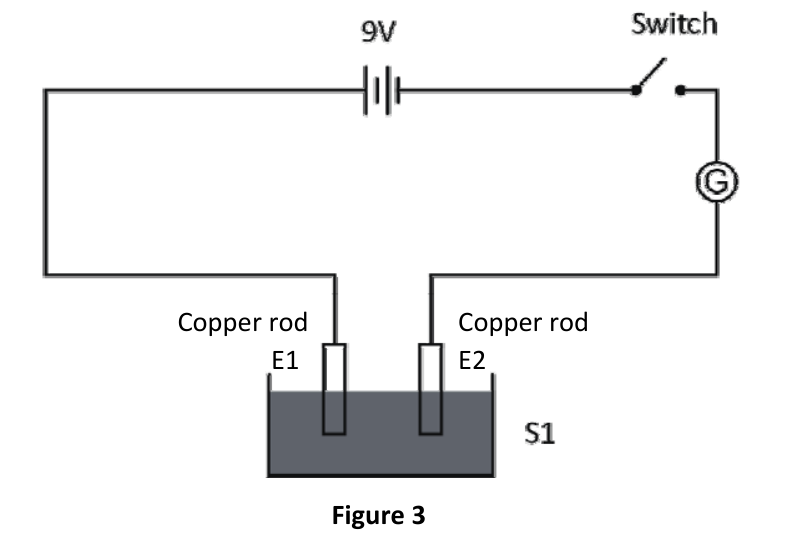
1. Set up the circuit as shown in Figure 3 and ensure the switch on the battery holder is set to “OFF” position. NOTE: Open the lid of container with liquid S1 carefully to avoid spilling the liquid.
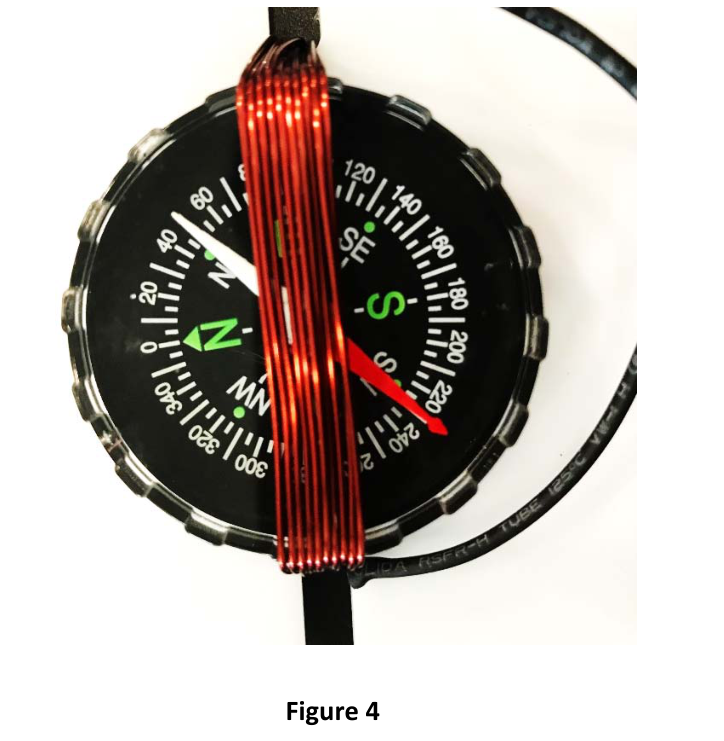
2. Orientate instrument G such that the white compass needle points to “50” as shown in Figure 4.
3. Flip the switch on the battery holder to “ON” position.
4. Observe and record in Table 1, the reading on instrument G when the needle stops moving.
5. Observe and record in Table 2, what happened in the container and to the copper rods.
6. Wipe the copper rods dry with the paper towel provided.
7. Repeat steps 1 to 4 with S2 and wipe the copper rods dry.
8. Repeat steps 1 to 4 with S3 and wipe the copper rods dry.
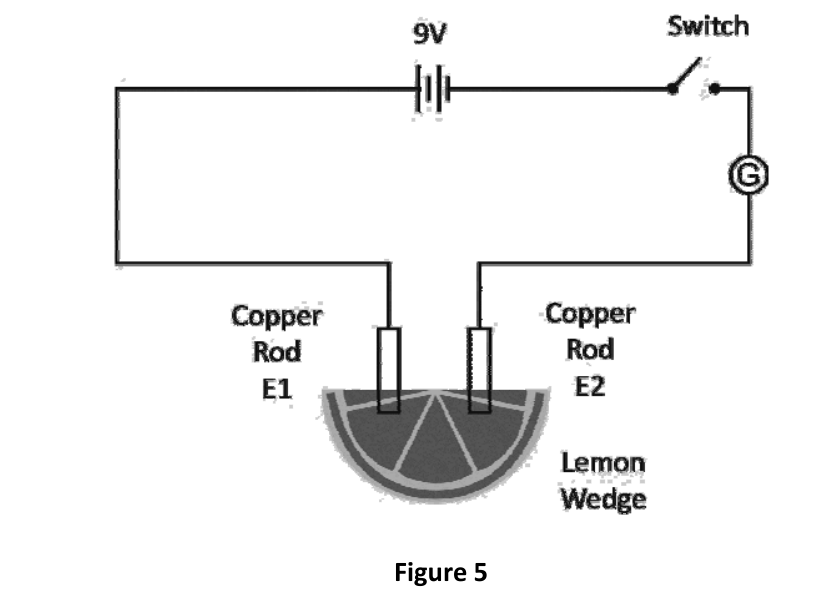
9. Set up the circuit with the wedge of lemon as shown in Figure 5 and ensure the switch on the battery holder is set to “OFF” position.
10. Repeat steps 2 to 4 with the wedge of lemon.
SECTION 1: RESULTS
Based on your observations, record the required readings on instrument G in Table 1.
| Material | S1: Salt solution | S2: Sugar solution | S3: Lemon juice | S4: Lemon wedge |
| --- | --- | --- | --- | --- |
| Reading on instrument G with switch in “ON” position / unit | ____ | ____ | ____ | ____ |
[4 marks]
Table 2
| Observations of solution S1 | Observations of copper rods |
| --- | --- |
| ____ | ____ |
[2 marks]
INTRODUCTION
During the 1780s, biologist Luigi Galvani observed an interesting phenomenon while he was conducting experiments involving frogs. While cutting a frog’s leg, his steel scalpel touched a brass hook holding the leg in place. The leg of the dead frog twitched!
Galvani performed more experiments and was convinced that a life force within the muscles of the frog was the source of “animal electricity”. His colleague, Alessandro Volta could replicate Galvani’s experiment but was sceptical of his hypothesis.
What conditions present in the dead frog’s muscle during Galvani’s accidental discovery were responsible for his observations? Could it be the presence of two different metals? Or substances present in the muscle? Or substances found only in animals?
You will be conducting a simplified version of Galvani’s experiment with instrument G instead of frog muscle.
AIM OF EXPERIMENT
The aim of this experiment is to investigate the conditions that are necessary for the dead frog’s muscle to twitch. You will use instrument G instead of frog legs.
WHAT YOU WILL NEED
A. Circuit consisting of a 9V battery, two copper rods E1 and E2, a switch and instrument G. The parts of the circuit are drawn and labelled in Figure 2 below.
B. Three liquids (S1, S2, and S3) in separate containers.
C. Lemon wedge in container labelled S4.
D. Paper towel.
WHAT YOU WILL DO
1. Set up the circuit as shown in Figure 3 and ensure the switch on the battery holder is set to “OFF” position. NOTE: Open the lid of container with liquid S1 carefully to avoid spilling the liquid.
2. Orientate instrument G such that the white compass needle points to “50” as shown in Figure 4.
3. Flip the switch on the battery holder to “ON” position.
4. Observe and record in Table 1, the reading on instrument G when the needle stops moving.
5. Observe and record in Table 2, what happened in the container and to the copper rods.
6. Wipe the copper rods dry with the paper towel provided.
7. Repeat steps 1 to 4 with S2 and wipe the copper rods dry.
8. Repeat steps 1 to 4 with S3 and wipe the copper rods dry.
9. Set up the circuit with the wedge of lemon as shown in Figure 5 and ensure the switch on the battery holder is set to “OFF” position.
10. Repeat steps 2 to 4 with the wedge of lemon.
SECTION 1: RESULTS
Based on your observations, record the required readings on instrument G in Table 1.
| Material | S1: Salt solution | S2: Sugar solution | S3: Lemon juice | S4: Lemon wedge |
| --- | --- | --- | --- | --- |
| Reading on instrument G with switch in “ON” position / unit | ____ | ____ | ____ | ____ |
[4 marks]
Table 2
| Observations of solution S1 | Observations of copper rods |
| --- | --- |
| ____ | ____ |
[2 marks]