Question 2
**Editorial safety override and missing materials:** Do not carry out the source instruction to blow talcum powder. Do not inhale or disperse talc or detergent dust. An adult/teacher must handle any powder in a way that prevents airborne dust; if this cannot be assured, use a teacher-provided demonstration/recording instead. Keep your face away, protect eyes, avoid skin/eye contact, do not taste any material, and wash hands afterward. Use a stable tray, handle spills promptly, and let the teacher collect the oil/detergent mixture for appropriate disposal; do not pour oil down a drain. Detergent is required in step 6 but missing from the source materials list. Step 5 also requires a way to measure 5 mL; an uncalibrated dropper does not establish this volume. The teacher must supply suitable detergent and a calibrated measure, and approve safe quantities, before proceeding. Keep the original wording below for source fidelity, but follow this safety override.
**Editorial scientific caution:** This is an oil–water surface demonstration, not a functioning cell membrane. The source questions contain oversimplifications. Record genuine observations and distinguish them from the membrane analogy; scientifically justified corrections are accepted.
### Experiment 2
### Introduction
The cell, the most basic organization of every living thing is covered by a cell membrane. This membrane keeps all of the pieces inside as well as protects every cell as it chooses the substances that can come into the cell. Compounds called proteins and phospholipids make up most of the cell membrane.
Scientists describe the organization of the phospholipids and proteins with the model called the fluid mosaic model. That model shows that the phospholipids are in a shape like a head and a tail. The heads like water (hydrophilic) and the tails do not like water (hydrophobic). The tails bump up against each other and the heads are out facing the watery area surrounding the cell. The two layers of the membrane is called the lipid bilayer.
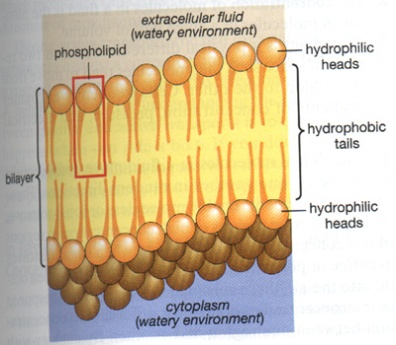
[Editorial Vietnamese label glossary is provided after the procedure; the original image is retained intact.]
In the following experiment, you will have an opportunity to observe hydrophobic and hydrophilic substances and how they actually react with water and other substances. In this activity, you can observe how the cell membrane behaves when substances comes into contact with it, thereby choosing what kinds of substances can enter the cell.
### List of Materials
Please check if you have complete set of the following materials:
1. shallow plastic container with cover — 1 piece
2. water — 1 bottle
3. talcum powder — 1 sachet
4. medicine dropper — 1 piece
5. cooking oil — 1 sachet
6. wooden stick (for stirring) — 1 piece
### Methods
1. Fill the plastic container almost up to the brim with water.
2. Sprinkle the talcum powder on the surface of the water. Once the water surface is entirely covered, gently blow away the excess powder.
**Safety override for step 2: do not blow; only adult-controlled, dust-preventing handling is allowed, or use a teacher-provided demonstration/recording.**
**3.** Using the medicine dropper, carefully put 5 drops of oil on the water. The area covered by the spreading film will be more or less circular in the shape when done with care.
**4.** In the same container, add 5 more drops of oil and observe what happen to the oil added at each drop. Record the results.
**5.** Add 5 mL more of oil in the same container. Using the wooden stick, stir the oil in the container and observe. Let the mixture stand for about 10 minutes and observe again. Record your observations.
**6.** Add a pinch of detergent powder to the mixture and observe what happens to oil. Record the results.
[Record actual observations for each stage, including each of the five added drops, immediately after stirring, after about 10 minutes, and after detergent. Blank response spaces are provided below; these are editorial recording aids, not supplied experimental results.]
| Stage | Your observations |
| --- | --- |
| Initial 5 oil drops | |
| Additional drop 1 | |
| Additional drop 2 | |
| Additional drop 3 | |
| Additional drop 4 | |
| Additional drop 5 | |
| After adding 5 mL oil and stirring | |
| After standing about 10 minutes | |
| After detergent | |
### Discussion of Results
Discuss your results by answering the following questions:
1. Which among the talcum powder and oil is hydrophobic and which is hydrophilic?
2. In the fluid mosaic model of the cell membrane, which part shall allow the entrance of the talcum powder, and which part shall allow the entrance of the oil molecules?
3. In your observation of the reaction of the detergent with the oil, what part of the cell membrane model can you liken the action of the detergent?
4. Considering all your observations, write your conclusion on the blank provided in your answer sheets.
[Answers 1–4 and conclusion: ____________________]
**Editorial glossary for the unchanged source image:** extracellular fluid (water environment) = dịch ngoại bào (môi trường nước); phospholipid = phospholipid; hydrophilic heads = các đầu ưa nước; hydrophobic tails = các đuôi kị nước; bilayer = lớp kép; cytoplasm (water environment) = tế bào chất (môi trường nước).
**Editorial scientific caution:** This is an oil–water surface demonstration, not a functioning cell membrane. The source questions contain oversimplifications. Record genuine observations and distinguish them from the membrane analogy; scientifically justified corrections are accepted.
### Experiment 2
### Introduction
The cell, the most basic organization of every living thing is covered by a cell membrane. This membrane keeps all of the pieces inside as well as protects every cell as it chooses the substances that can come into the cell. Compounds called proteins and phospholipids make up most of the cell membrane.
Scientists describe the organization of the phospholipids and proteins with the model called the fluid mosaic model. That model shows that the phospholipids are in a shape like a head and a tail. The heads like water (hydrophilic) and the tails do not like water (hydrophobic). The tails bump up against each other and the heads are out facing the watery area surrounding the cell. The two layers of the membrane is called the lipid bilayer.
[Editorial Vietnamese label glossary is provided after the procedure; the original image is retained intact.]
In the following experiment, you will have an opportunity to observe hydrophobic and hydrophilic substances and how they actually react with water and other substances. In this activity, you can observe how the cell membrane behaves when substances comes into contact with it, thereby choosing what kinds of substances can enter the cell.
### List of Materials
Please check if you have complete set of the following materials:
1. shallow plastic container with cover — 1 piece
2. water — 1 bottle
3. talcum powder — 1 sachet
4. medicine dropper — 1 piece
5. cooking oil — 1 sachet
6. wooden stick (for stirring) — 1 piece
### Methods
1. Fill the plastic container almost up to the brim with water.
2. Sprinkle the talcum powder on the surface of the water. Once the water surface is entirely covered, gently blow away the excess powder.
**Safety override for step 2: do not blow; only adult-controlled, dust-preventing handling is allowed, or use a teacher-provided demonstration/recording.**
**3.** Using the medicine dropper, carefully put 5 drops of oil on the water. The area covered by the spreading film will be more or less circular in the shape when done with care.
**4.** In the same container, add 5 more drops of oil and observe what happen to the oil added at each drop. Record the results.
**5.** Add 5 mL more of oil in the same container. Using the wooden stick, stir the oil in the container and observe. Let the mixture stand for about 10 minutes and observe again. Record your observations.
**6.** Add a pinch of detergent powder to the mixture and observe what happens to oil. Record the results.
[Record actual observations for each stage, including each of the five added drops, immediately after stirring, after about 10 minutes, and after detergent. Blank response spaces are provided below; these are editorial recording aids, not supplied experimental results.]
| Stage | Your observations |
| --- | --- |
| Initial 5 oil drops | |
| Additional drop 1 | |
| Additional drop 2 | |
| Additional drop 3 | |
| Additional drop 4 | |
| Additional drop 5 | |
| After adding 5 mL oil and stirring | |
| After standing about 10 minutes | |
| After detergent | |
### Discussion of Results
Discuss your results by answering the following questions:
1. Which among the talcum powder and oil is hydrophobic and which is hydrophilic?
2. In the fluid mosaic model of the cell membrane, which part shall allow the entrance of the talcum powder, and which part shall allow the entrance of the oil molecules?
3. In your observation of the reaction of the detergent with the oil, what part of the cell membrane model can you liken the action of the detergent?
4. Considering all your observations, write your conclusion on the blank provided in your answer sheets.
[Answers 1–4 and conclusion: ____________________]
**Editorial glossary for the unchanged source image:** extracellular fluid (water environment) = dịch ngoại bào (môi trường nước); phospholipid = phospholipid; hydrophilic heads = các đầu ưa nước; hydrophobic tails = các đuôi kị nước; bilayer = lớp kép; cytoplasm (water environment) = tế bào chất (môi trường nước).