Question 2
### Playing with Yeast Ball
**Editorial safety and source note before practical work:** This historical paper does not identify the organic materials or indicator chemically. A supervising adult must verify the supplied materials and their safe use. Do not taste the mixtures or inhale powders. Avoid skin/eye contact with the indicator and wash hands. An adult should handle hot water; check temperature with the thermometer. Do not block or fully seal the gas outlet: fermentation gas must be able to move the indicator and escape safely. Keep the apparatus away from flames. The source's reassurance about indicator contamination is not a general safety claim. The source prints approximately 40⁰ Celsius (40 °C), not 400 °C. Its materials list and tables name A and B, but Part A additionally names C; no identity, supply or table for C is given. Ask the supervisor before using an additional sample.
### Introduction
Fermentation is a process to break down organic material such as fat, carbohydrate and protein into more simple substances. Fermentation in general is caused by microorganisms such as yeast, bacteria or fungus. Fermentation needs organic materials and water to keep the microorganisms alive.
Temperature is also an important factor in the process of fermentation. For example, inactive yeast can be activated rapidly if fermentation condition occurs under approximately 40⁰ Celsius.
The production of a gas during fermentation is caused by the types of substrate used. In most cases fermentation does not require oxygen so that an enclosed condition can be used for process.
### Instruction: materials and equipment
In this experiment you will be provided with 4 small containers. Three of them have a hole on their lid. One of the containers contains color indicator. You can put the indicator into the plastic tube by tapping the tip of the plastic tube into the color indicator. You can observe the fermentation activity based on movement of the indicator. Ignore if the color indicator contaminating your mixture, fermentation will not be affected! [This is the source's statement, retained for fidelity; see the safety note above.]
A pen marker and a ruler can be used to mark the plastic tube. The markings on the plastic tube are used to measure the rate of fermentation. Make several markings on the plastic tube (refer to the tables given). A stop watch is also provided to measure the time.
Use 10 ml of warm water for each experiment by mixing hot water with fresh water in the plastic cup available. A thermometer is available to measure the fermentation temperature. **Beware of hot water!**
List of materials and equipment:
| Item | Materials and equipment |
| --- | --- |
| 1 | Small containers (3 pieces) |
| 2 | A container of color indicator |
| 3 | Plastic cups (2 pieces) |
| 4 | Plastic tubes (3 pieces, 1.5 meters each) |
| 5 | Spoons (4 pieces) |
| 6 | An adhesive tape |
| 7 | A vacuum flask of hot water |
| 8 | A bottle of freshwater |
| 9 | A thermometer |
| 10 | A stopwatch |
| 11 | A plastic measuring cylinder, 15 ml size |
| 12 | A cotton towel |
| 13 | Organic materials (two packs: labeled A and B) |
| 14 | Two packs of yeast ball |
| 15 | A marker |
| 16 | Plasticine (toy clay) |
| 17 | Graph papers |
The ruler mentioned in the instructions is not separately listed in the numbered inventory. Check that one is available.
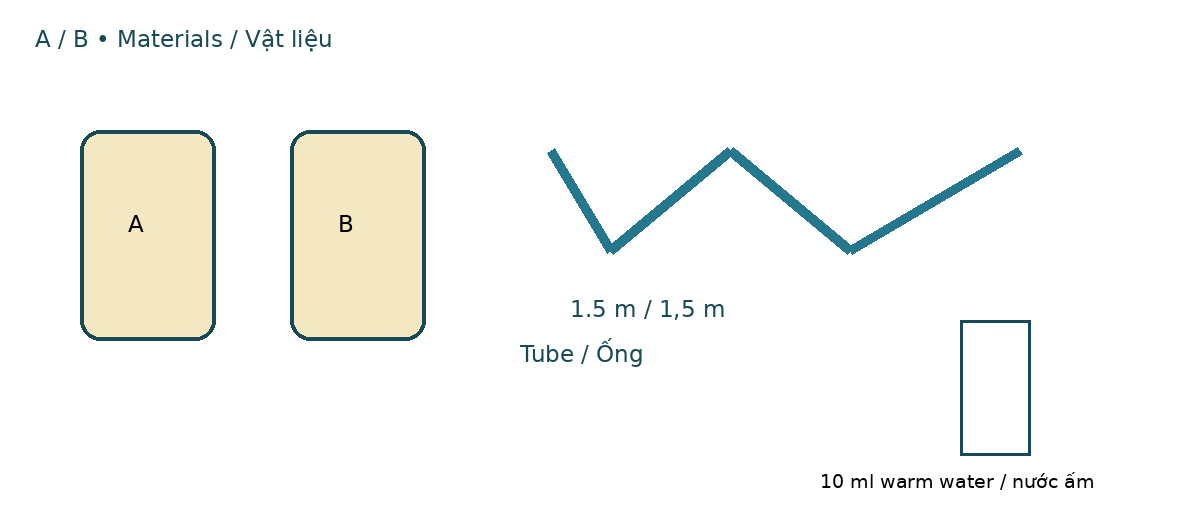
Editorial materials sketch only, not a proposed completed apparatus or experimental result. Labels A and B identify the source's supplied samples.
### PART A: Construct a fermentation device and prove that it works
Design a setup using materials and equipment available to show fermentation. Draw the setup on a paper and explain how it works. Use blank pages on the back of this exam paper if you need more space to draw and write explanation.
Answer: ___ (Score 5)
Perform the experiments based on what you have designed. Use organic materials A, B and C to measure fermentation rate. Wait for 3 to 5 minutes before you measure the fermentation. Record your results in the tables.
Number of markings in your plastic tubes: ___
Distance between two markings: ___
(Score for data recording: 8 points)
**Organic material A**
| Markings | Distance from starting point (cm) | Time (minutes) | Time (second) |
| --- | --- | --- | --- |
| 0 | 0 | 0′00″ | 0 |
| 1 | ___ | ___ | ___ |
| 2 | ___ | ___ | ___ |
| 3 | ___ | ___ | ___ |
| 4 | ___ | ___ | ___ |
| 5 | ___ | ___ | ___ |
| 6 | ___ | ___ | ___ |
| 7 | ___ | ___ | ___ |
**Organic material B**
| Markings | Distance from starting point (cm) | Time (minutes) | Time (second) |
| --- | --- | --- | --- |
| 0 | 0 | 0′00″ | 0 |
| 1 | ___ | ___ | ___ |
| 2 | ___ | ___ | ___ |
| 3 | ___ | ___ | ___ |
| 4 | ___ | ___ | ___ |
| 5 | ___ | ___ | ___ |
| 6 | ___ | ___ | ___ |
| 7 | ___ | ___ | ___ |
The source's B table omits its column headings; the identical headings from A are repeated here for readability. No data table for C is supplied. Blank cells are for actual measurements, not example results.
### Questions
(a) What are the important material(s) and condition(s) needed for fermentation?
Important material(s): ___
Condition(s): ___ (Score 3)
(b) In this experiment, how do you mix your organic materials with warm water without contaminating the other setups? Answer: ___ (Score 1)
(c) Why should you wait for 3 to 5 minutes before measuring the fermentation rate? Answer: ___ (Score 1)
### PART B: Analyze the effect of various organic material on the fermentation rate
(a) Draw graphs from the results of each setup (distance vs. time) on the same axes using the millimeter block sheet. (Score 2)
(b) Based on your graph what is the best organic material to be used for this fermentation reaction? Explain. (Score 2)
**Editorial safety and source note before practical work:** This historical paper does not identify the organic materials or indicator chemically. A supervising adult must verify the supplied materials and their safe use. Do not taste the mixtures or inhale powders. Avoid skin/eye contact with the indicator and wash hands. An adult should handle hot water; check temperature with the thermometer. Do not block or fully seal the gas outlet: fermentation gas must be able to move the indicator and escape safely. Keep the apparatus away from flames. The source's reassurance about indicator contamination is not a general safety claim. The source prints approximately 40⁰ Celsius (40 °C), not 400 °C. Its materials list and tables name A and B, but Part A additionally names C; no identity, supply or table for C is given. Ask the supervisor before using an additional sample.
### Introduction
Fermentation is a process to break down organic material such as fat, carbohydrate and protein into more simple substances. Fermentation in general is caused by microorganisms such as yeast, bacteria or fungus. Fermentation needs organic materials and water to keep the microorganisms alive.
Temperature is also an important factor in the process of fermentation. For example, inactive yeast can be activated rapidly if fermentation condition occurs under approximately 40⁰ Celsius.
The production of a gas during fermentation is caused by the types of substrate used. In most cases fermentation does not require oxygen so that an enclosed condition can be used for process.
### Instruction: materials and equipment
In this experiment you will be provided with 4 small containers. Three of them have a hole on their lid. One of the containers contains color indicator. You can put the indicator into the plastic tube by tapping the tip of the plastic tube into the color indicator. You can observe the fermentation activity based on movement of the indicator. Ignore if the color indicator contaminating your mixture, fermentation will not be affected! [This is the source's statement, retained for fidelity; see the safety note above.]
A pen marker and a ruler can be used to mark the plastic tube. The markings on the plastic tube are used to measure the rate of fermentation. Make several markings on the plastic tube (refer to the tables given). A stop watch is also provided to measure the time.
Use 10 ml of warm water for each experiment by mixing hot water with fresh water in the plastic cup available. A thermometer is available to measure the fermentation temperature. **Beware of hot water!**
List of materials and equipment:
| Item | Materials and equipment |
| --- | --- |
| 1 | Small containers (3 pieces) |
| 2 | A container of color indicator |
| 3 | Plastic cups (2 pieces) |
| 4 | Plastic tubes (3 pieces, 1.5 meters each) |
| 5 | Spoons (4 pieces) |
| 6 | An adhesive tape |
| 7 | A vacuum flask of hot water |
| 8 | A bottle of freshwater |
| 9 | A thermometer |
| 10 | A stopwatch |
| 11 | A plastic measuring cylinder, 15 ml size |
| 12 | A cotton towel |
| 13 | Organic materials (two packs: labeled A and B) |
| 14 | Two packs of yeast ball |
| 15 | A marker |
| 16 | Plasticine (toy clay) |
| 17 | Graph papers |
The ruler mentioned in the instructions is not separately listed in the numbered inventory. Check that one is available.
Editorial materials sketch only, not a proposed completed apparatus or experimental result. Labels A and B identify the source's supplied samples.
### PART A: Construct a fermentation device and prove that it works
Design a setup using materials and equipment available to show fermentation. Draw the setup on a paper and explain how it works. Use blank pages on the back of this exam paper if you need more space to draw and write explanation.
Answer: ___ (Score 5)
Perform the experiments based on what you have designed. Use organic materials A, B and C to measure fermentation rate. Wait for 3 to 5 minutes before you measure the fermentation. Record your results in the tables.
Number of markings in your plastic tubes: ___
Distance between two markings: ___
(Score for data recording: 8 points)
**Organic material A**
| Markings | Distance from starting point (cm) | Time (minutes) | Time (second) |
| --- | --- | --- | --- |
| 0 | 0 | 0′00″ | 0 |
| 1 | ___ | ___ | ___ |
| 2 | ___ | ___ | ___ |
| 3 | ___ | ___ | ___ |
| 4 | ___ | ___ | ___ |
| 5 | ___ | ___ | ___ |
| 6 | ___ | ___ | ___ |
| 7 | ___ | ___ | ___ |
**Organic material B**
| Markings | Distance from starting point (cm) | Time (minutes) | Time (second) |
| --- | --- | --- | --- |
| 0 | 0 | 0′00″ | 0 |
| 1 | ___ | ___ | ___ |
| 2 | ___ | ___ | ___ |
| 3 | ___ | ___ | ___ |
| 4 | ___ | ___ | ___ |
| 5 | ___ | ___ | ___ |
| 6 | ___ | ___ | ___ |
| 7 | ___ | ___ | ___ |
The source's B table omits its column headings; the identical headings from A are repeated here for readability. No data table for C is supplied. Blank cells are for actual measurements, not example results.
### Questions
(a) What are the important material(s) and condition(s) needed for fermentation?
Important material(s): ___
Condition(s): ___ (Score 3)
(b) In this experiment, how do you mix your organic materials with warm water without contaminating the other setups? Answer: ___ (Score 1)
(c) Why should you wait for 3 to 5 minutes before measuring the fermentation rate? Answer: ___ (Score 1)
### PART B: Analyze the effect of various organic material on the fermentation rate
(a) Draw graphs from the results of each setup (distance vs. time) on the same axes using the millimeter block sheet. (Score 2)
(b) Based on your graph what is the best organic material to be used for this fermentation reaction? Explain. (Score 2)