Question 2
Experiment II — Human Respiration
Safety note (editorial): Do not inhale or suck through an apparatus containing limewater, and do not perform this experiment unsupervised. The historical mouth-to-apparatus instructions below are retained as source text, not a recommended procedure. A teacher should use separately collected air samples and controlled one-way gas delivery with backflow protection for a demonstration; avoid eye/skin contact and use suitable protective equipment. Any such setup is a safety adaptation, not the original apparatus or an original observation. No observation may be invented.
Materials: limewater, Ca(OH)₂.
Tools: 2 test tubes, 2 rubber stoppers, 1 T- or Y-shaped plastic pipe, 1 syringe, 1 test-tube rack, 1 timer or stopwatch.
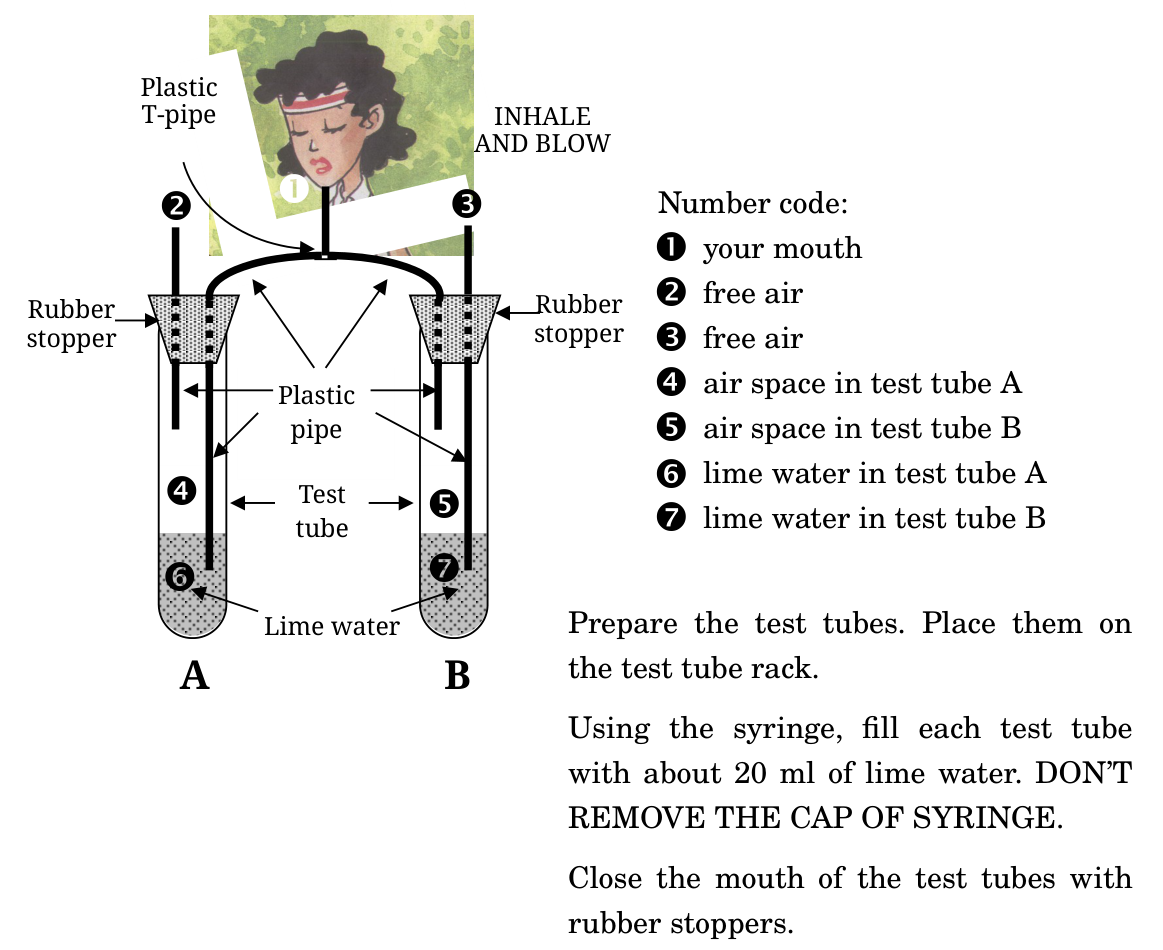
Historical procedures (for source study only): Set up the apparatus shown below. (15 points)
Number codes in the original figure: 1 = your mouth; 2 and 3 = free air; 4 = air space in test tube A; 5 = air space in test tube B; 6 = limewater in A; 7 = limewater in B.
Prepare the test tubes and place them on the rack. Using the syringe, fill each with about 20 ml of limewater. The source says, “DON’T REMOVE THE CAP OF SYRINGE.” Close the tube mouths with rubber stoppers. This ambiguous syringe instruction is preserved, not interpreted as a safe operating instruction; a teacher must select suitable equipment.
**1.** Observe the initial condition of limewater before inhaling and blowing. Record A: ____; B: ____. (2 points)
**2.** The historical source instructs inhaling through the T-pipe “as hard as you can,” 4–5 times. Observe and record A: ____; B: ____. (2 points) Do not carry out that instruction; use the supervised safety adaptation above.
**3.** The historical source instructs exhaling (blowing) through the T-pipe “as hard as you can,” 4–5 times. Observe and record A: ____; B: ____. (2 points) Use the supervised safety adaptation instead.
**4.** Compare the limewater in both test tubes before and after inhaling and blowing. Record A: ____; B: ____. (4 points)
Answer the questions:
**1.** Trace the airflow during inhaling, using only the number codes in the original setup. (6 points)
**2.** Trace the airflow during exhaling, using only those codes. (6 points)
**3.** According to these routes, the condition of limewater will differ between A and B. Explain the difference. (6 points)
**4.** If the changes are caused by mixing or reaction between limewater and carbon dioxide, what can you conclude? (6 points)
The original apparatus drawing is preserved below for interpreting the historical questions only.
Safety note (editorial): Do not inhale or suck through an apparatus containing limewater, and do not perform this experiment unsupervised. The historical mouth-to-apparatus instructions below are retained as source text, not a recommended procedure. A teacher should use separately collected air samples and controlled one-way gas delivery with backflow protection for a demonstration; avoid eye/skin contact and use suitable protective equipment. Any such setup is a safety adaptation, not the original apparatus or an original observation. No observation may be invented.
Materials: limewater, Ca(OH)₂.
Tools: 2 test tubes, 2 rubber stoppers, 1 T- or Y-shaped plastic pipe, 1 syringe, 1 test-tube rack, 1 timer or stopwatch.
Historical procedures (for source study only): Set up the apparatus shown below. (15 points)
Number codes in the original figure: 1 = your mouth; 2 and 3 = free air; 4 = air space in test tube A; 5 = air space in test tube B; 6 = limewater in A; 7 = limewater in B.
Prepare the test tubes and place them on the rack. Using the syringe, fill each with about 20 ml of limewater. The source says, “DON’T REMOVE THE CAP OF SYRINGE.” Close the tube mouths with rubber stoppers. This ambiguous syringe instruction is preserved, not interpreted as a safe operating instruction; a teacher must select suitable equipment.
**1.** Observe the initial condition of limewater before inhaling and blowing. Record A: ____; B: ____. (2 points)
**2.** The historical source instructs inhaling through the T-pipe “as hard as you can,” 4–5 times. Observe and record A: ____; B: ____. (2 points) Do not carry out that instruction; use the supervised safety adaptation above.
**3.** The historical source instructs exhaling (blowing) through the T-pipe “as hard as you can,” 4–5 times. Observe and record A: ____; B: ____. (2 points) Use the supervised safety adaptation instead.
**4.** Compare the limewater in both test tubes before and after inhaling and blowing. Record A: ____; B: ____. (4 points)
Answer the questions:
**1.** Trace the airflow during inhaling, using only the number codes in the original setup. (6 points)
**2.** Trace the airflow during exhaling, using only those codes. (6 points)
**3.** According to these routes, the condition of limewater will differ between A and B. Explain the difference. (6 points)
**4.** If the changes are caused by mixing or reaction between limewater and carbon dioxide, what can you conclude? (6 points)
The original apparatus drawing is preserved below for interpreting the historical questions only.