Question 3
Source header: International Mathematics and Science Olympiad for Primary Schools (IMSO) 2004 · Science Contest in Taiwan. Fields: Name, School, Grade, ID number. No round or duration is printed. This combined four-experiment package uses one shared 120-minute fallback, not a historical time claim.
## Experiment III: Black Box Electric Circuit
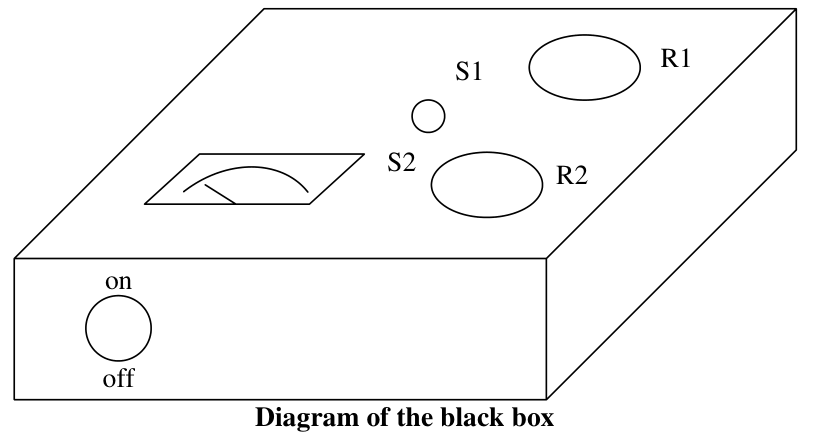
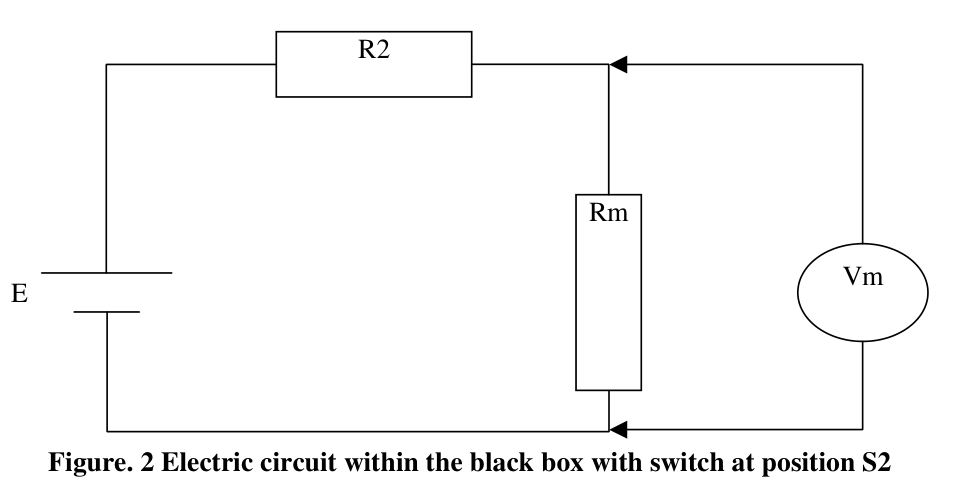
A black box containing an electric circuit is provided. A two-position switch selects the circuit: S1 uses Figure 1; S2 uses Figure 2. A voltmeter $V_m$ measures the voltage across resistor $R_m$. The source lists measured voltages $0,2.5,3,3.75,\ldots,15\,\mathrm V$.
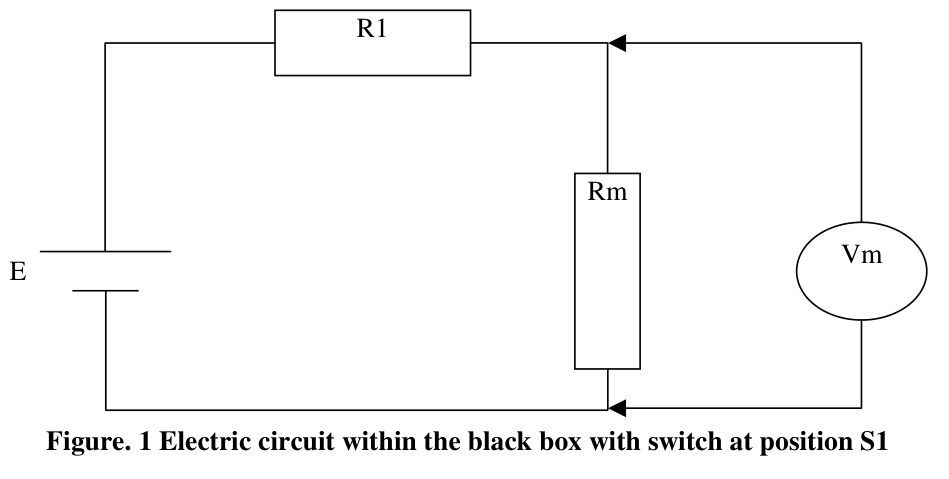
**A. Set the switch to S1.** The source says “Resistor is varied as shown in.” (unfinished sentence).
A1. As $R_1$ changes, read $V_m$ in column 3 of Table 1.
A2. Choose the right answer. Theoretically, current through $R_1$ is: (a) less than current through $R_m$; (b) equal to it; (c) more than it; (d) less than or equal to it; (e) more than or equal to it. **13 points.**
A3. With $R_m$ and battery voltage constant, increasing $R_1$ makes: (a) voltage $V_{R1}$ increase; (b) $V_{R1}$ decrease; (c) $V_m$ increase; (d) $V_m$ decrease; (e) $V_{R1}$ remain constant; (f) $V_{Rm}$ remain constant. The source says “choose the right answer.” **6 points.**
A4. Fill Table 1 by calculating current through $R_1$. **3 points.** Preserve the two blank calculated columns:
| Rotary position | R1 (ohm) | Vm (V), supplied | VR 1=E−Vm (V) | IR 1=VR 1/R1 (mA) |
|---|---|---|---|---|
|1|500|2.50|____|____|
|2|400|3.00|____|____|
|3|300|3.75|____|____|
|4|200|5.00|____|____|
|5|100|7.50|____|____|
|6|0|15.00|____|____|
A5. Draw $V_m$ versus current through $R_1$. **6 points.**
A6. The slope (voltage difference divided by current difference) equals ______. **5 points.**
A7. What does the slope represent? (a) $R_1$; (b) $R_2$; (c) $R_m$; (d) current through $R_1$; (e) current through $R_2$; (f) battery voltage $E$. **5 points.**
A8. Calculate current through $R_1$ when $R_1=0$. **6 points.**
**B. Set the switch to S2.** Unknown $R_2$ varies with its rotary-switch position.
B1. Read the supplied voltmeter values in column 2 of Table 2.
B2. Calculate voltage across $R_2$ and fill column 3. **6 points.**
**C. Data Analysis.** Estimate $R_2$ from the data and enter the results in Table 2. **24 points.**
| Rotary position | Vm (V), supplied | VR 2=E−Vm (V) | R2 (ohm) |
|---|---|---|---|
|1|12.50|____|____|
|2|10.00|____|____|
|3|7.50|____|____|
|4|6.00|____|____|
|5|5.00|____|____|
|6|3.00|____|____|
Original labels: on/off; S1/S2; R1/R2/Rm; Vm; E. All listed readings are source-provided, not newly observed. Source subpart marks sum to 74.
## Experiment III: Black Box Electric Circuit
A black box containing an electric circuit is provided. A two-position switch selects the circuit: S1 uses Figure 1; S2 uses Figure 2. A voltmeter $V_m$ measures the voltage across resistor $R_m$. The source lists measured voltages $0,2.5,3,3.75,\ldots,15\,\mathrm V$.
**A. Set the switch to S1.** The source says “Resistor is varied as shown in.” (unfinished sentence).
A1. As $R_1$ changes, read $V_m$ in column 3 of Table 1.
A2. Choose the right answer. Theoretically, current through $R_1$ is: (a) less than current through $R_m$; (b) equal to it; (c) more than it; (d) less than or equal to it; (e) more than or equal to it. **13 points.**
A3. With $R_m$ and battery voltage constant, increasing $R_1$ makes: (a) voltage $V_{R1}$ increase; (b) $V_{R1}$ decrease; (c) $V_m$ increase; (d) $V_m$ decrease; (e) $V_{R1}$ remain constant; (f) $V_{Rm}$ remain constant. The source says “choose the right answer.” **6 points.**
A4. Fill Table 1 by calculating current through $R_1$. **3 points.** Preserve the two blank calculated columns:
| Rotary position | R1 (ohm) | Vm (V), supplied | VR 1=E−Vm (V) | IR 1=VR 1/R1 (mA) |
|---|---|---|---|---|
|1|500|2.50|____|____|
|2|400|3.00|____|____|
|3|300|3.75|____|____|
|4|200|5.00|____|____|
|5|100|7.50|____|____|
|6|0|15.00|____|____|
A5. Draw $V_m$ versus current through $R_1$. **6 points.**
A6. The slope (voltage difference divided by current difference) equals ______. **5 points.**
A7. What does the slope represent? (a) $R_1$; (b) $R_2$; (c) $R_m$; (d) current through $R_1$; (e) current through $R_2$; (f) battery voltage $E$. **5 points.**
A8. Calculate current through $R_1$ when $R_1=0$. **6 points.**
**B. Set the switch to S2.** Unknown $R_2$ varies with its rotary-switch position.
B1. Read the supplied voltmeter values in column 2 of Table 2.
B2. Calculate voltage across $R_2$ and fill column 3. **6 points.**
**C. Data Analysis.** Estimate $R_2$ from the data and enter the results in Table 2. **24 points.**
| Rotary position | Vm (V), supplied | VR 2=E−Vm (V) | R2 (ohm) |
|---|---|---|---|
|1|12.50|____|____|
|2|10.00|____|____|
|3|7.50|____|____|
|4|6.00|____|____|
|5|5.00|____|____|
|6|3.00|____|____|
Original labels: on/off; S1/S2; R1/R2/Rm; Vm; E. All listed readings are source-provided, not newly observed. Source subpart marks sum to 74.