Question 1
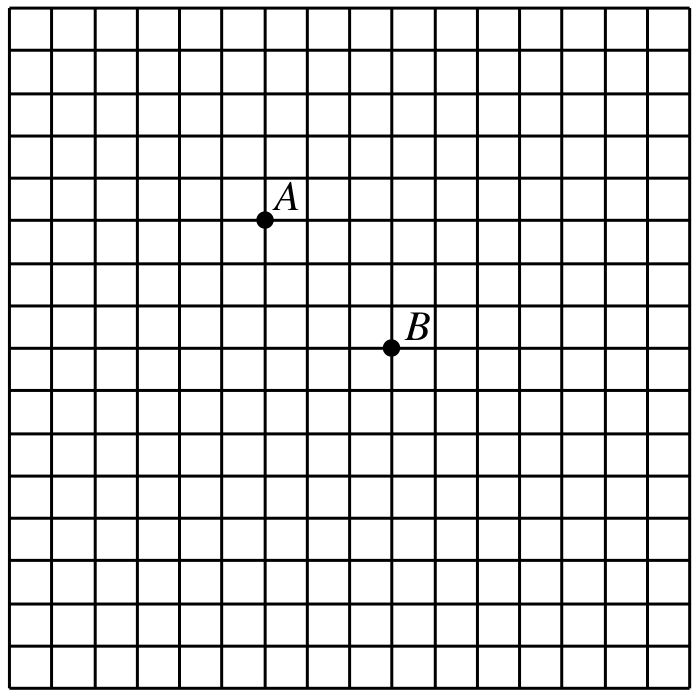
Suppose that we are living in a city where the streets are laid out on a square grid as shown below. In this city, you are only allowed to move along vertical lines (streets running north–south) or horizontal lines (streets running east–west). Suppose your home is at point $A$ and you want to go to your friend's house at point $B$. The distance travelled is not the straight-line distance measured with a ruler, but the distance walked along the streets. We define the TCG distance between $A$ and $B$ to be the length of a shortest such route. For example, from $A$ to $B$ you may move 3 right and 3 down, or 3 down and 3 right, so the TCG distance in the diagram is 6.
(a) How many grid points have TCG distance 6 from both $A$ and $B$? Draw the diagram. (2 marks)
(b) How many grid points have TCG distance 12 from both $A$ and $B$? Draw the diagram. (4 marks)
Answer-sheet instruction: no partial score for each subpart. The original answer sheet supplies a larger blank grid for drawing.
(a) How many grid points have TCG distance 6 from both $A$ and $B$? Draw the diagram. (2 marks)
(b) How many grid points have TCG distance 12 from both $A$ and $B$? Draw the diagram. (4 marks)
Answer-sheet instruction: no partial score for each subpart. The original answer sheet supplies a larger blank grid for drawing.