Question 4
A move chooses two boxes and redistributes their marbles equally, using whole marbles. Boxes with an odd combined total cannot be chosen. The game ends when no move changes the distribution. (The source’s examples require excluding a no-change move between equal boxes.)
Example: starting A–F at 10,11,12,14,19,24, merge B,E; A,C; D,F; A,D; C,F. The successive states are shown below.
Now start A–H at 4,5,6,8,9,31,32,35. Finish in the least number of moves. Record the pair and all eight box counts after each move.
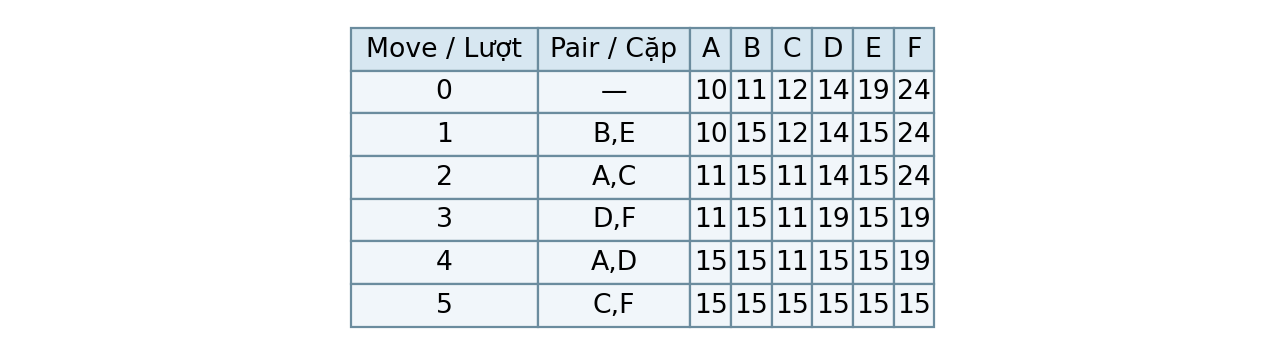
Example: starting A–F at 10,11,12,14,19,24, merge B,E; A,C; D,F; A,D; C,F. The successive states are shown below.
Now start A–H at 4,5,6,8,9,31,32,35. Finish in the least number of moves. Record the pair and all eight box counts after each move.