Question 4
We can put together four equilateral triangles of side length 1 unit to form shapes in the plane, subject to these conditions:
(i) The shape is connected.
(ii) No triangles overlap.
(iii) A triangle is connected to the rest by at least a side or part of a side.
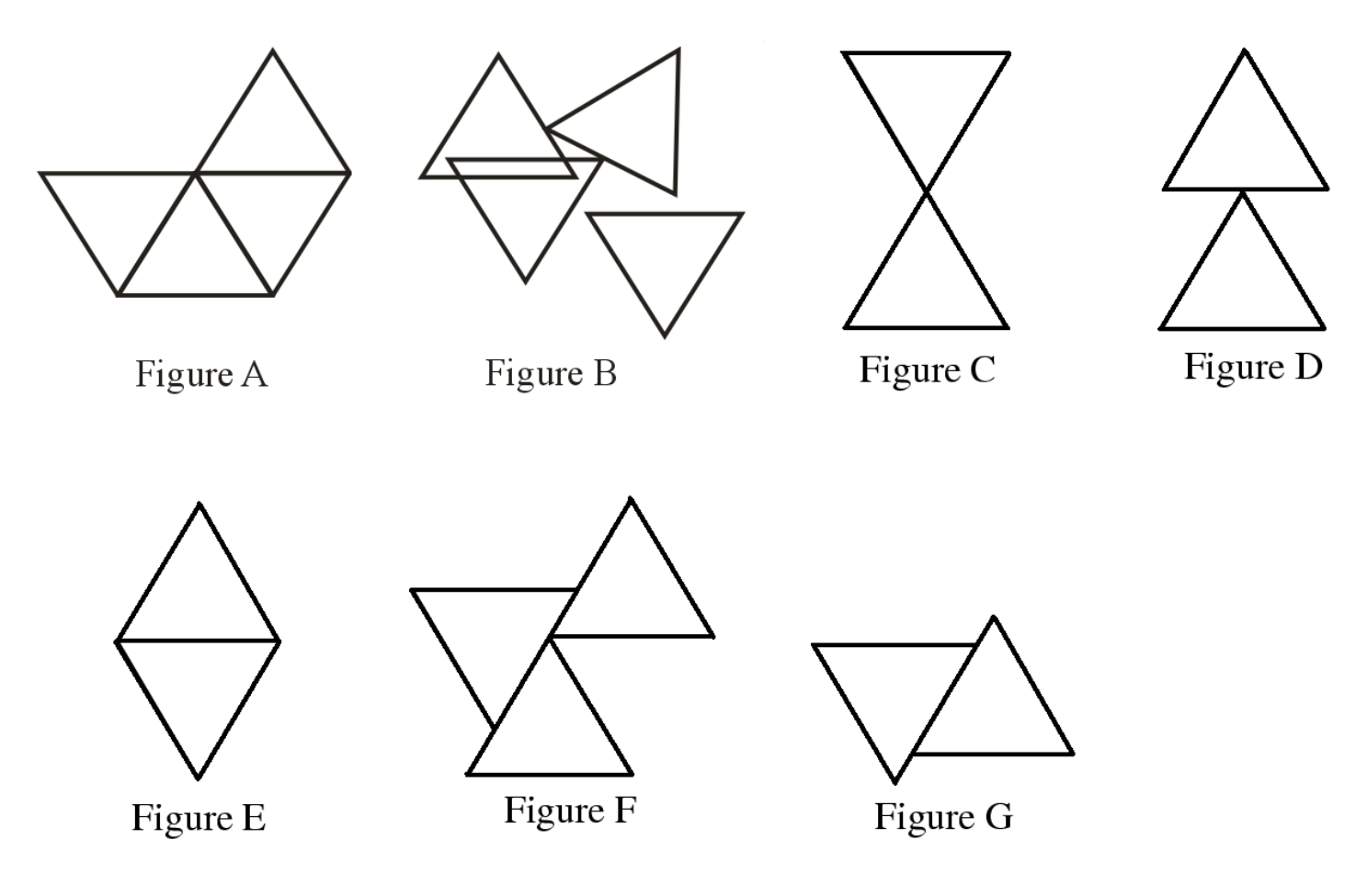
Figure A satisfies the conditions and has perimeter 6 units. Figures B, C and D are not allowed; Figures E, F and G are allowed.
(a) Using four triangles, draw one shape with perimeter 7 units.
(b) Can you make a shape with perimeter 11 units using four triangles? If yes, draw one example.
(c) What is the smallest whole number that can be the perimeter of a shape made with six triangles?
(d) What is the largest whole number that can be the perimeter of a shape made with six triangles?
The source figure labels “Figure A” through “Figure G” identify the seven examples.
(i) The shape is connected.
(ii) No triangles overlap.
(iii) A triangle is connected to the rest by at least a side or part of a side.
Figure A satisfies the conditions and has perimeter 6 units. Figures B, C and D are not allowed; Figures E, F and G are allowed.
(a) Using four triangles, draw one shape with perimeter 7 units.
(b) Can you make a shape with perimeter 11 units using four triangles? If yes, draw one example.
(c) What is the smallest whole number that can be the perimeter of a shape made with six triangles?
(d) What is the largest whole number that can be the perimeter of a shape made with six triangles?
The source figure labels “Figure A” through “Figure G” identify the seven examples.