Question 10
Answer all ten questions and show detailed solutions. Printed time 60 minutes; each question 4 points. Subcriterion allocations are editorial.
Unit equilateral triangles and unit squares can be joined to construct convex polygons, completely covering the enclosed region with no gaps or overlaps. The source examples use two triangles and one square for a hexagon, and three triangles and two squares for a 7-sided polygon. How can this process construct a convex polygon with 11 sides?
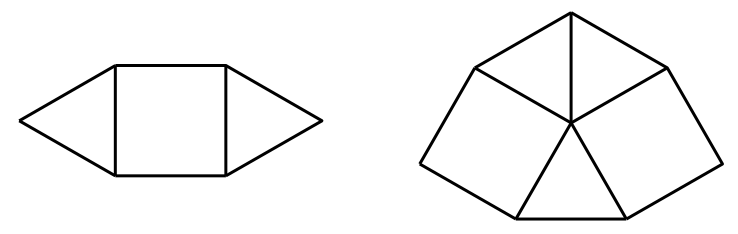
Unit equilateral triangles and unit squares can be joined to construct convex polygons, completely covering the enclosed region with no gaps or overlaps. The source examples use two triangles and one square for a hexagon, and three triangles and two squares for a 7-sided polygon. How can this process construct a convex polygon with 11 sides?