Question 21
The Fibonacci sequence was developed by the famous Italian mathematician Leonardo Fibonacci in an idealized experiment on rabbit reproduction. Each newborn pair, one male and one female, needs one month to mature; from its second month onward it produces a new pair each month. Rabbits never die. During five months he obtained these results:
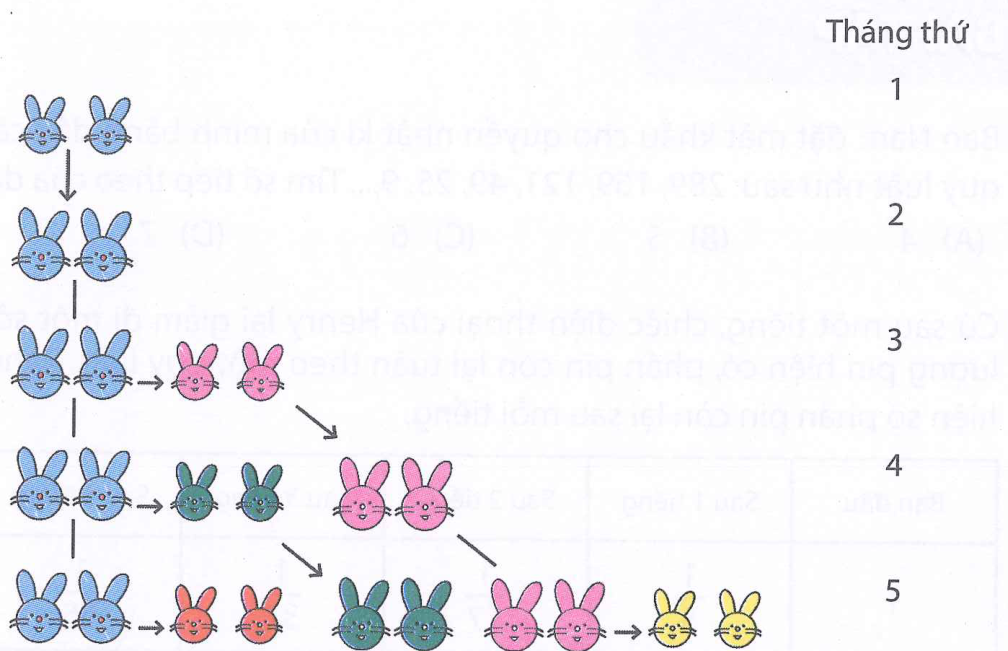
– Month 1: A newborn pair, one male and one female, is placed in a field.
– Month 2: The pair from month 1 has become mature pair (1).
– Month 3: Mature pair (1) produces a newborn pair, one male and one female.
– Month 4: Mature pair (1) produces another newborn pair, one male and one female; the pair born in month 3 becomes mature pair (2).
– Month 5: Mature pairs (1) and (2) each produce a newborn pair, one male and one female; the pair born in month 4 matures.
In the illustration, arrows represent maturation or reproduction, while the strokes represent the same pair continuing from before.
The numbers of rabbit pairs in months 1,2,3,4,5,... are 1,1,2,3,5,... . This is the Fibonacci sequence.
1. Observe the Fibonacci sequence and state its rule.
2. What is its seventh term?
3. Denote terms n,n−1,n−2, for an integer n>2, by $F_n,F_{n-1},F_{n-2}$. Write an equation relating them.
4. Can the Fibonacci sequence have a greatest term?
– Month 1: A newborn pair, one male and one female, is placed in a field.
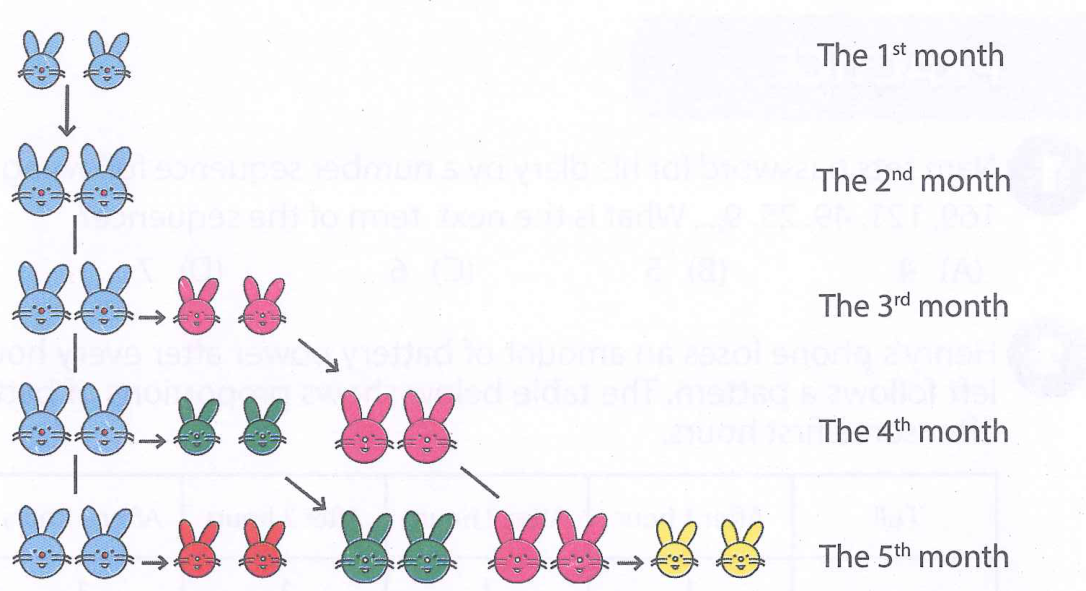
– Month 2: The pair from month 1 has become mature pair (1).
– Month 3: Mature pair (1) produces a newborn pair, one male and one female.
– Month 4: Mature pair (1) produces another newborn pair, one male and one female; the pair born in month 3 becomes mature pair (2).
– Month 5: Mature pairs (1) and (2) each produce a newborn pair, one male and one female; the pair born in month 4 matures.
In the illustration, arrows represent maturation or reproduction, while the strokes represent the same pair continuing from before.
The numbers of rabbit pairs in months 1,2,3,4,5,... are 1,1,2,3,5,... . This is the Fibonacci sequence.
1. Observe the Fibonacci sequence and state its rule.
2. What is its seventh term?
3. Denote terms n,n−1,n−2, for an integer n>2, by $F_n,F_{n-1},F_{n-2}$. Write an equation relating them.
4. Can the Fibonacci sequence have a greatest term?