Question 3
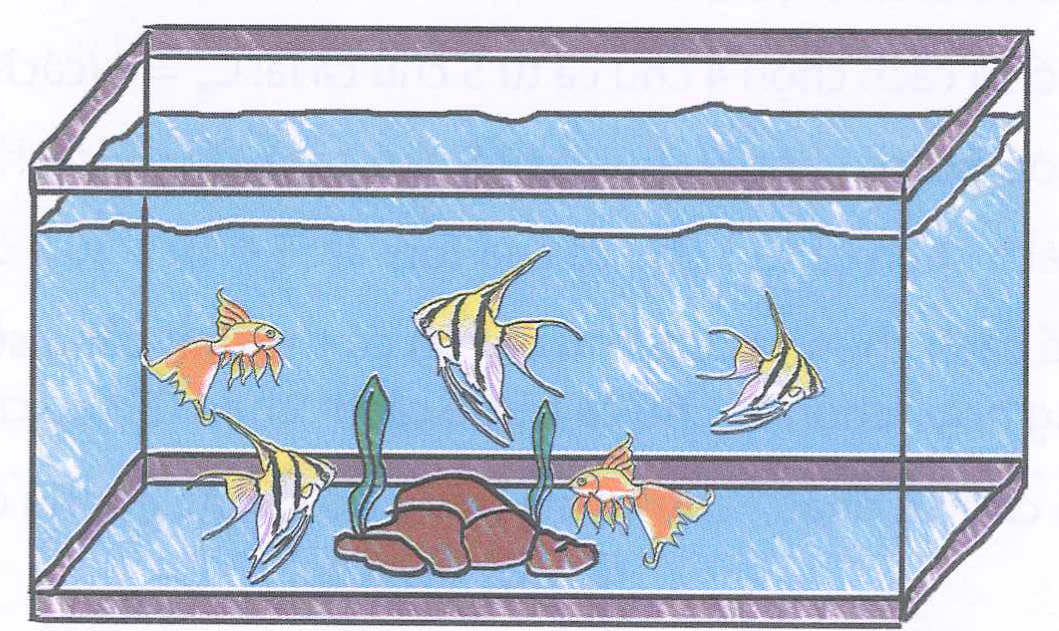
Tony’s aquarium contains two goldfish and three angelfish. He wants to give Anna some fish, including at least two angelfish. Find the number of possible selections through the following questions.
(1) Choosing $k$ elements from $n$ elements, where $k,n\in\mathbb N$, is called a combination, denoted $C_n^k$. Using $C_n^k=\frac{n(n-1)\cdots(n-k+1)}{k(k-1)\cdots1}$, how many ways can Tony choose 1 fish, 2 fish, 3 fish, 4 fish, and 5 fish from the five fish? Hence find the total number of ways to choose fish from his five fish.
(2) How many ways can Tony choose at least one fish with no angelfish included?
(3) How many ways can Tony choose goldfish, including choosing zero? How many ways can he choose one angelfish from the three? Hence find the number of selections from the five fish containing exactly one angelfish.
(4) How many ways can Tony choose fish to give Anna with at least two angelfish included?
(1) Choosing $k$ elements from $n$ elements, where $k,n\in\mathbb N$, is called a combination, denoted $C_n^k$. Using $C_n^k=\frac{n(n-1)\cdots(n-k+1)}{k(k-1)\cdots1}$, how many ways can Tony choose 1 fish, 2 fish, 3 fish, 4 fish, and 5 fish from the five fish? Hence find the total number of ways to choose fish from his five fish.
(2) How many ways can Tony choose at least one fish with no angelfish included?
(3) How many ways can Tony choose goldfish, including choosing zero? How many ways can he choose one angelfish from the three? Hence find the number of selections from the five fish containing exactly one angelfish.
(4) How many ways can Tony choose fish to give Anna with at least two angelfish included?