Question 9
A translation system supports languages A,B,C,D,E. Its accuracy for each pair lies between 0.0 and 1.0, with larger values better, as in the table.
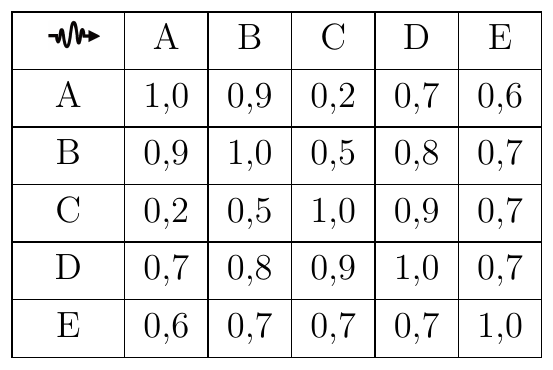
Accuracy through intermediate languages is the product of the accuracies used. For example C→A has accuracy 0.2, while C→B→A gives 0.5×0.9=0.45>0.2. Consider A→D, B→A, C→B and D→B. For how many can an indirect translation be strictly more accurate than the direct one?
Accuracy through intermediate languages is the product of the accuracies used. For example C→A has accuracy 0.2, while C→B→A gives 0.5×0.9=0.45>0.2. Consider A→D, B→A, C→B and D→B. For how many can an indirect translation be strictly more accurate than the direct one?