Question 9
Ann and Bob are playing a game where they take turns moving a counter on a grid. Ann goes first. The goal is to move the counter to the bottom-left corner.
In a single move, a player must perform exactly one of the following two actions:
- Move the counter one or more cells to the left.
- Move the counter one or more cells down.
However, the counter **CANNOT** be moved onto or across a shaded cell.
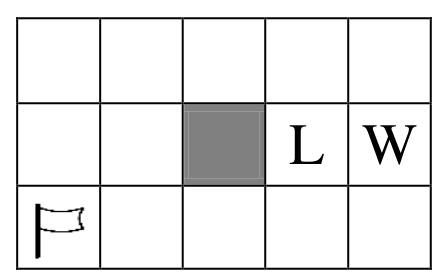
Ann has a “winning cell” if, when the game starts with the counter on that cell and Ann and Bob both play optimally, Ann has a winning strategy. Otherwise, the cell is known as a “losing cell”. For example, in the diagram below, cell $L$ is a losing cell for Ann since her only option is to move the counter down 1 cell, after which Bob can win by moving the counter 3 cells to the left. Cell $W$ is a winning cell for Ann because Ann can move the counter 1 cell to the left, causing Bob to move the counter down 1 cell. Ann can then win by moving the counter 3 cells to the left.
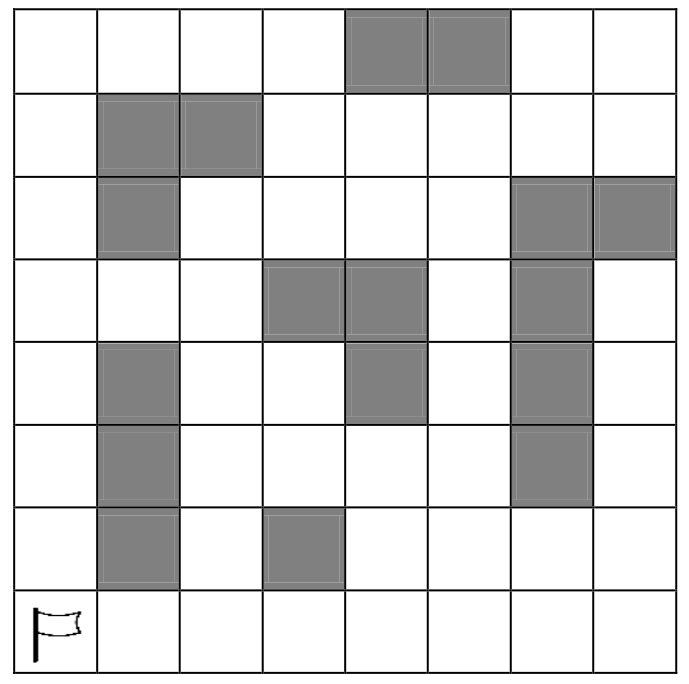
In the $8\times8$ grid below, how many winning cells does Ann have?

In a single move, a player must perform exactly one of the following two actions:
- Move the counter one or more cells to the left.
- Move the counter one or more cells down.
However, the counter **CANNOT** be moved onto or across a shaded cell.
Ann has a “winning cell” if, when the game starts with the counter on that cell and Ann and Bob both play optimally, Ann has a winning strategy. Otherwise, the cell is known as a “losing cell”. For example, in the diagram below, cell $L$ is a losing cell for Ann since her only option is to move the counter down 1 cell, after which Bob can win by moving the counter 3 cells to the left. Cell $W$ is a winning cell for Ann because Ann can move the counter 1 cell to the left, causing Bob to move the counter down 1 cell. Ann can then win by moving the counter 3 cells to the left.
In the $8\times8$ grid below, how many winning cells does Ann have?