Question 115
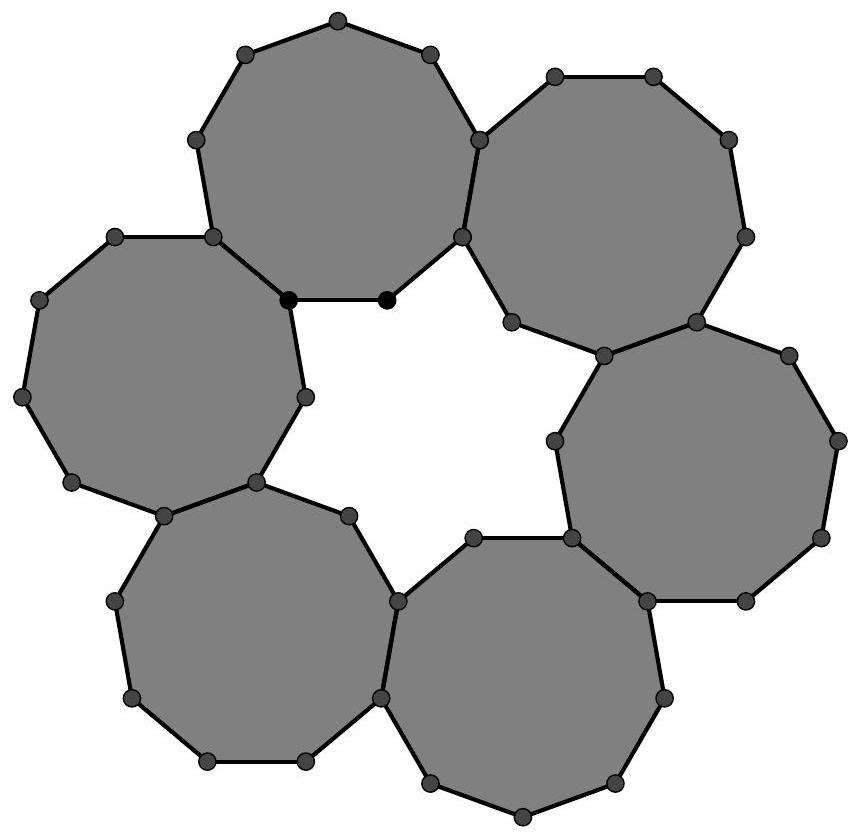
A symmetrical ring with $m$ regular polygons of $n$ sides each is formed according to the rules: i) each polygon in the ring meets two others; ii) two adjacent polygons have only one side in common; iii) The perimeter of the inner region delimited by the polygons consists of exactly two sides of each polygon. The example in the following figure shows a ring with $m=6$ and $n=9$. For how many different values of $n$ is it possible to build this ring?