Question 1
IMSO 20 · Indonesia · Experiment · 19 November 2023
EXPERIMENT TEST · 1 experiment | 25 points | 120 minutes
Investigating Osmosis with Gummy Bears
It is necessary to have some understanding of cell transport and how materials enter and exit cells before beginning the activity. The cell membrane in a living thing is what lets various molecules enter and exit the cell. In living things, it has selective permeability and the ability to distinguish between molecules of the same size. The primary distinction between a living being and a non-living object, such as a gummy bear, is that non-living objects are semi- permeable. They are able to let some materials or molecules enter and exit the object, but they are unable to distinguish between various molecules.
Editorial source notice: The preceding paragraph is reproduced from the source, but its proposed living/non-living distinction is scientifically inaccurate. See the clearly separated scientific correction in the explanation. Pages 2–4 are printed with “Science Theory Test 1” and “18 November 2023”, inconsistent with this experiment cover; both header variants are preserved here without silently resolving the date.
Objective: To observe and understand the process of osmosis using gummy bears.
Materials
1\. 10 pieces Gummy bears (same color and size)
2\. 4 pieces clear plastic cups (12 oz)
3\. 1 liter Tap water
4\. 1 cup (approximately 100 g) of iodize or rock salt
5\. Measuring spoons (or kitchen scale/balance if available)
6\. 12-inch ruler
7\. 1 roll paper tape or masking tape
8\. 1 piece black permanent marker
9\. Timer or clock
10\. 5 sheets paper towel
Procedure
1\. Prepare four gummy bears of the same size and color.
2\. Measure the initial height of the gummy bears using a ruler. Record your measurement in Table 1.1.
3\. Observe the physical characteristics of the gummy bears such color and texture. Record your data in Table 1.1.
4\. Label the four plastic cups as follows: Control (for plain water), Saltwater Solution 1 (3.0 g salt/100 mL water), Saltwater Solution 2 (6.0 g salt/100 mL water), and Saltwater Solution 3 (9.0 g salt/100 mL water).
5\. Prepare three setups with the following salt concentrations:
- a. In the Saltwater Solution 1 container, prepare a solution of saltwater by adding 3.0 g of salt to 100 mL of water.
- b. In Saltwater Solution 2 container, prepare a solution of saltwater by adding 6.0 g of salt to 100 mL of water.
- c. Saltwater Solution 3 container, prepare a solution of saltwater by adding 9.0 g of salt to 100 mL of water.
6\. Stir all mixtures until salt is completely dissolved.
7\. Place one gummy bear in each container (including the control). Ensure that each gummy bear is fully submerged in its respective solution.
8\. Start a timer or note the time when you place the gummy bears in the solutions.
9\. Let the gummy bears sit in the solutions for about 30-45 minutes.
10\. After the designated time, carefully remove the gummy bears from the solutions, gently pat them dry with a paper towel, and place them on a paper towel.
11\. Measure the height of each gummy bear using a ruler. Refer to the illustration below.
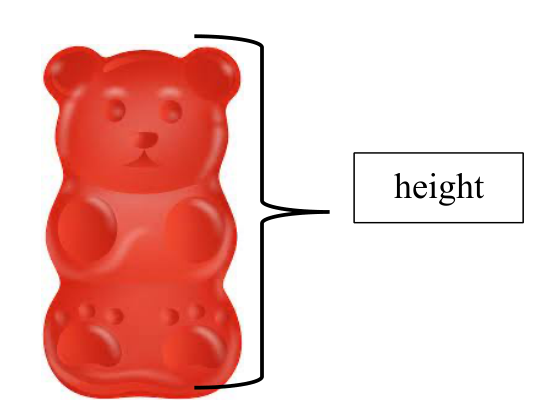
12\. Record your data in Table 1.2.
13\. Show the relationship between the salt concentrations and the final height of the gummy bear through a graph.
Variables
1\. Identify the following:
- a. Independent variable that you purposefully change: [1 point]
- b. Dependent variable: [1 point]
- c. Controlled variables (State 2 of them): [2 points]
Hypothesis
2\. State the hypothesis. [2 points]
Data Table
Table 1.1
| Setups | Initial Height of Gummy Bears (in mm) | Physical Observations |
| --- | --- | --- |
| Control | ________________ | ________________ |
| Saltwater Solution 1 | ________________ | ________________ |
| Saltwater Solution 2 | ________________ | ________________ |
| Saltwater Solution 3 | ________________ | ________________ |
Total Mark: [4 marks]
Table 1.2
| Setups | Final Height of Gummy Bears (in mm) | Physical Observations |
| --- | --- | --- |
| Control | ________________ | ________________ |
| Saltwater Solution 1 | ________________ | ________________ |
| Saltwater Solution 2 | ________________ | ________________ |
| Saltwater Solution 3 | ________________ | ________________ |
Total Mark: [4 marks]
Graph [4 marks]
The source provides a blank graph area. Added blank scaffold below; choose the vertical scale using your actual data. No measurements or predicted curve are supplied.
Questions
1\. Describe the changes you observed in the gummy bears after they were placed in different salt-water solutions. [1 point]
2\. How does the salt concentration affect the movement of the water into and out of the gummy bear? [1.5 points]
3\. Compare and contrast the results of osmosis in gummy bears with those in plant cells. What similarities and differences in osmotic responses would you expect between the two? [1.5 points]
4\. What do you think will happen if the gummy bear is placed in 100 mL of plain water? Support your answer. [1.5 points]
5\. Based on the results of your experiment, will you accept your hypothesis? Why or why not? [1.5 points]
EXPERIMENT TEST · 1 experiment | 25 points | 120 minutes
Investigating Osmosis with Gummy Bears
It is necessary to have some understanding of cell transport and how materials enter and exit cells before beginning the activity. The cell membrane in a living thing is what lets various molecules enter and exit the cell. In living things, it has selective permeability and the ability to distinguish between molecules of the same size. The primary distinction between a living being and a non-living object, such as a gummy bear, is that non-living objects are semi- permeable. They are able to let some materials or molecules enter and exit the object, but they are unable to distinguish between various molecules.
Editorial source notice: The preceding paragraph is reproduced from the source, but its proposed living/non-living distinction is scientifically inaccurate. See the clearly separated scientific correction in the explanation. Pages 2–4 are printed with “Science Theory Test 1” and “18 November 2023”, inconsistent with this experiment cover; both header variants are preserved here without silently resolving the date.
Objective: To observe and understand the process of osmosis using gummy bears.
Materials
1\. 10 pieces Gummy bears (same color and size)
2\. 4 pieces clear plastic cups (12 oz)
3\. 1 liter Tap water
4\. 1 cup (approximately 100 g) of iodize or rock salt
5\. Measuring spoons (or kitchen scale/balance if available)
6\. 12-inch ruler
7\. 1 roll paper tape or masking tape
8\. 1 piece black permanent marker
9\. Timer or clock
10\. 5 sheets paper towel
Procedure
1\. Prepare four gummy bears of the same size and color.
2\. Measure the initial height of the gummy bears using a ruler. Record your measurement in Table 1.1.
3\. Observe the physical characteristics of the gummy bears such color and texture. Record your data in Table 1.1.
4\. Label the four plastic cups as follows: Control (for plain water), Saltwater Solution 1 (3.0 g salt/100 mL water), Saltwater Solution 2 (6.0 g salt/100 mL water), and Saltwater Solution 3 (9.0 g salt/100 mL water).
5\. Prepare three setups with the following salt concentrations:
- a. In the Saltwater Solution 1 container, prepare a solution of saltwater by adding 3.0 g of salt to 100 mL of water.
- b. In Saltwater Solution 2 container, prepare a solution of saltwater by adding 6.0 g of salt to 100 mL of water.
- c. Saltwater Solution 3 container, prepare a solution of saltwater by adding 9.0 g of salt to 100 mL of water.
6\. Stir all mixtures until salt is completely dissolved.
7\. Place one gummy bear in each container (including the control). Ensure that each gummy bear is fully submerged in its respective solution.
8\. Start a timer or note the time when you place the gummy bears in the solutions.
9\. Let the gummy bears sit in the solutions for about 30-45 minutes.
10\. After the designated time, carefully remove the gummy bears from the solutions, gently pat them dry with a paper towel, and place them on a paper towel.
11\. Measure the height of each gummy bear using a ruler. Refer to the illustration below.
12\. Record your data in Table 1.2.
13\. Show the relationship between the salt concentrations and the final height of the gummy bear through a graph.
Variables
1\. Identify the following:
- a. Independent variable that you purposefully change: [1 point]
- b. Dependent variable: [1 point]
- c. Controlled variables (State 2 of them): [2 points]
Hypothesis
2\. State the hypothesis. [2 points]
Data Table
Table 1.1
| Setups | Initial Height of Gummy Bears (in mm) | Physical Observations |
| --- | --- | --- |
| Control | ________________ | ________________ |
| Saltwater Solution 1 | ________________ | ________________ |
| Saltwater Solution 2 | ________________ | ________________ |
| Saltwater Solution 3 | ________________ | ________________ |
Total Mark: [4 marks]
Table 1.2
| Setups | Final Height of Gummy Bears (in mm) | Physical Observations |
| --- | --- | --- |
| Control | ________________ | ________________ |
| Saltwater Solution 1 | ________________ | ________________ |
| Saltwater Solution 2 | ________________ | ________________ |
| Saltwater Solution 3 | ________________ | ________________ |
Total Mark: [4 marks]
Graph [4 marks]
The source provides a blank graph area. Added blank scaffold below; choose the vertical scale using your actual data. No measurements or predicted curve are supplied.
Questions
1\. Describe the changes you observed in the gummy bears after they were placed in different salt-water solutions. [1 point]
2\. How does the salt concentration affect the movement of the water into and out of the gummy bear? [1.5 points]
3\. Compare and contrast the results of osmosis in gummy bears with those in plant cells. What similarities and differences in osmotic responses would you expect between the two? [1.5 points]
4\. What do you think will happen if the gummy bear is placed in 100 mL of plain water? Support your answer. [1.5 points]
5\. Based on the results of your experiment, will you accept your hypothesis? Why or why not? [1.5 points]