Skip to content / Đến nội dung
ThichHocToan.com

Question bank ASMO Science 2015

Exam papers

50 questions

Question 1

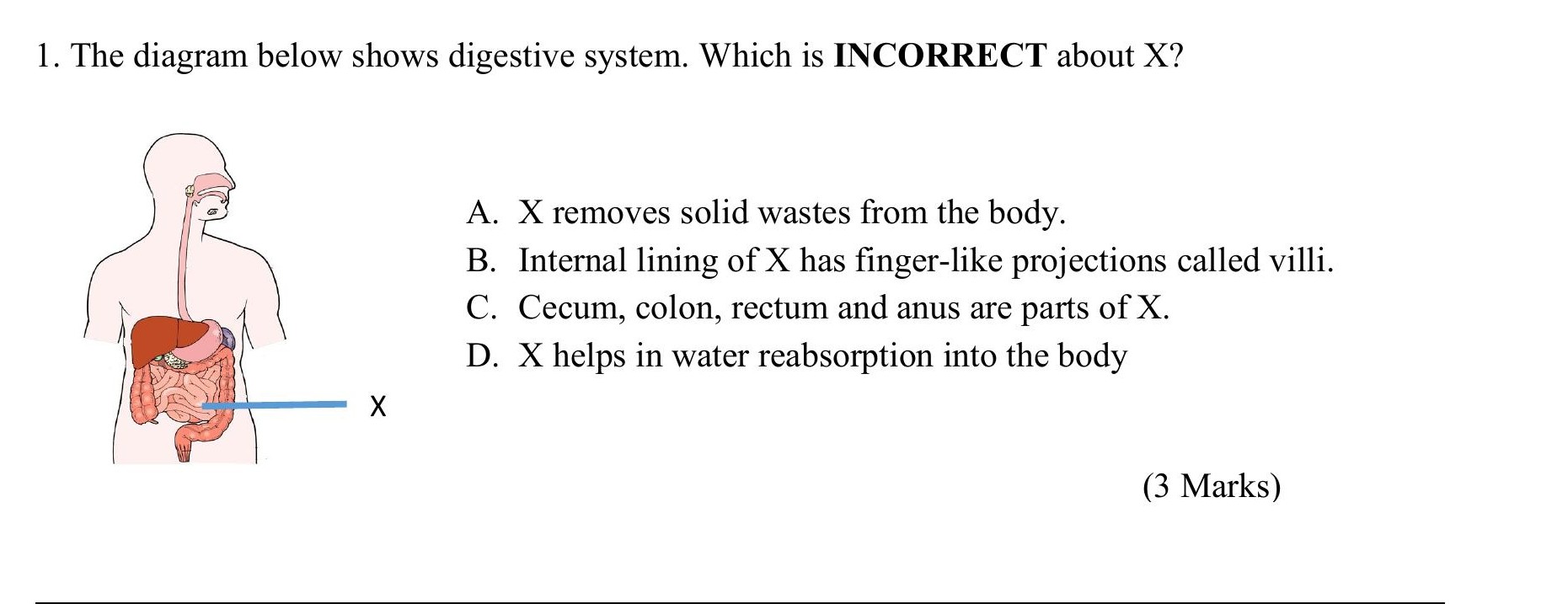
The diagram below shows digestive system. Which is INCORRECT about X?

Question illustration
  1. X removes solid wastes from the body.
  2. Internal lining of X has finger-like projections called villi.
  3. Cecum, colon, rectum and anus are parts of X.
  4. X helps in water reabsorption into the body

Question 2

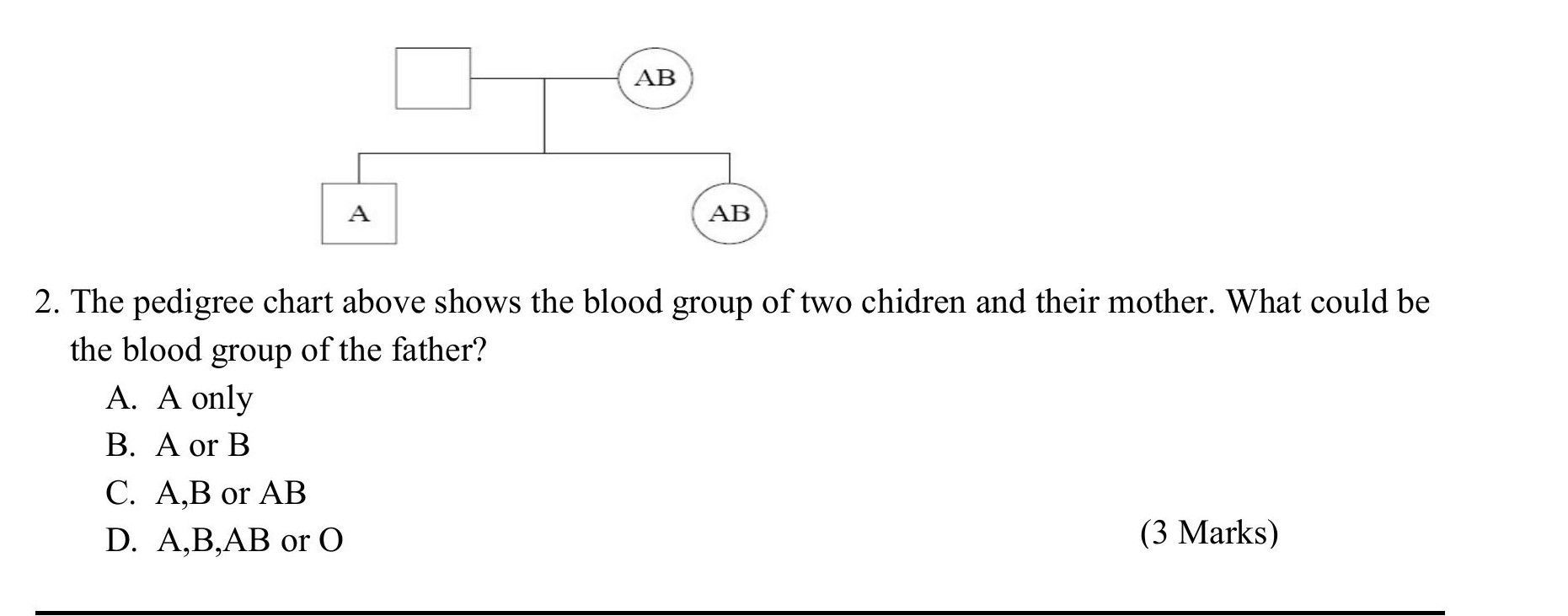
The pedigree chart above shows the blood group of two chidren and their mother. What could be the blood group of the father?

Question illustration
  1. A only
  2. A or B
  3. A,B or AB
  4. A,B,AB or O

Question 3

A car travels the first 100 m with a speed of 10 m s⁻¹. It then travels the next 100 m with a speed of 20 m s⁻¹. What is its average speed?

Question illustration
  1. 13.3 m s⁻¹
  2. 15.0 m s⁻¹
  3. 16.7 m s⁻¹
  4. 17.5 m s⁻¹

Question 4

Which metal reacts most vigorously with water?

Question illustration
  1. Ca
  2. K
  3. Mg
  4. Na

Question 5

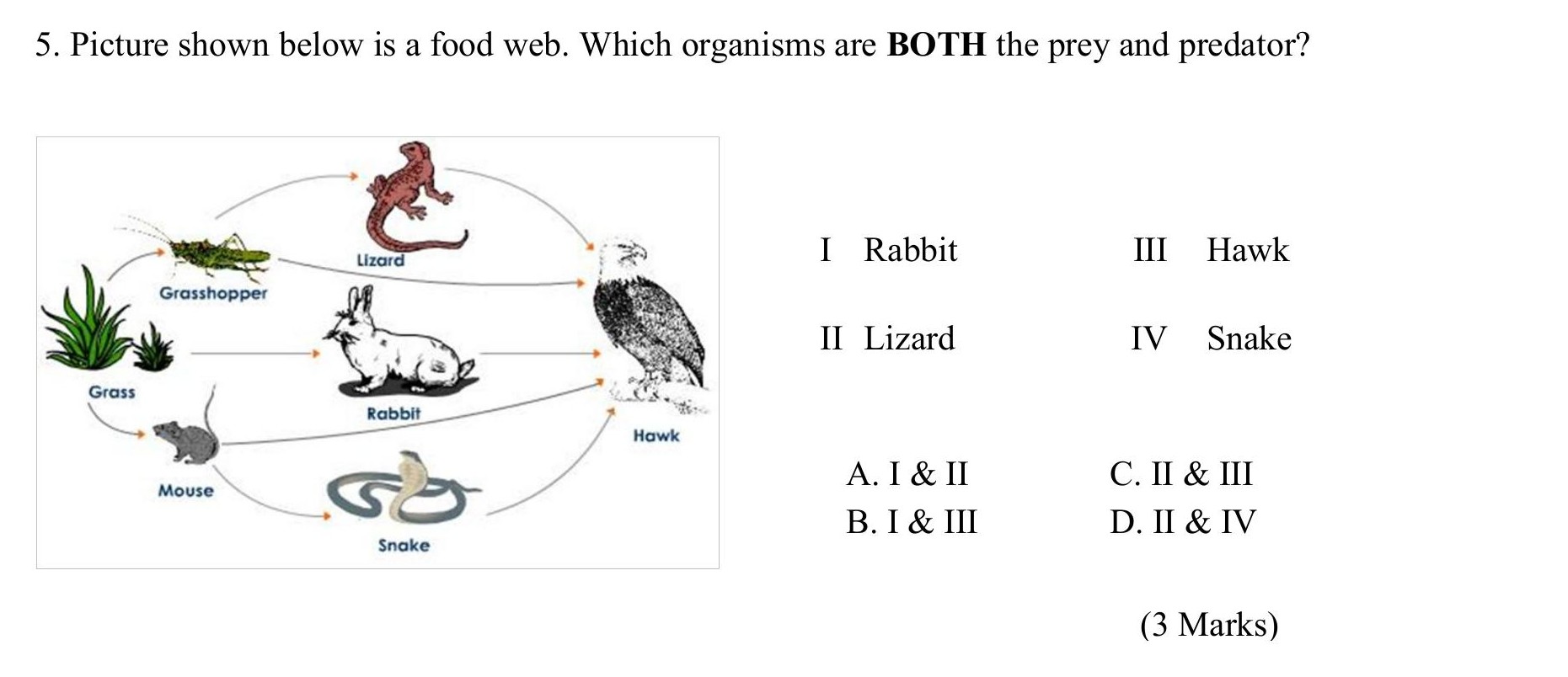
Picture shown below is a food web. Which organisms are BOTH the prey and predator?

I Rabbit III Hawk
II Lizard IV Snake

Question illustration
  1. I & II
  2. I & III
  3. II & III
  4. II & IV

Question 6

If a person’s diet is deficient in sour fruits, he or she might be at risk for

Question illustration
  1. Rickets
  2. Beri-beri
  3. Scurvy
  4. Night blindness

Question 7

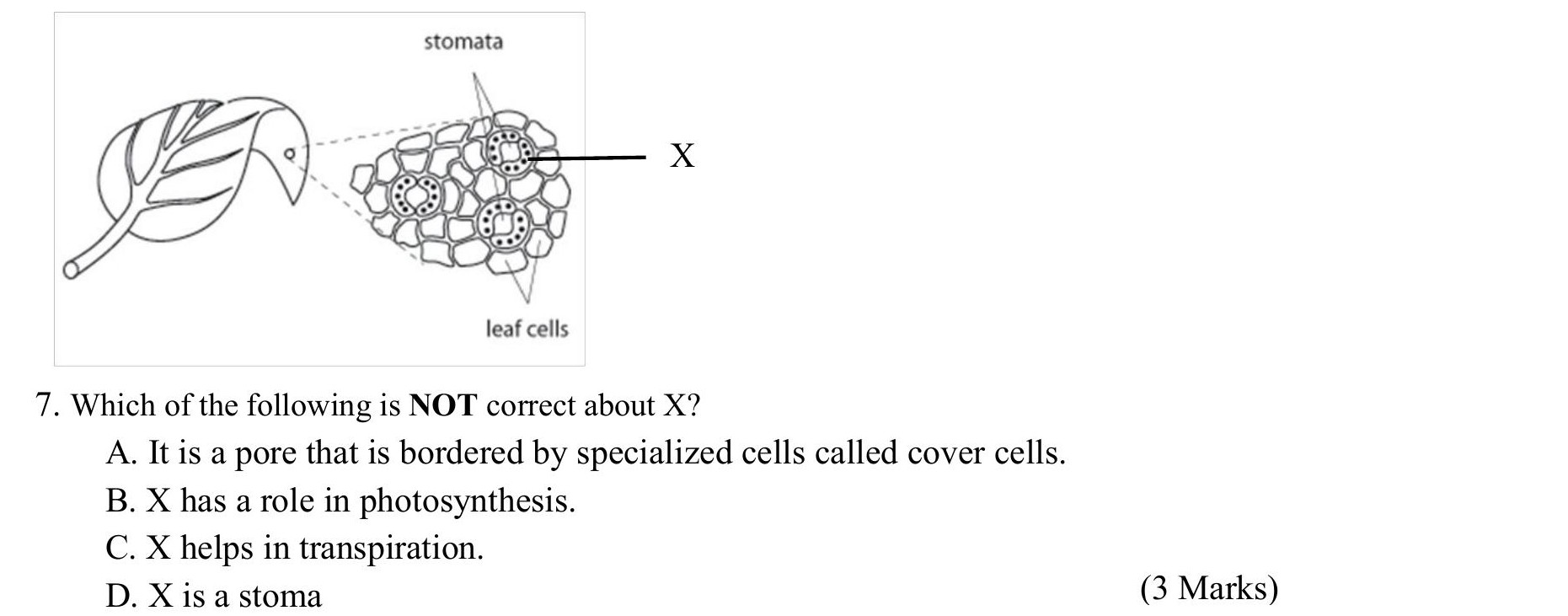
Which of the following is NOT correct about X?

Question illustration
  1. It is a pore that is bordered by specialized cells called cover cells.
  2. X has a role in photosynthesis.
  3. X helps in transpiration.
  4. X is a stoma

Question 8

Which of the following is NOT a type of body protein?

Question illustration
  1. Enzymatic: Pepsin
  2. Structural: Hair
  3. Nervous: Brain
  4. Defensive: Antibodies

Question 9

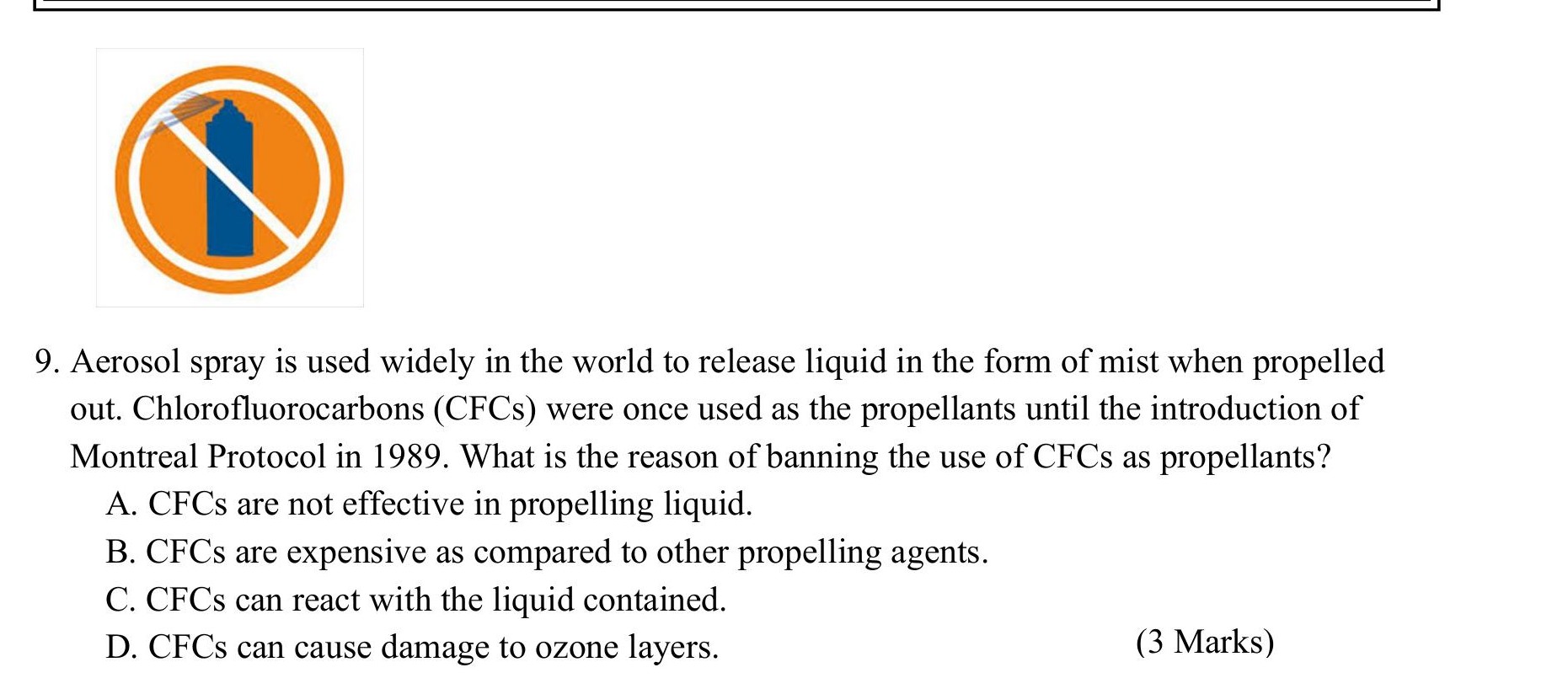
Aerosol spray is used widely in the world to release liquid in the form of mist when propelled out. Chlorofluorocarbons (CFCs) were once used as the propellants until the introduction of Montreal Protocol in 1989. What is the reason of banning the use of CFCs as propellants?

Question illustration
  1. CFCs are not effective in propelling liquid.
  2. CFCs are expensive as compared to other propelling agents.
  3. CFCs can react with the liquid contained.
  4. CFCs can cause damage to ozone layers.

Question 10

An accelerometer is a device to measure acceleration. At the earth sea level, the acceleration due to gravity is g = 9.8 m s⁻². Most of the smartphones such as Android and Apple iPhone consist of a builtin accelerometer. If a smartphone is moving vertically upward at sea level with constant velocity 9.8 m s⁻¹, the instantaneous scalar readings of the x, y, and z components from the accelerometer are:
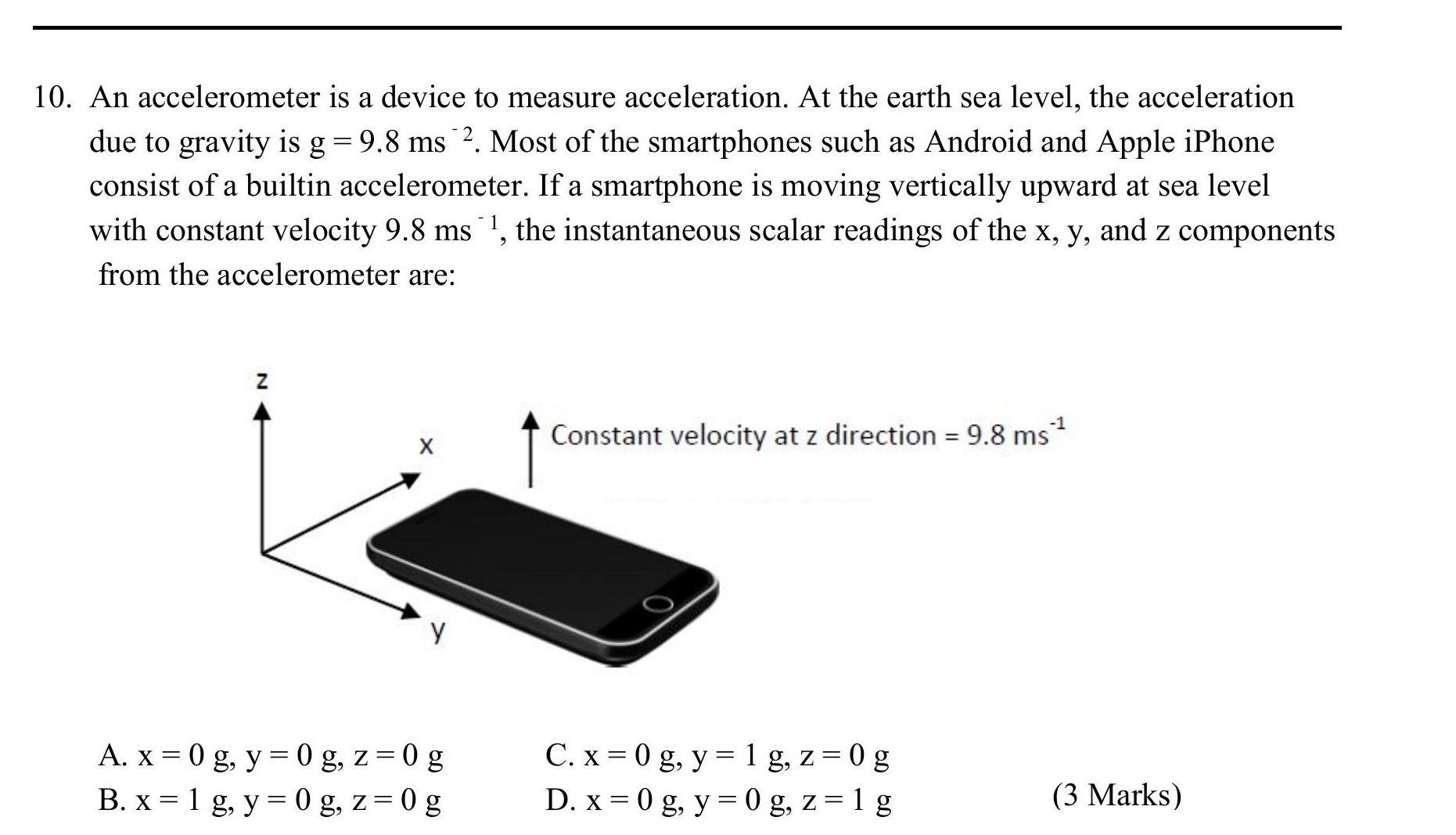
Question illustration
  1. x = 0 g, y = 0 g, z = 0 g
  2. x = 1 g, y = 0 g, z = 0 g
  3. x = 0 g, y = 1 g, z = 0 g
  4. x = 0 g, y = 0 g, z = 1 g

Question 11

A man of weight W is standing on the ground. Which of the followings forms an action-and-reaction pair with W?

Question illustration
  1. The reaction force acting on the man by the ground.
  2. The force acting on the ground by the man.
  3. The gravitational force acting on the man by the Earth.
  4. The gravitational force acting on the Earth by the man

Question 12

Which of the following observations is not true about the fermentation process of rice?

Question illustration
  1. Sour smell is produced.
  2. The rice slowly decomposes.
  3. Bubbles are formed at the water surface.
  4. The water turns clear

Question 13

Leaded petrol was once used widely as fuel for vehicles. It was banned in 1970’s and slowly be phased out with the replacement of unleaded petrol. What is the main reason behind it?

Question illustration
  1. Leaded petrol is expensive.
  2. Leaded petrol cannot burn completely.
  3. Lead is very toxic and cause impacts to human health.
  4. Leaded petrol will cause knocking sounds in car engines.

Question 14

High level of mercury content was discovered in the river of Minimata city, Japan in 1956. The release of waste water containing mercury compounds by factory was banned by the city council and ordered to clean up the contaminants. What is the main reason to prevent mercury from being discharged into river?

Question illustration
  1. Mercury is toxic and can cause damage to nervous system.
  2. Mercury will cause the river water to be turbid.
  3. Mercury is heavy and will settle down at the river bed.
  4. Mercury is reactive and can cause explosion.

Question 15

Which characteristic is most useful for determining that a substance is a metal?

Question illustration
  1. Conductivity
  2. Hardness
  3. Melting point
  4. X-ray pattern

Question 16

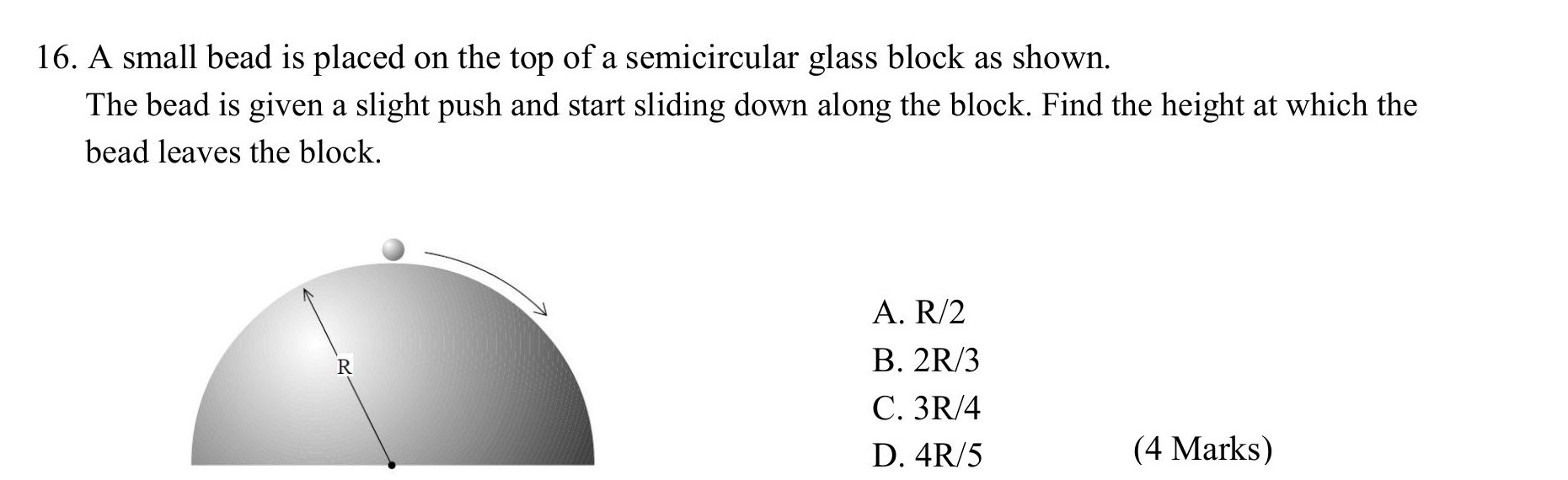
A small bead is placed on the top of a semicircular glass block as shown. The bead is given a slight push and start sliding down along the block. Find the height at which the bead leaves the block.

Question illustration
  1. R/2
  2. 2R/3
  3. 3R/4
  4. 4R/5

Question 17

A student is asked to measure 12 ml of a liquid as precisely as possible. Which piece of equipment should she select for this task?

Question illustration
  1. 25 ml beaker
  2. 25 ml graduated cylinder
  3. 25 ml conical flask
  4. 25 ml volumetric flask

Question 18

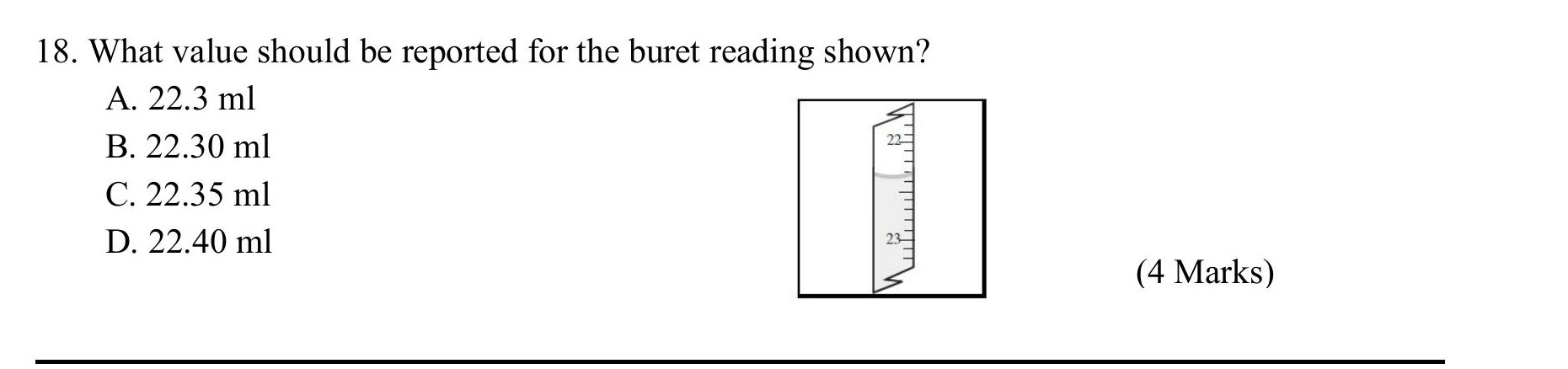
What value should be reported for the buret reading shown?

Question illustration
  1. 22.3 ml
  2. 22.30 ml
  3. 22.35 ml
  4. 22.40 ml

Question 19

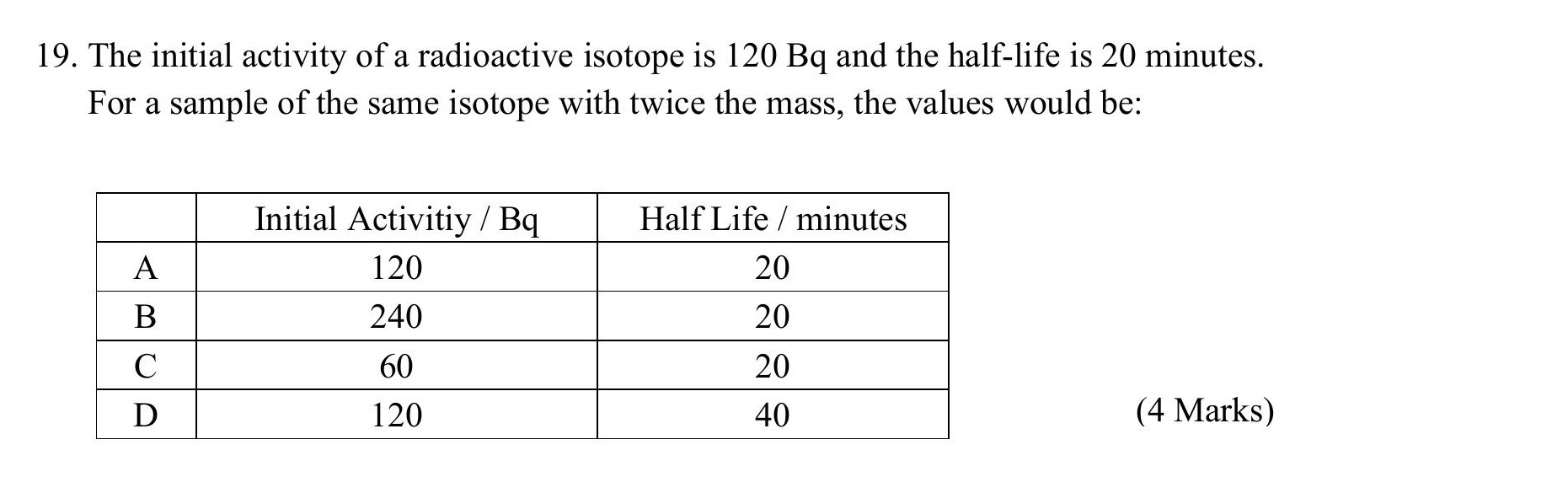
The initial activity of a radioactive isotope is 120 Bq and the half-life is 20 minutes. For a sample of the same isotope with twice the mass, the values would be:

| Choice | Initial Activitiy / Bq | Half Life / minutes |
|:--:|--:|--:|
| A | 120 | 20 |
| B | 240 | 20 |
| C | 60 | 20 |
| D | 120 | 40 |

Question illustration
  1. Initial activity 120 Bq; half-life 20 minutes
  2. Initial activity 240 Bq; half-life 20 minutes
  3. Initial activity 60 Bq; half-life 20 minutes
  4. Initial activity 120 Bq; half-life 40 minutes

Question 20

Which separation technique is based on differences in the volatility of the substances to be separated?

Question illustration
  1. Filtration
  2. Distillation
  3. Solvent extraction
  4. Paper Chromatography