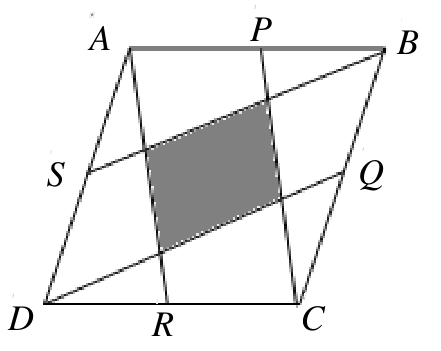
$ABCD$ is a parallelogram. $P,Q,R,S$ are the midpoints of its four sides. If the area of the shaded region is $20\text{ cm}^2$, find the area of parallelogram $ABCD$.
Jane added up all the digits of the whole number $\underbrace{3\times3\times\cdots\times3}_{2012\text{ factors}}$ and obtained a new number $n_1$. She then added up all the digits of $n_1$ and obtained $n_2$. She continued until she obtained a single digit number. Find that number.
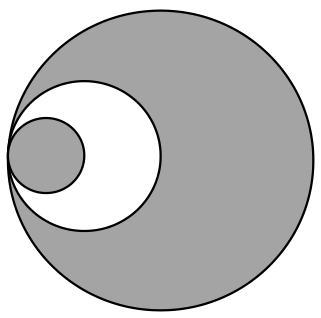
The diagram shows 3 circles. The circumference of the smallest circle passes through the centre of the middle circle, and the circumference of the middle circle passes through the centre of the largest circle. Find the ratio of the shaded area to the unshaded area.
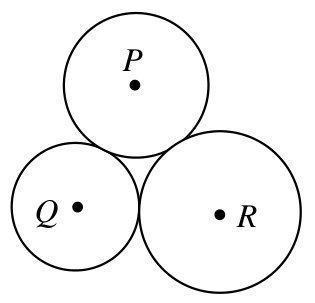
The diagram shows 3 circles with centres $P,Q,R$ respectively. Each circle has a point of contact with the other circles. If $PQ=35$ cm, $QR=36$ cm and $PR=37$ cm, find the radius of the circle with centre $R$.
Only 1 of the 3 boys Abel, Ben and Cain can swim. Abel says, “I can swim.” Ben says, “I cannot swim.” Cain says, “Abel cannot swim.” Only 1 boy is telling the truth. Who can swim?
10 boys received their test papers. The test has a maximum score of 10. Each boy added the scores of the other 9 boys. The 10 totals are 66, 66, 67, 67, 68, 68, 69, 70, 71 and 72. Find the lowest score.
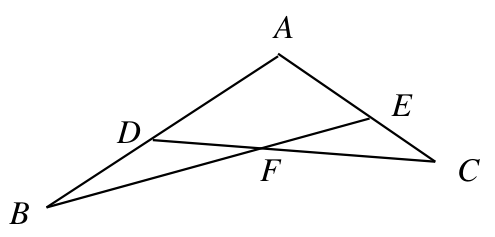
$D,E$ are the midpoints of $AB,AC$ respectively. $BE$ cuts $CD$ at $F$. If the area of quadrilateral $ADFE$ is $256\text{ cm}^2$, find the area of triangle $ABE$.
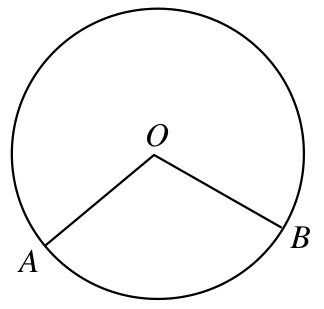
A circle with centre $O$ passes through $A,B$ as shown. If its radius is 5 cm and $\angle AOB=120^\circ$, find the radius of another circle passing through $O,A,B$.
A line can divide a plane into a maximum of 2 regions. Two lines can divide a plane into a maximum of 4 regions. Find the number of regions that 5 lines can divide a plane into.
Trains $A$ and $B$ are travelling towards each other at 48 km/h. In train $A$, Jane notices that it takes 6 seconds for train $B$ to pass her. Find the length of train $B$ in metres.
Find the largest whole number $k$ such that $\underbrace{12\times12\times\cdots\times12}_{50\text{ factors}}>\underbrace{k\times k\times\cdots\times k}_{75\text{ factors}}$.
Jane was given a sum of money for her 10 day trip. At the end of day 1, she spent $1/10$ of the money. At the end of day 2, she spent $1/9$ of the remaining sum. At the end of day 3, she spent $1/8$, and so on. At the end of day 9, she spent $1/2$ of the remaining sum and has 99 dollars left. How much money did she have at the beginning?
Four classes $A,B,C,D$ each have fewer than 50 students and their average class size is 46. The sizes of $A,B$ differ by 4; those of $B,C$ differ by 3; those of $C,D$ differ by 2. If $A$ has the most students, find its size.
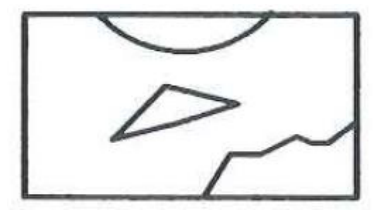
The diagram shows a figure comprising 4 regions. At most 4 different colours are used, with one colour per region and adjacent regions receiving different colours. Find the number of different ways to colour the figure.