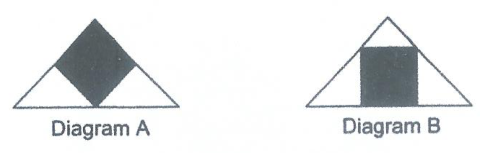
The diagrams show two identical isosceles right-angled triangles. If the shaded square in diagram A has area 50 cm$^2$, what is the area of the shaded square in diagram B?
A rectangular wooden block measuring $30\times10\times6$ cm is cut into as many cubes of side 5 cm as possible. Find the volume of the remaining wood in cm$^3$.
An organism reproduces by dividing into two. Each division takes 5 minutes. Starting with one organism, a container is filled in 1 hour. How long, in minutes, would filling take if we started with two organisms?
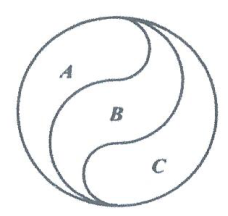
The diagram comprises a circle of radius 3 cm, two semicircles of radius 2 cm and two semicircles of radius 1 cm. Find the ratio of the areas of regions $A,B,C$.
In 2005, John and Mary had the same monthly pocket money. In 2006, John’s increased by 10% and Mary’s decreased by 10%. In 2007, John’s decreased by 10% and Mary’s increased by 10%. Which statement is correct?
Water expands 10% when it freezes. A rectangular container has base $22\times33$ cm and height 44 cm. To what water depth, in cm, should it be filled so that the ice fills it exactly?
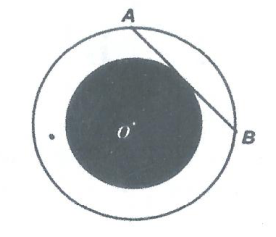
Two circles have centre $O$. Chord $AB$ of the outer circle is 14 cm long and just touches the shaded inner circle. Find the area of the unshaded region in cm$^2$. Take $\pi=22/7$.
Joan cycles 1 km in 4 minutes with the wind and returns in 5 minutes against the wind. How long, in minutes, would she take to cycle 1 km with no wind? Assume both her cycling speed and the wind speed are constant.
Given $\sqrt{1+1\times2\times3\times4}=5$, $\sqrt{1+2\times3\times4\times5}=11$, $\sqrt{1+3\times4\times5\times6}=19$ and $\sqrt{1+4\times5\times6\times7}=29$, find $\sqrt{1+204\times205\times206\times207}$.
Peter walks once around a track while Jane runs several laps in the same direction. They start and finish together. In between, Jane overtakes Peter twice. If Jane ran in the opposite direction instead, how many times would she pass Peter between their start and finish? Assume constant speeds.
Three clocks have no hour hands. Their minute hands run fast: clocks A, B, C gain 2, 6, 15 minutes per hour respectively. At noon all minute hands point to 12. How many hours pass before all three next point to the same point at the same time?
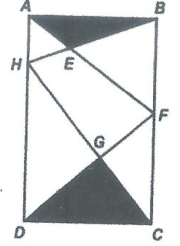
$ABCD$ is a rectangle, and $A,E,F$; $B,E,H$; $H,G,C$; $F,G,D$ are collinear. The quadrilateral $EFGH$ has area 82 cm$^2$. Find the total area of the shaded regions in cm$^2$.
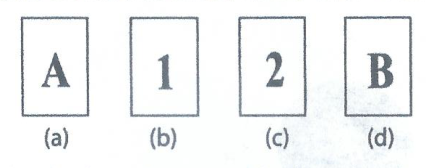
Four cards each have a letter on one side and a number on the other. The visible faces are (a) A, (b) 1, (c) 2, (d) B. John claims that any card with A on one side always has 1 on the other. Which two cards should be turned over to check his claim?
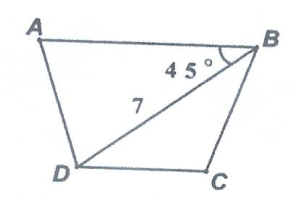
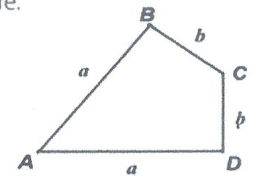
The diagram shows quadrilateral $ABCD$ with $AB=AD=a$ cm and $BC=CD=b$ cm, where $a>b$ and both are whole numbers. Its area is 385 cm$^2$. Find its smallest perimeter, in cm. Source note: the diagram contains no right-angle marks; the source key appears to assume right angles. This discrepancy is analysed in the solution.