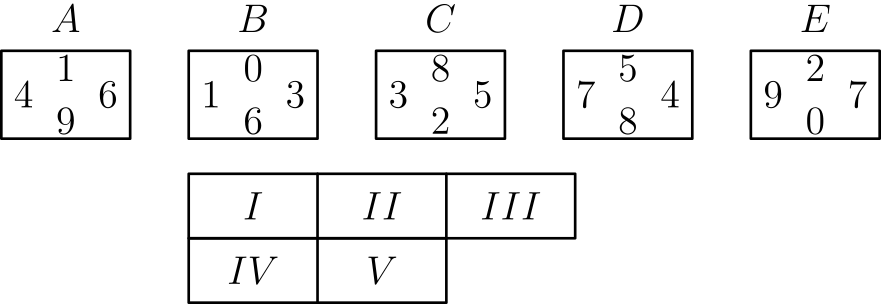
Each of the sides of five congruent rectangles is labeled with an integer, as shown. These five rectangles are placed, without rotating or reflecting, in positions $I$ through $V$ so that the labels on coincident sides are equal. Which of the rectangles is in position $I?$
Letters $A,$ $B,$ $C,$ and $D$ represent four different digits selected from $0,$ $1,$ $2,$ $\ldots,$ $9.$ If $\frac{A+B}{C+D}$ is an integer that is as large as possible, what is the value of $A+B?$
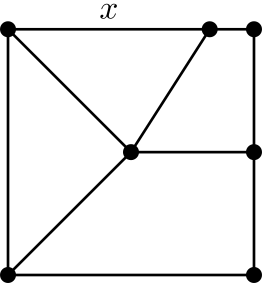
A square with sides of length $1$ is divided into two congruent trapezoids and a pentagon, which have equal areas, by joining the center of the square with points on three of the sides, as shown. Find $x,$ the length of the longer parallel side of each trapezoid.
A speaker talked for sixty minutes to a full auditorium. Twenty percent of the audience heard the entire talk and ten percent slept through the entire talk. Half of the remainder heard one third of the talk and the other half heard two thirds of the talk. What was the average number of minutes of the talk heard by members of the audience?
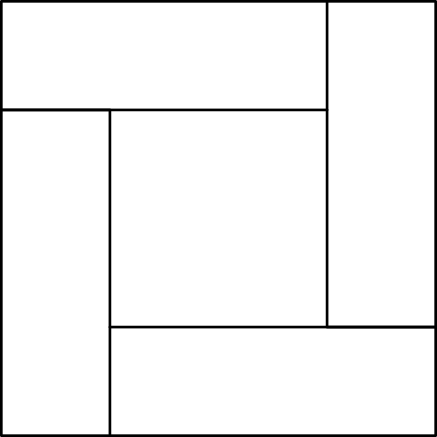
A large square is divided into a small square surrounded by four congruent rectangles as shown. The perimeter of each of the congruent rectangles is $14.$ What is the area of the large square?
Walter rolls four standard six-sided dice and finds that the product of the numbers on the upper faces is $144.$ Which of the following could not be the sum of the upper four faces?
A parabola has vertex at $(4,-5)$ and has two $x$-intercepts, one positive and one negative. If this parabola is the graph of $y=ax^2+bx+c,$ which of $a,$ $b,$ and $c$ must be positive?
A regular hexagon and an equilateral triangle have equal areas. What is the ratio of the length of a side of the triangle to the length of a side of the hexagon?
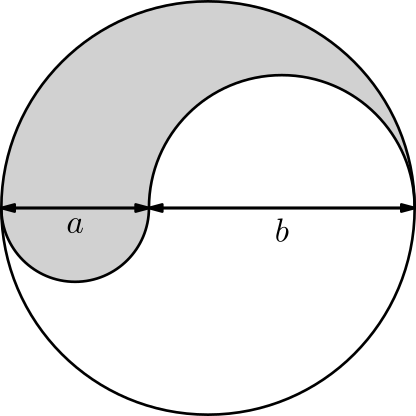
The figure shown is the union of a circle and two semicircles of diameters $a$ and $b,$ all of whose centers are collinear. The ratio of the area of the shaded region to that of the unshaded region is
A right circular cone of volume $A,$ a right circular cylinder of volume $M,$ and a sphere of volume $C$ all have the same radius, and the common height of the cone and the cylinder is equal to the diameter of the sphere. Then
Three cards, each with a positive integer written on it, are lying face-down on a table. Casey, Stacy, and Tracy are told that
(a) the numbers are all different,
(b) they sum to $13,$ and
(c) they are in increasing order, left to right.
First, Casey looks at the number on the leftmost card and says, “I don’t have enough information to determine the other two numbers.” Then Tracy looks at the number on the rightmost card and says, “I don’t have enough information to determine the other two numbers.” Finally, Stacy looks at the number on the middle card and says, “I don’t have enough information to determine the other two numbers.” Assume that each person knows that the other two reason perfectly and hears their comments. What number is on the middle card?
$2$
$3$
$4$
$5$
There is not enough information to determine the number.