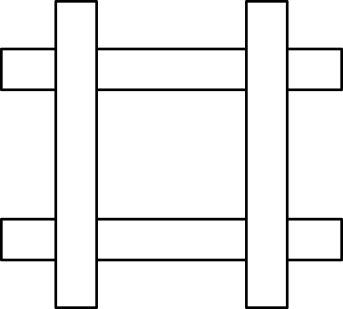
Four rectangular paper strips of length $10$ and width $1$ are put flat on a table and overlap perpendicularly as shown. How much area of the table is covered?
Estimate the time it takes to send $60$ blocks of data over a communications channel if each block consists of $512$ “chunks” and the channel can transmit $120$ chunks per second.
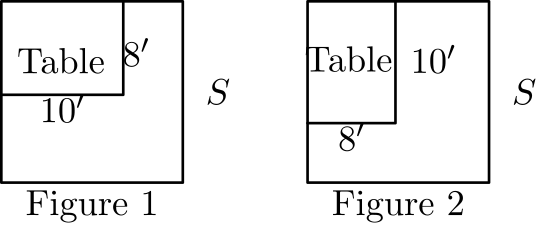
An $8'\times10'$ table sits in the corner of a square room, as in Figure $1$ below. The owners desire to move the table to the position shown in Figure $2.$ The side of the room is $S$ feet. What is the smallest integer value of $S$ for which the table can be moved as desired without tilting it or taking it apart?
In an experiment, a scientific constant $C$ is determined to be $2.43865$ with an error of at most $\pm0.00312.$ The experimenter wishes to announce a value for $C$ in which every digit is significant. That is, whatever $C$ is, the announced value must be the correct result when $C$ is rounded to that number of digits. The most accurate value the experimenter can announce for $C$ is
On each horizontal line in the figure below, the five large dots indicate the populations of cities $A,$ $B,$ $C,$ $D,$ and $E$ in the year indicated. Which city had the greatest percentage increase in population from $1970$ to $1980?$
Each integer $1$ through $9$ is written on a separate slip of paper and all nine slips are put into a hat. Jack picks one of these slips at random and puts it back. Then Jill picks a slip at random. Which digit is most likely to be the units digit of the sum of Jack’s integer and Jill’s integer?
For any real number $a$ and positive integer $k,$ define $$
\binom ak= \frac{\begin{gathered} a(a-1)(a-2)\cdots\\ {}\cdot(a-(k-1)) \end{gathered}} {\begin{gathered} k(k-1)(k-2)\cdots\\ {}\cdot(2)(1) \end{gathered}}.
$$ What is $$
\binom{-\frac12}{100}\div\binom{\frac12}{100}\ ?
$$
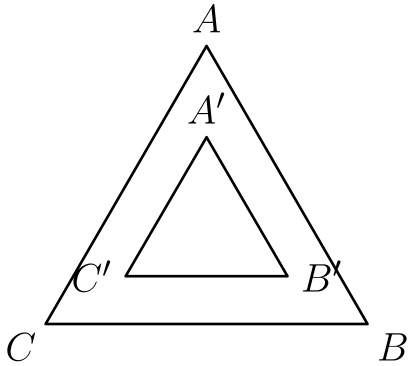
$ABC$ and $A'B'C'$ are equilateral triangles with parallel sides and the same center, as in the figure. The distance between side $BC$ and side $B'C'$ is $\frac16$ the altitude of $\triangle ABC.$ The ratio of the area of $\triangle A'B'C'$ to the area of $\triangle ABC$ is
At the end of a professional bowling tournament, the top $5$ bowlers have a play-off. First #$5$ bowls #$4.$ The loser receives $5$th prize and the winner bowls #$3$ in another game. The loser of this game receives $4$th prize and the winner bowls #$2.$ The loser of this game receives $3$rd prize and the winner bowls #$1.$ The winner of this game gets $1$st prize and the loser gets $2$nd prize. In how many orders can bowlers #$1$ through #$5$ receive the prizes?
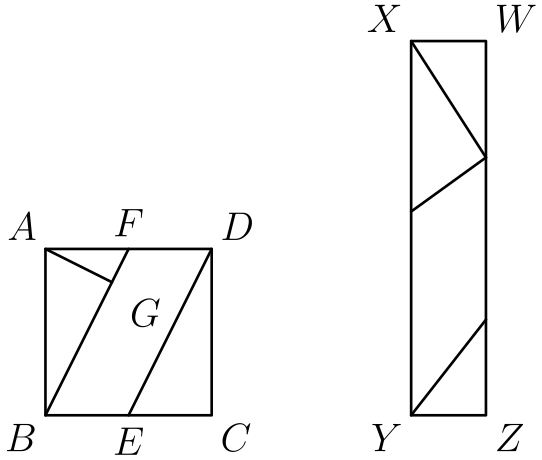
In one of the adjoining figures a square of side $2$ is dissected into four pieces so that $E$ and $F$ are the midpoints of opposite sides and $AG$ is perpendicular to $BF.$ These four pieces can then be reassembled into a rectangle as shown in the second figure. The ratio of height to base, $\frac{XY}{YZ},$ in this rectangle is