The lengths in inches of the three sides of each of four triangles $\mathrm{I},$ $\mathrm{II},$ $\mathrm{III},$ and $\mathrm{IV}$ are as follows: $$
\begin{aligned} \mathrm{I}\quad&3,4,5\\ \mathrm{II}\quad&4,7\frac12,8\frac12\\ \mathrm{III}\quad&7,24,25\\ \mathrm{IV}\quad&3\frac12,4\frac12,5\frac12 \end{aligned}
$$ Of these four given triangles, the only right triangles are:
If a dealer could get his goods for $8\%$ less while keeping his selling price fixed, his profit, based on cost, would be increased to $(x+10)\%$ from his present profit of $x\%,$ which is:
From among $2^{\frac{1}{2}},$ $3^{\frac{1}{3}},$ $8^{\frac{1}{8}},$ $9^{\frac{1}{9}},$ those which have the greatest and the next to the greatest values, in that order, are:
Ann and Sue bought identical boxes of stationery. Ann used hers to write $1$-sheet letters and Sue used hers to write $3$-sheet letters. Ann used all the envelopes and had $50$ sheets of paper left, while Sue used all of the sheets of paper and had $50$ envelopes left. The number of sheets of paper in each box was:
The value(s) of $y$ for which the following pair of equations $$
\begin{aligned} x^2+y^2-16&=0,\\ x^2-3y+12&=0 \end{aligned}
$$ may have a real common solution, are:
The number of cubic feet in the volume of a cube is the same as the number of square inches in its surface area. The length of the edge expressed as a number of feet is:
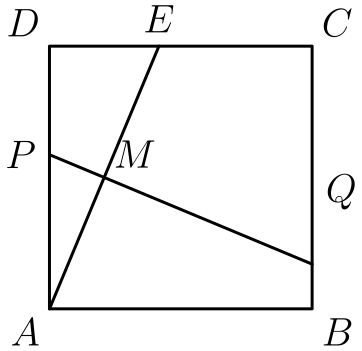
Inside square $ABCD$ with sides of length $12$ inches, segment $AE$ is drawn, where $E$ is the point on $DC$ which is $5$ inches from $D.$ The perpendicular bisector of $AE$ is drawn and intersects $AE,$ $AD,$ and $BC$ at points $M,$ $P,$ and $Q,$ respectively. The ratio of segment $PM$ to $MQ$ is:
A triangle has angles of $30^\circ$ and $45^\circ.$ If the side opposite the $45^\circ$ angle has length $8,$ then the side opposite the $30^\circ$ angle has length:
A contractor estimated that one of his two bricklayers would take $9$ hours to build a certain wall and the other $10$ hours. However, he knew from experience that when they worked together, their combined output fell by $10$ bricks per hour. Being in a hurry, he put both men on the job and found that it took exactly $5$ hours to build the wall. The number of bricks in the wall was:
There are two positive numbers that may be inserted between $3$ and $9$ such that the first three are in geometric progression while the last three are in arithmetic progression. The sum of those two positive numbers is:
A piece of string is cut in two at a point selected at random. The probability that the longer piece is at least $x$ times as large as the shorter piece is:
Let $ABCD$ be a trapezoid with the measure of base $AB$ twice that of base $DC,$ and let $E$ be the point of intersection of the diagonals. If the measure of diagonal $AC$ is $11,$ then that of segment $EC$ is equal to:
The sum of the first $n$ terms of the sequence $$
\begin{gathered} 1,\ (1+2),\ (1+2+2^2),\\ \ldots,\ (1+2+2^2+\cdots+2^{n-1}) \end{gathered}
$$ in terms of $n$ is: