The number of distinct lines representing the altitudes, medians, and interior angle bisectors of a triangle that is isosceles, but not equilateral, is:
An open box is constructed by starting with a rectangular sheet of metal $10$ in. by $14$ in. and cutting a square of side $x$ inches from each corner. The resulting projections are folded up and the seams welded. The volume of the resulting box is:
The numbers $x,$ $y,$ $z$ are proportional to $2,$ $3,$ $5.$ The sum of $x,$ $y,$ and $z$ is $100.$ The number $y$ is given by the equation $y=ax-10.$ Then $a$ is:
A cube is made by soldering twelve $3$-inch lengths of wire properly at the vertices of the cube. If a fly alights at one of the vertices and then walks along the edges, the greatest distance it could travel before coming to any vertex a second time, without retracing any distance, is:
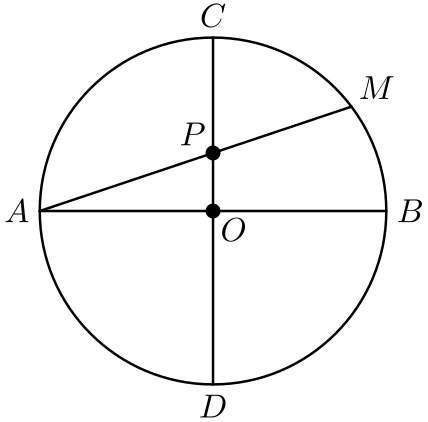
Circle $O$ has diameters $\overline{AB}$ and $\overline{CD}$ perpendicular to each other. $\overline{AM}$ is any chord intersecting $\overline{CD}$ at $P.$ Then $AP\cdot AM$ is equal to:
The base of the decimal number system is ten, meaning, for example, that $123=1\cdot10^2+2\cdot10+3.$ In the binary system, which has base two, the first five positive integers are $1,$ $10,$ $11,$ $100,$ $101.$ The numeral $10011$ in the binary system would then be written in the decimal system as:
A man makes a trip by automobile at an average speed of $50$ mph. He returns over the same route at an average speed of $45$ mph. His average speed for the entire trip is: