An ordered pair $(m,n)$ of nonnegative integers is called “simple” if adding $m+n$ in base $10$ requires no carrying. Find the number of simple ordered pairs that sum to $1492.$
What is the largest possible distance between two points, one on the sphere of radius $19$ centered at $(-2,-10,5)$ and the other on the sphere of radius $87$ centered at $(12,8,-16)?$
A proper divisor of a natural number is a positive integral divisor other than $1$ and the number itself. A natural number greater than $1$ is called “nice” if it equals the product of its distinct proper divisors. What is the sum of the first ten nice numbers?
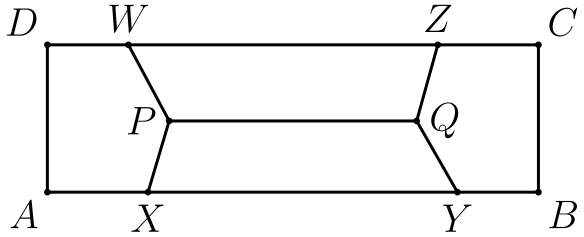
Rectangle $ABCD$ is divided into four parts of equal area by five segments as shown, where $XY=YB+BC+CZ,$ $YB+BC+CZ=ZW,$ $ZW=WD+DA+AX,$ and $PQ\parallel AB.$ Find $AB$ (in cm) if $BC=19$ cm and $PQ=87$ cm.
Let $[r,s]$ denote the least common multiple of positive integers $r,$ $s.$ Find the number of ordered triples $(a,b,c)$ for which $[a,b]=1000,$ $[b,c]=2000,$ and $[c,a]=2000.$
Al walks down an escalator that is moving up and counts $150$ steps. Bob walks up and counts $75$ steps. If Al’s walking speed is three times Bob’s, how many steps are visible at a given time? Assume this is constant.
A given sequence $r_1,$ $r_2,$ $\ldots,$ $r_n$ of distinct real numbers can be put in ascending order by means of one or more “bubble passes.” A bubble pass through a given sequence consists of comparing the second term with the first term, and exchanging them if and only if the second term is smaller, then comparing the third term with the second term and exchanging them if and only if the third term is smaller, and so on in order, through comparing the last term, $r_n,$ with its current predecessor and exchanging them if and only if the last term is smaller.
The example below shows how the sequence $1,$ $9,$ $8,$ $7$ is transformed into the sequence $1,$ $8,$ $7,$ $9$ by one bubble pass. The numbers compared at each step are underlined.
Suppose that $n=40,$ and that the terms of the initial sequence $r_1,$ $r_2,$ $\ldots,$ $r_{40}$ are distinct from one another and are in random order. Let $\frac{p}{q},$ in lowest terms, be the probability that the number that begins as $r_{20}$ will end up, after one bubble pass, in the $30$th place. Find $p+q.$
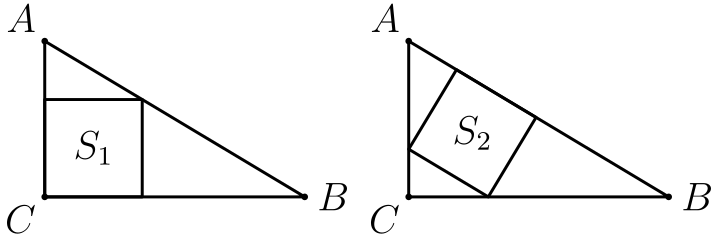
Squares $S_1,$ $S_2$ are inscribed in right triangle $ABC$ as shown. Find $AC+CB$ if $\operatorname{area}(S_1)=441$ and $\operatorname{area}(S_2)=440.$