In a long line of people arranged left to right, the $1013$th person from the left is also the $1010$th person from the right. How many people are in the line?
Balls numbered $1,$ $2,$ $3,$ $\ldots$ are deposited in $5$ bins, labeled $A,$ $B,$ $C,$ $D,$ and $E,$ using the following procedure. Ball $1$ is deposited in bin $A,$ and balls $2$ and $3$ are deposited in bin $B.$ The next $3$ balls are deposited in bin $C,$ the next $4$ in bin $D,$ and so on, cycling back to bin $A$ after balls are deposited in bin $E.$ (For example, balls numbered $22,$ $23,$ $\ldots,$ $28$ are deposited in bin $B$ at step $7$ of this process.) In which bin is ball $2024$ deposited?
Real numbers $a,$ $b,$ and $c$ have arithmetic mean $0.$ The arithmetic mean of $a^2,$ $b^2,$ and $c^2$ is $10.$ What is the arithmetic mean of $ab,$ $ac,$ and $bc?$
Quadrilateral $ABCD$ is a parallelogram, and $E$ is the midpoint of the side $\overline{AD}.$ Let $F$ be the intersection of lines $EB$ and $AC.$ What is the ratio of the area of quadrilateral $CDEF$ to the area of triangle $CFB?$
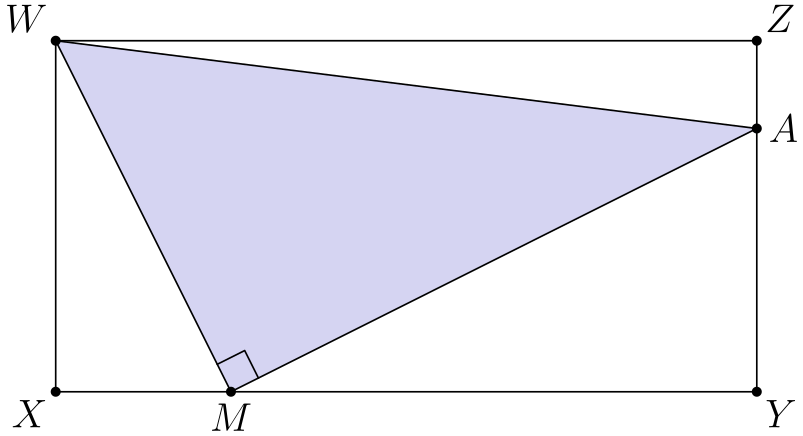
In the figure below $WXYZ$ is a rectangle with $WX = 4$ and $WZ = 8.$ Point $M$ lies on $\overline{XY},$ point $A$ lies on $\overline{YZ},$ and $\angle WMA$ is a right angle. The areas of $\triangle WXM$ and $\triangle WAZ$ are equal. What is the area of $\triangle WMA?$
A group of $100$ students from different countries meet at a mathematics competition. Each student speaks the same number of languages, and, for every pair of students $A$ and $B,$ student $A$ speaks some language that student $B$ does not speak, and student $B$ speaks some language that student $A$ does not speak. What is the least possible total number of languages spoken by all the students?
A dartboard is the region $B$ in the coordinate plane consisting of points $(x, y)$ such that $|x| + |y| \le 8.$ A target $T$ is the region where $(x^2 + y^2 - 25)^2 \le 49.$ A dart is thrown and lands at a random point in $B.$ The probability that the dart lands in $T$ can be expressed as $\dfrac{m}{n} \cdot \pi,$ where $m$ and $n$ are relatively prime positive integers. What is $m + n?$
A list of $9$ real numbers consists of $1,$ $2.2,$ $3.2,$ $5.2,$ $6.2,$ $7,$ as well as $x,$ $y,$ $z$ with $x \le y \le z.$ The range of the list is $7,$ and the mean and median are both positive integers. How many ordered triples $(x, y, z)$ are possible?
Jerry likes to play with numbers. One day, he wrote all the integers from $1$ to $2024$ on the whiteboard. Then he repeatedly chose four numbers on the whiteboard, erased them, and replaced them by either their sum or their product. (For example, Jerry’s first step might have been to erase $1,$ $2,$ $3,$ and $5,$ and then write either $11,$ their sum, or $30,$ their product, on the whiteboard.) After repeatedly performing this operation, Jerry noticed that all the remaining numbers on the whiteboard were odd. What is the maximum possible number of integers on the whiteboard at that time?
In a race among $5$ snails, there is at most one tie, but that tie can involve any number of snails. For example, the result of the race might be that Dazzler is first; Abby, Cyrus, and Elroy are tied for second; and Bruna is fifth. How many different results of the race are possible?
In the following table, each question mark is to be replaced by “Possible” or “Not Possible” to indicate whether a nonvertical line with the given slope can contain the given number of lattice points (points both of whose coordinates are integers). How many of the $12$ entries will be “Possible”?
Three different pairs of shoes are placed in a row so that no left shoe is next to a right shoe from a different pair. In how many ways can these six shoes be lined up?