Menkara has a $4 \times 6$ index card. If she shortens the length of one side of this card by $1$ inch, the card would have area $18$ square inches. What would the area of the card be in square inches if instead she shortens the length of the other side by $1$ inch?
What is the maximum number of balls of clay with radius $2$ that can completely fit inside a cube of side length $6$ assuming that the balls can be reshaped but not compressed before they are packed in the cube?
Mr. Lopez has a choice of two routes to get to work. Route A is $6$ miles long, and his average speed along this route is $30$ miles per hour. Route B is $5$ miles long, and his average speed along this route is $40$ miles per hour, except for a $\dfrac{1}{2}$-mile stretch in a school zone where his average speed is $20$ miles per hour. By how many minutes is Route B quicker than Route A?
The six-digit number $\underline{2}\,\underline{0}\,\underline{2}\,\underline{1}\,\underline{0}\,\underline{A}$ is prime for only one digit $A.$ What is $A?$
Elmer the emu takes $44$ equal strides to walk between consecutive telephone poles on a rural road. Oscar the ostrich can cover the same distance in $12$ equal leaps. The telephone poles are evenly spaced, and the $41$st pole along this road is exactly one mile ($5280$ feet) from the first pole. How much longer, in feet, is Oscar’s leap than Elmer’s stride?
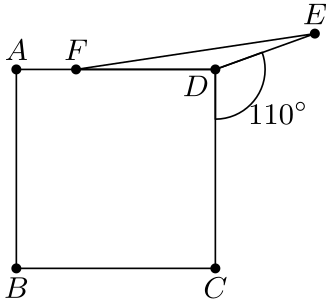
As shown in the figure below, point $E$ lies in the opposite half-plane determined by line $CD$ from point $A$ so that $\angle CDE = 110^\circ.$ Point $F$ lies on $\overline{AD}$ so that $DE=DF,$ and $ABCD$ is a square. What is the degree measure of $\angle AFE?$
A two-digit positive integer is said to be *cuddly* if it is equal to the sum of its nonzero tens digit and the square of its units digit. How many two-digit positive integers are cuddly?
When a certain unfair die is rolled, an even number is $3$ times as likely to appear as an odd number. The die is rolled twice. What is the probability that the sum of the numbers rolled is even?
A school has $100$ students and $5$ teachers. In the first period, each student is taking one class, and each teacher is teaching one class. The enrollments in the classes are $50,$ $20,$ $20,$ $5,$ and $5.$ Let $t$ be the average value obtained if a teacher is picked at random and the number of students in their class is noted. Let $s$ be the average value obtained if a student was picked at random and the number of students in their class, including the student, is noted. What is $t-s?$
Emily sees a ship traveling at a constant speed along a straight section of a river. She walks parallel to the riverbank at a uniform rate faster than the ship. She counts $210$ equal steps walking from the back of the ship to the front. Walking in the opposite direction, she counts $42$ steps of the same size from the front of the ship to the back. In terms of Emily’s equal steps, what is the length of the ship?
Each of $6$ balls is randomly and independently painted either black or white with equal probability. What is the probability that every ball is different in color from more than half of the other $5$ balls?
How many ordered pairs $(x,y)$ of real numbers satisfy the following system of equations? $$
\begin{aligned} x^2+3y&=9, \\ (|x|+|y|-4)^2&=1. \end{aligned}
$$
Isosceles triangle $ABC$ has $AB = AC = 3\sqrt6,$ and a circle with radius $5\sqrt2$ is tangent to line $AB$ at $B$ and to line $AC$ at $C.$ What is the area of the circle that passes through vertices $A,$ $B,$ and $C?$
An architect is building a structure that will place vertical pillars at the vertices of regular hexagon $ABCDEF,$ which is lying horizontally on the ground. The six pillars will hold up a flat solar panel that will not be parallel to the ground. The heights of pillars at $A,$ $B,$ and $C$ are $12,$ $9,$ and $10$ meters, respectively. What is the height, in meters, of the pillar at $E?$
A farmer’s rectangular field is partitioned into a $2$ by $2$ grid of $4$ rectangular sections as shown in the figure. In each section the farmer will plant one crop: corn, wheat, soybeans, or potatoes. The farmer does not want to grow corn and wheat in any two sections that share a border, and the farmer does not want to grow soybeans and potatoes in any two sections that share a border. Given these restrictions, in how many ways can the farmer choose crops to plant in each of the four sections of the field?
A disk of radius $1$ rolls all the way around the inside of a square of side length $s > 4$ and sweeps out a region of area $A.$ A second disk of radius $1$ rolls all the way around the outside of the same square and sweeps out a region of area $2A.$ The value of $s$ can be written as $a+\dfrac{b\pi}{c},$ where $a,$ $b,$ and $c$ are positive integers and $b$ and $c$ are relatively prime. What is $a+b+c?$