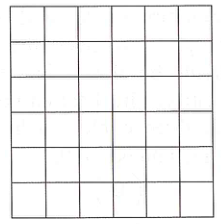
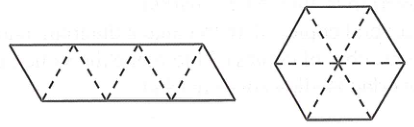
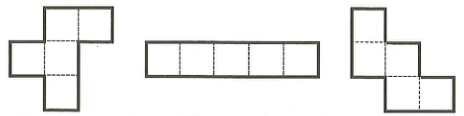
Each of the $36$ cells in a $6\times6$ table is to be filled with numbers $0,1$ or $2$. The sum of the six numbers in each row and each column is then computed. How do you fill the cells to get the maximum number of different values among the $12$ sums?
In the Indonesian village Sevenia, each bill is worth a number of rupiahs equal to a power of $7$, namely, $7^0=1$, $7^2=49$, $7^3=343$, $7^4=2401$, $7^5=16807$, $7^6=117649$, $7^7=823543$ and so on. A millionaire has some bills worth a total of exactly $1000000$ rupiahs, but at most $8$ bills of any kind. No two millionaires have exactly the same combination of bills. What is the maximum number of millionaires in Sevenia?
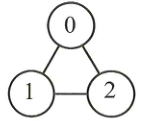
A magic triangle consists of several circles in a triangular configuration and are filled with consecutive integers starting from $0$. The integer written in a circle that is supported by two other circles below it is the remainder when the sum of the integers in the supporting circles is divided by the number of circles of the triangle. Moreover, the integer in the bottom leftmost circle should be always less than the integer in the bottom rightmost circle. The diagram below shows an example of a triangle with three circles such that the only division $(1+2)\div3$ leaves a remainder of $0$.
(a) Write down all magic triangles with six circles. (2 marks)
(b) Write down all magic triangles with ten circles. (4 marks)