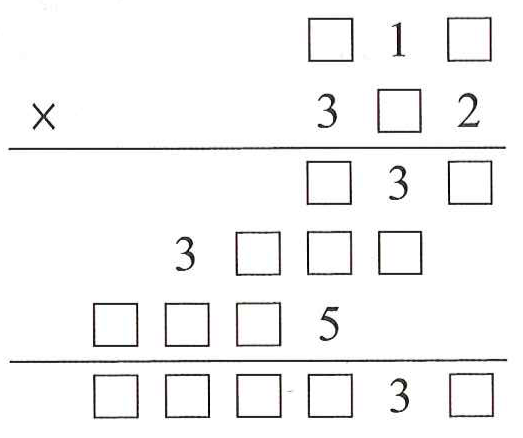
The diagram on the right shows the multiplication of two three-digit numbers, yielding a six-digit product. Some of the digits are replaced by boxes. What is the value of this six-digit product?
Twenty-seven digits consisting of 1, 2, 3, 4, 5, 6, 7, 8 and 9 are each to be filled in and arranged in a row of boxes such that each digit is exactly used three times. There is another digit between the first 1 and the second 1, and another digit between the second 1 and the third 1. There are two other digits between the first 2 and the second 2, and two other digits between the second 2 and the third 2. The same applies to the other digits, so that there are nine other digits between the first 9 and the second 9, and nine other digits between the second 9 and the third 9. The middle seven digits are 7469258. Complete the boxes below.
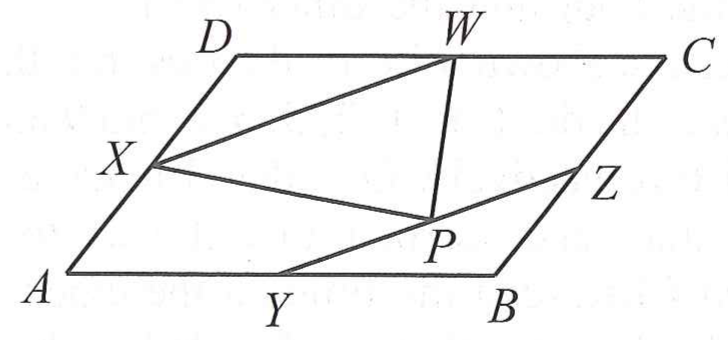
Points $W$, $X$, $Y$ and $Z$ are the midpoints of the four sides of parallelogram $ABCD$. If $P$ is a point on line segment $YZ$, what percent of the area of parallelogram $ABCD$ is the area of triangle $PXW$?
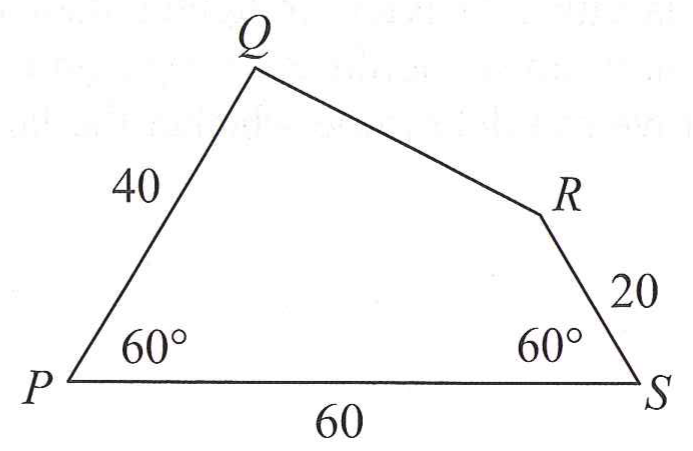
Four rods are connected together with flexible joints at their ends to make a quadrilateral as shown in the diagram below. If $\angle QPS=\angle RSP=60^\circ$, $PQ=40$ cm, $RS=20$ cm and $PS=60$ cm. What is the measure, in degrees, of $\angle QRS$?
The ‘4’ button on my calculator is defective, so I cannot enter numbers which contain the digit 4, thus, I cannot enter the calculation $2\times14$ and do not attempt to do so. Moreover, my calculator also does not display the digit 4 if 4 is part of an answer, so for example, the result of multiplying 3 by 18 is displayed as 5 instead of 54 and the result of multiplying 2 by 71 is displayed as 12 instead of 142. If I multiply a positive one-digit number by a positive two-digit number on my calculator and it displays 26, list all such pairs of numbers which I could have multiplied?
My twelve-hour digital clock has four digits, two of which represents the hour and the other two represents the minutes. The minutes are shown with leading 0s, but the hours are not. Upside down, the digits 0, 1, 2, 5, 6, 8 and 9 are read as 0, 1, 2, 5, 9, 8 and 6 respectively. One day, I made a phone call on a scheduled time, and learned that it was too early. Then I realized that I had read the time on the clock upside down. If you know by how much time I called early, you will know what time I made the call. What time should I have made the call?
There are 15 real coins all of the same weight, and one fake coin which is either heavier or lighter than the real coin. At least how many times should we weigh on a two-pan balance scale so that we can determine whether the fake coin is heavier or lighter?
In a chess tournament with 15 players, every two players play against each other once. A win is worth 2 points, a draw 1 point and a loss 0 points. A prize is given to any player with a total score of at least 20 points. What is the maximum number of prize winners?
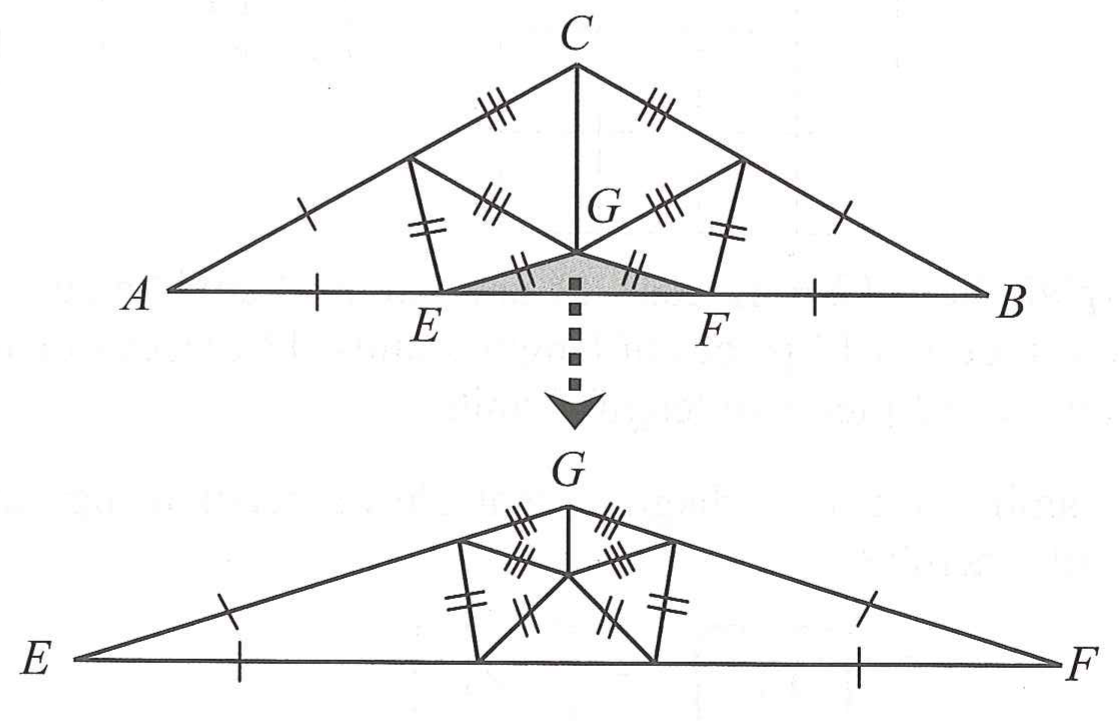
Isosceles triangle $ABC$ has been dissected into thirteen isosceles acute triangles, as shown in the two following diagrams, where all segments of the same length are marked the same way, and the second diagram shows the details of the dissection of triangle $EFG$. Given that $\angle CAB$ has an integral value, in degrees, what is the measure, in degrees, of $\angle CAB$?