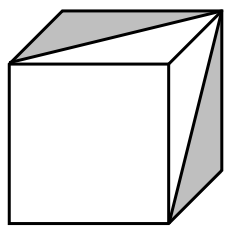
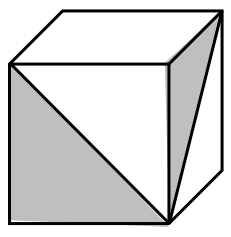
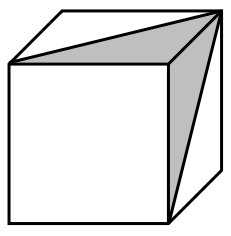
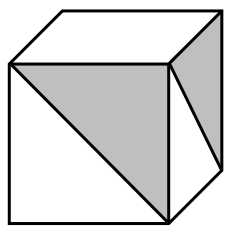
Twelve players compose a basketball team. Each player must select a jersey number from 4, 5, 6, …, 14 and 15, where two players cannot choose the same number. If Alvin is a member of the basketball team and it is known that the sum of the jersey numbers of all his other teammates is 106, what is his jersey number?
Teacher Josie brought a box of cookies for her Kindergarten students. If she allocates 6 cookies to each student, there would be 5 cookies left. But when she gives each student 7 cookies, it will be 8 cookies short. How many students are there in her class?
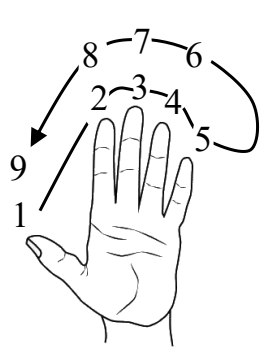
Let’s play a game where we start counting from the thumb with the number 1, the index finger is 2, the middle finger is 3, the ring finger is 4 and the little finger is 5, then after which we count in backward order, where the ring finger is 6, the middle finger is 7, the index finger is 8, and the thumb is 9; then we count in forward order again, and we keep on counting in this manner, as shown on the diagram. Which finger will it land into when I count to 2021?
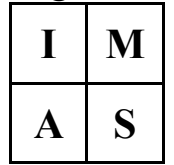
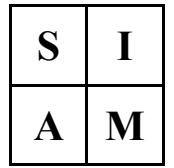
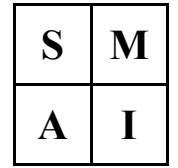
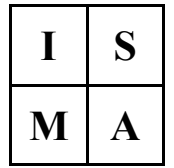
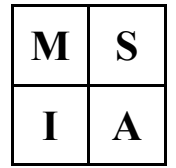
In the diagram below, the four unit squares with letters “I”, “M”, “A” and “S” are rearranged according to the following conditions: I M A S
a. The square containing “S” is now on the top row.
b. The square containing “S” remains farther right than “I” in the diagram.
c. The square containing “S” will shares a horizontal side with the square containing “A”
d. Only one of the squares is not moved. Which of the following diagrams is the new diagram?
Let $\overline{ab}$ be a two-digit number. Now, swap its digits to form another two-digit number, multiply it by 5 and take the remainder of the result when divided by 9. If the resulting number is 5, then how many different $\overline{ab}$ exist?
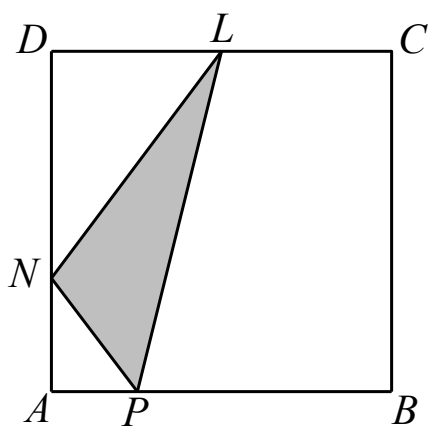
In the diagram below, ABCD is a square with side length 12 cm. Point P is on side AB such that AP:PB = 1:3, point L is on side CD such that $CL=DL$ and point N is on side DA such that DN:NA = 2:1. What is the area, in cm² , of the triangle PNL?
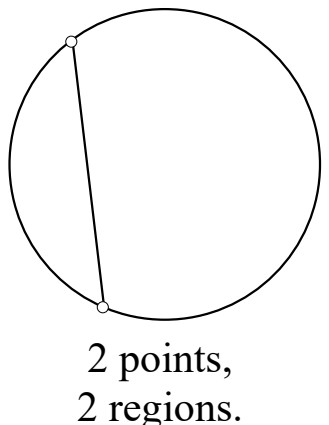
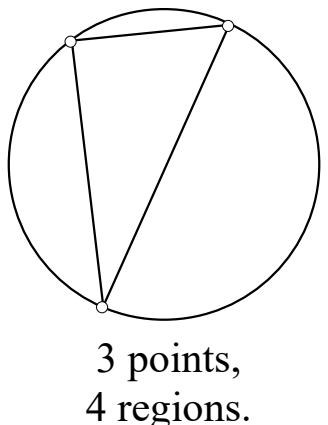
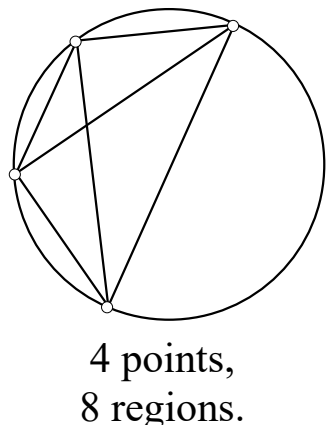
The three circles below have some number of points on their circumference. Connect all the points on the same circle using straight lines and count the number of regions these segments have partitioned the circle into. If there are 5 points on the circumference of a circle, how many regions have been partitioned at the most?
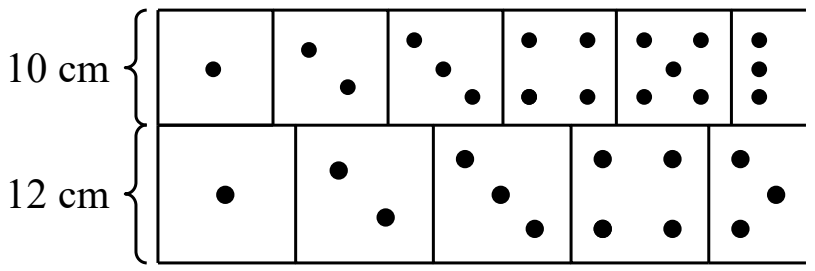
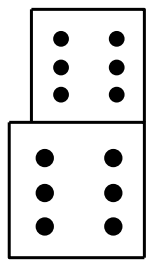
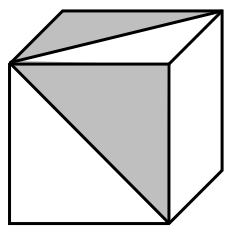
The length of the edge of the small and big dice are 10 cm and 12 cm, respectively. All the big dice are arranged side by side at the lower level, while all the small dice are stacked above the big dice and are also placed side by side at the upper level as shown in the diagram below on the left. The front faces of each row of dice show the same sequence of points: 1, 2, …, 6, 1, 2, …, 6, 1, 2, … When both the small and big dice show the same “6-point” face and their right edge is aligned for the first time (as shown on the diagram below on the right). In what position, when counting starting from the far left, is the big dice?
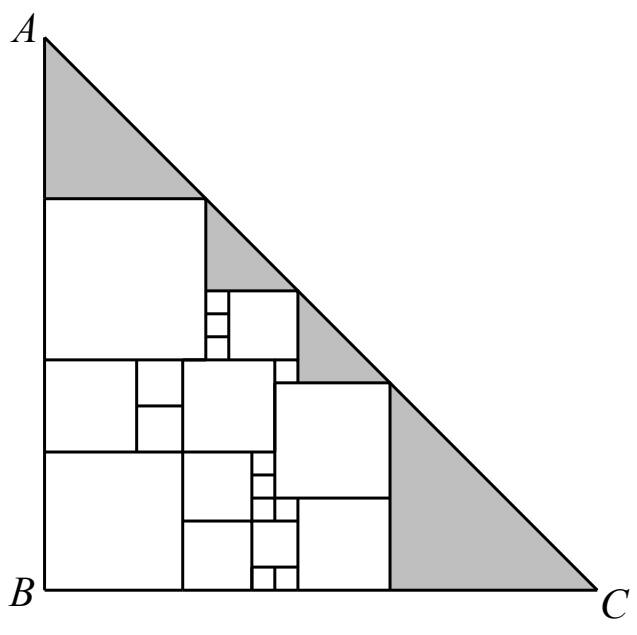
In the diagram below, ABC is an isosceles right-angled triangle, where $AB=BC=8$ cm. There are various squares of different sizes inside it, while the other triangular parts are shaded. What is the total sum of the areas, in cm² , of the shaded region?
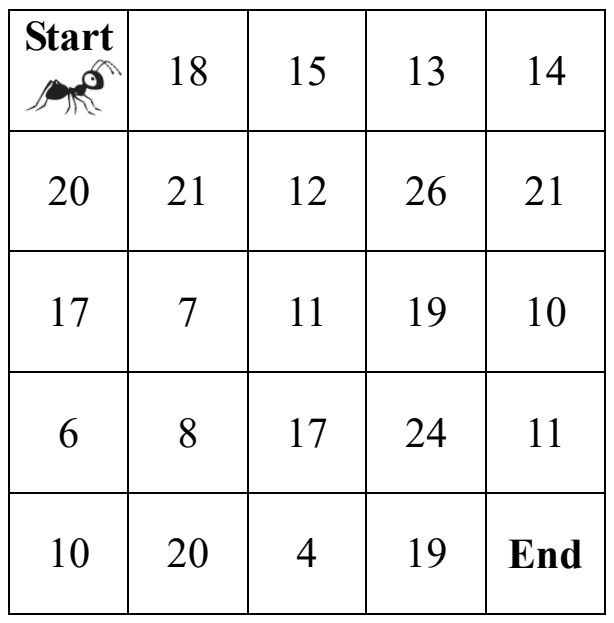
In the given grid, an ant begins at the “Start” cell and in each move, it can go either one step right or down to any adjacent cell with common side until it reaches the “End” cell. If in each move, it gets the number in the square, then what is the smallest sum the ant can get? Start 18 15 13 14 20 21 12 26 21 17 7 11 19 10 6 8 17 24 11 10 20 4 19 End
How many ways can we arrange two 1’s, two 2’s and two 3’s in a row such that there is at least one “2” between two 1’s, at least one “3” between two 2’s and at least one “1” between two 3’s?
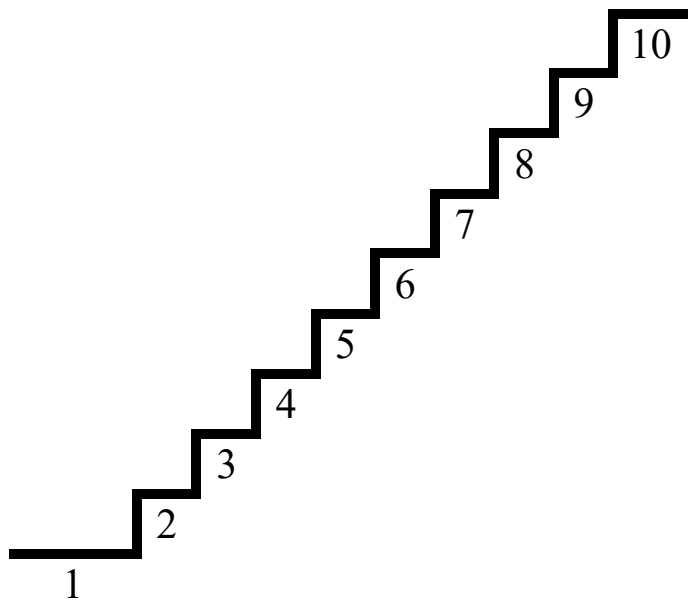
Alan and Benjie use the staircase shown in the diagram below to play a game where the goal is to reach a certain level on the staircase first. At the beginning, both of them will start in step 1, and in each turn, they will be playing the “Rock, Paper and Scissors” game to move around the staircase. The winner in each game gets to move 4 consecutive steps upward (or downward or a combination of both) for showing a rock; 5 consecutive steps for showing scissors and 6 consecutive steps for showing a paper. So, for example, when someone reaches step 10, he must go down to the step 9 and so on, finally returning to the step 1 and then goes back up doing the same procedure again until somebody wins. To illustrate further, when a person shows a rock on the first game and wins and then in the second game shows a paper and wins, he will then move and land on step 9. Since Alan is currently on step 1 of the stairs, what is the least number of times he has to win in order to reach step 2? Note: If a game is a tie (where both players show the same hand, i.e. paper and paper), then they don’t move.
The following table shows the results of the math test of eight students A, B, C, D, E, F, G and H. The perfect score is 100 marks and their average score is 64 marks. It is known that student F is the top scorer of the math test and his score is twice that of another student, what is the score of student C ? A B C D E F G H 74 48 90 33 60 78
There are five two-digit integers A, B, C, D and E where $A>B>C>D>E$ , such that the average of the five numbers is 33, the average of the four largest numbers is 34 and the average of the four smallest numbers is 31. If it is known that C is an even number, what is the value of integer B?