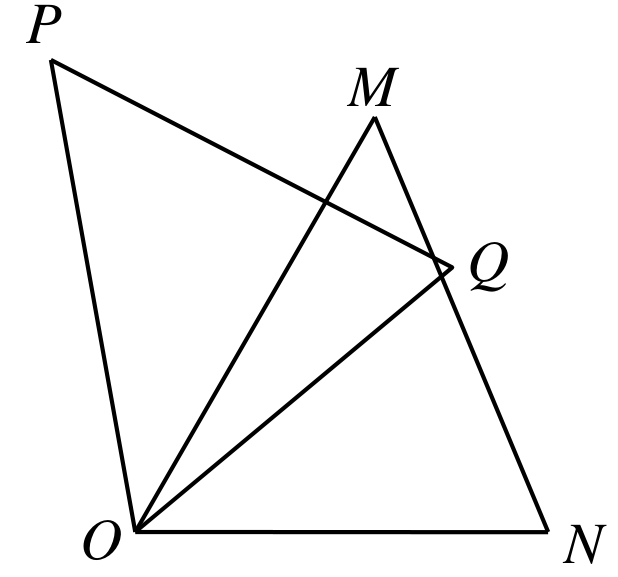
In the figure below, it is known that $\triangle POQ\cong\triangle MON$, $\angle PON=100^\circ$ and $\angle MOQ=20^\circ$. What is the measure, in degrees, of $\angle POQ$?
Two positive integers $m$ and $n$ satisfy the following conditions: When $m$ is divided by 35, it leaves a remainder of 12 and when $n$ is divided by 21, it leaves a remainder of 15. What is the remainder when $m-n$ is divided by 7?
The teacher has 2 identical pens and 3 identical pencils to be given out as prizes to two of his students. If each student should receive at least one object, in how many ways can the teacher distribute the prizes?
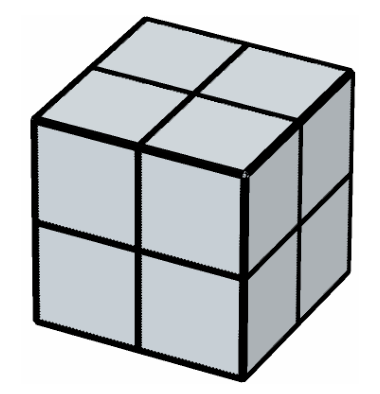
As shown in the figure below, a $2\times2\times2$ cube is formed by placing together eight $1\times1\times1$ cubes. If one $1\times1\times1$ cube is removed, what will be the surface area of the remaining figure?
A palindrome number is a positive integer that is the same when read forwards or backwards. The numbers 909 and 1221 are examples of palindromes. How many three-digit palindrome numbers are divisible by 9?
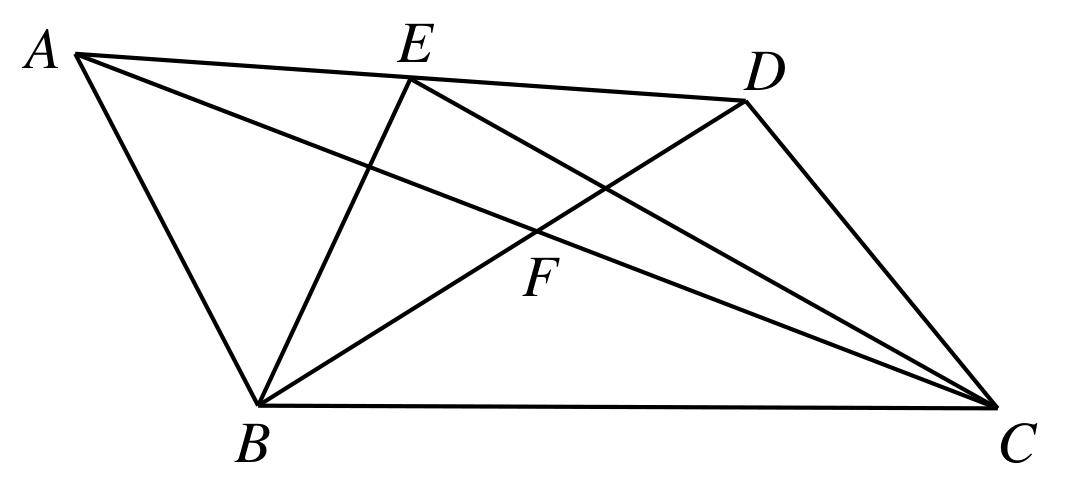
In the figure below, let point $E$ be the midpoint of $AD$ and point $F$ be the midpoint of $AC$. If the area of triangle $ABF$ is 8 cm² and area of $ADF$ is 6 cm², then what is the area, in cm², of triangle $BCE$?
Shade 3 unit squares on the $3\times3$ grid below, such that there must be two shaded squares in some row and two shaded squares in some column but it must not have three shaded squares in any row or column. Find the total number of ways in shading the figure.
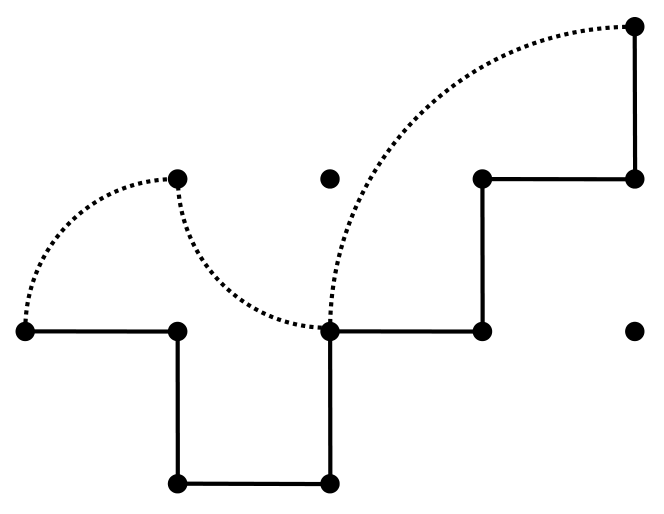
In the figure below, the eight line-segments drawn are all equal to 1 m and the three dotted lines are all quarter arcs. What the is difference, in m, between the total length of all the line segments and total length of all the dotted arcs? (Use $\pi=3.14$)
Starting from $\frac34$, add 2 to the numerator or add 3 to the denominator for each operation, but not both, and no reduction is performed. At least how many operations one needs to get a fraction again that is of the same value as $\frac34$?
Let $a$, $b$, $c$ and $d$ be consecutive positive integers such that $\frac1a+\frac1b+\frac1c+\frac1d+\frac1{36}+\frac1{45}=1$. What is the value of $a+b+c+d$?
Replace all the 9 variables in the expression $a+\frac cb+d+\frac fe+g+\frac ih$ using the digits 1, 2, 3, … 9, where each digit is only used once. Find the maximum possible value of the result.
An ant crawls on the plane. It starts at point $A$ and crawls for 1 cm, then turns $60^\circ$ to the right; crawls for another 2 cm and again turns $60^\circ$ to the right; crawls for another 3 cm and turns $60^\circ$ to the right; crawls for another 4 cm and turns $60^\circ$ to the right; and finally it craws 5 cm and reaches $F$. What is the distance, in cm, between $A$ and $F$?
Arrange all proper fractions in a sequence such that the denominators are all in non-decreasing order, and while for equal denominators, the numerator is arranged in increasing order. The resulting sequence is as follows: $\frac12$, $\frac13$, $\frac23$, $\frac14$, $\frac24$, $\frac34$, $\frac15$, …. It is known that the sum of first $n$ terms of this sequence is an integer, which of the integers below is a possible value for $n$?
Using the digits 1, 2, 3, 4, 5, 6, 7 and 8 only once, create a sequence such that there is one number between 1 and 2, two numbers between 2 and 4, three numbers between 3 and 6 and four numbers between 4 and 8. How many different ways can we do this?