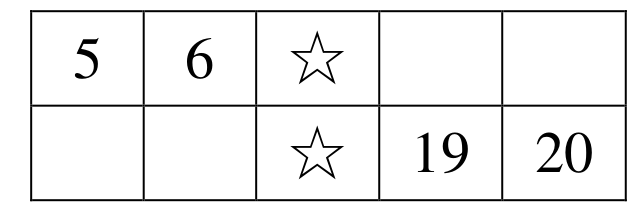
The two stars in the diagram represent the same number. The sum of the three numbers in the second row is equal to twice the sum of the three numbers in the first row. What number does each star represent?
In a restaurant, one cup of tea and two cups of coffee cost 78 dollars, while three cups of tea and one cup of coffee cost 94 dollars. How many more dollars does a cup of coffee cost than a cup of tea?
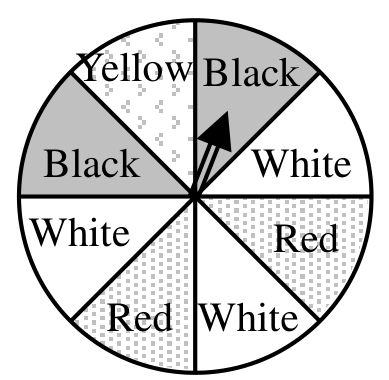
A circular spinner is divided into eight equal sectors. Two of them are painted red, two black, three white and one yellow. What is the probability for the pointer of the spinner to be pointing at a black sector?
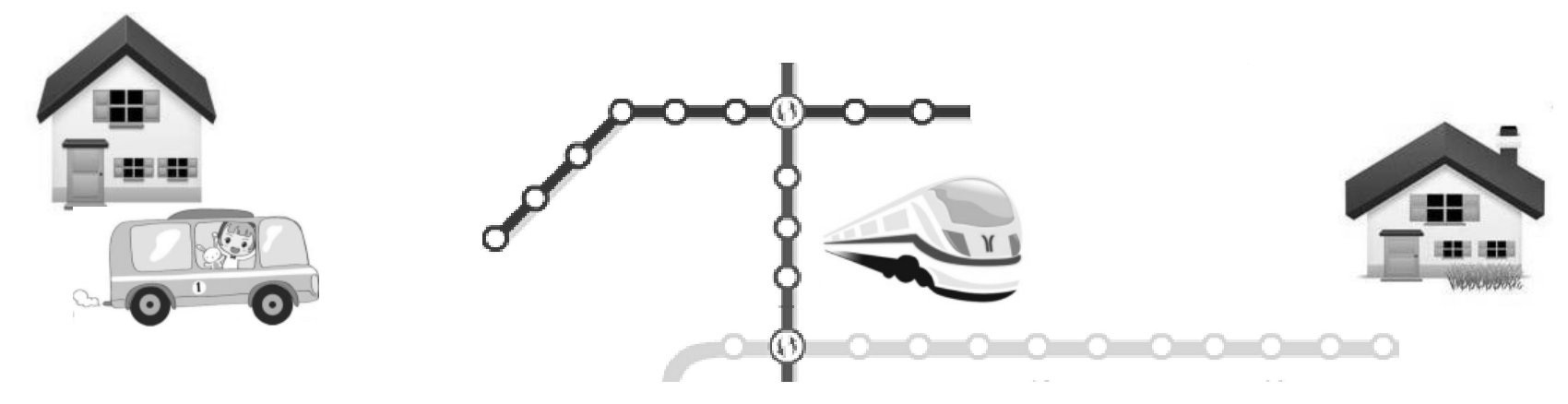
To visit a friend, Rod must take the bus to the nearest Metro station, and this takes 15 minutes. He has to ride the Metro train for 20 stops, each taking 2.5 minutes. He also has to change trains twice, and it takes 3 minutes each time. Finally, after exiting the Metro, he still has to walk another 12 minutes before reaching his friend’s place. How many minutes does Rod have to spend traveling to his friend’s house?
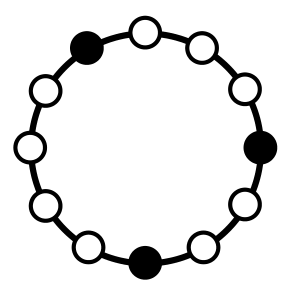
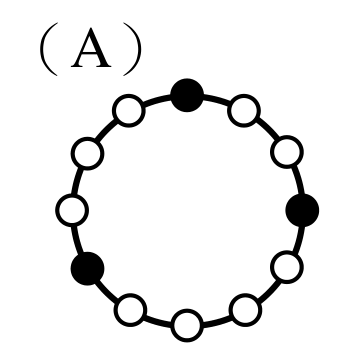
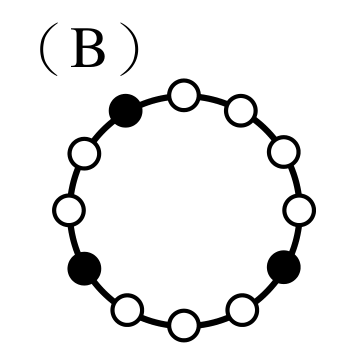
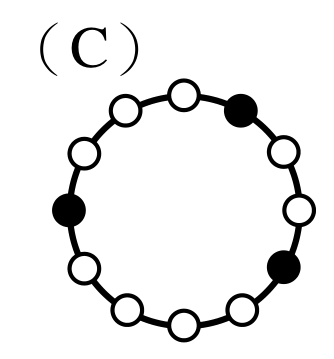
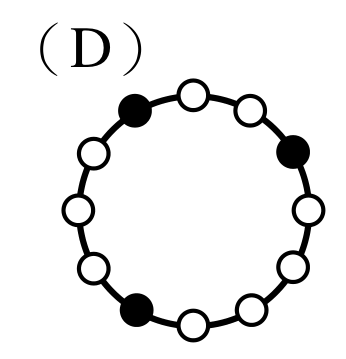
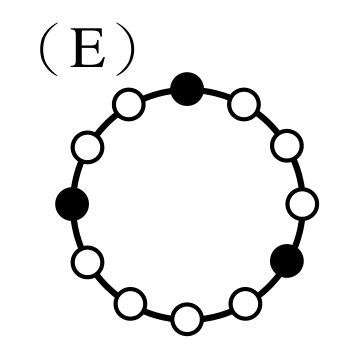
On a table there is a ring, there are 12 equally spaced beads on the ring, 3 of which are black, as shown in the diagram. Which of the following five figures cannot be obtained from the given figure by rotating the ring on the table?
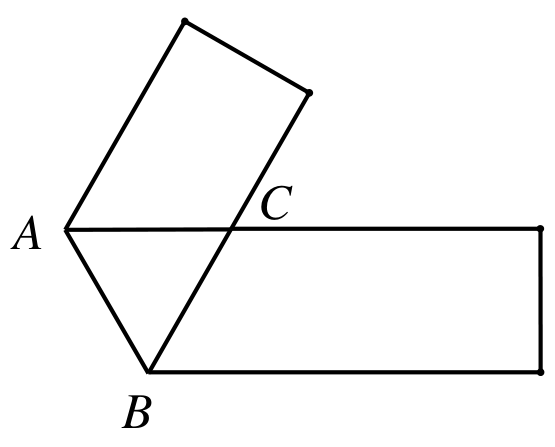
The diagram shows a strip of paper folded along the segment $AB$. If $\angle ACB=60^\circ$ and the area of triangle $ABC$ is $\sqrt{3}$ cm², what is the width, in cm, of this strip?
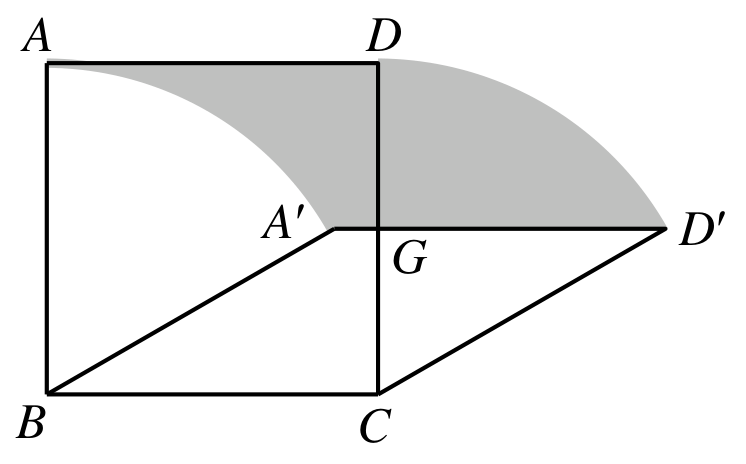
$ABCD$ is a square of side length 10 cm. The segment $BC$ is fixed. The segment $AD$ moves in the plane to the segment $A^{\prime} D^{\prime}$ so that the lengths $AB$, $DC$ and $AD$ do not change. What is the area, in cm², of the shaded region in the diagram when the segment $A^{\prime} D^{\prime}$ intersects the segment $CD$ at its midpoint $G$?
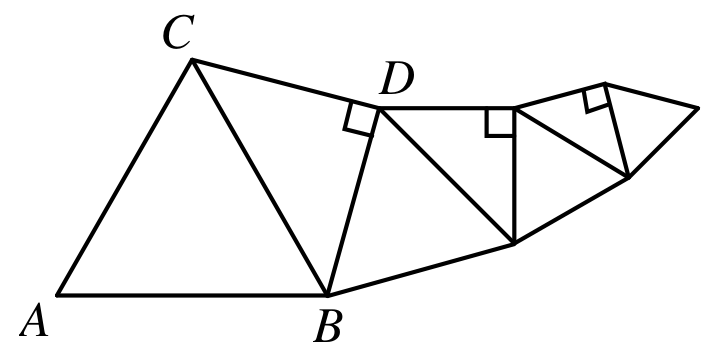
We start with an equilateral triangle $ABC$ of area 80 cm². We construct a right isosceles triangle $BCD$ using $BC$ as the hypotenuse. Then we construct an equilateral triangle using $BD$ as a side. This continued alternately, as shown in the diagram. What is the area, in cm², of the fourth equilateral triangle?
We wish to spend 100 dollars to buy 18 stamps, each costing 4 dollars, 8 dollars or 10 dollars. We must buy at least 1 stamp of each of the three kinds. How many different ways can the buying of stamps be possible?
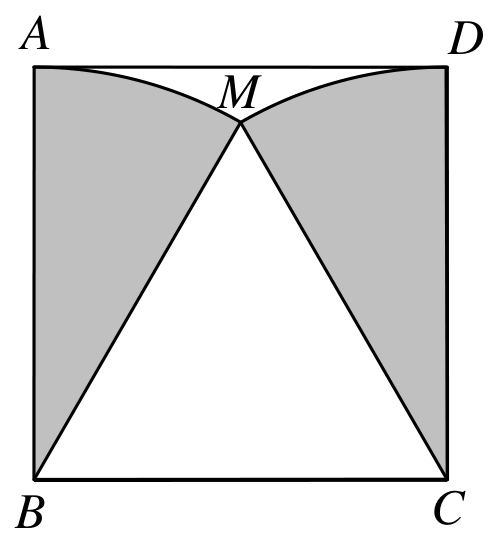
The sectors $MAB$ and $MCD$ are inside the square $ABCD$ of side length 10 cm, as shown in the diagram. What is the total area, in cm², of these two sectors, correct to 1 decimal place? Take $\pi=3.14$.
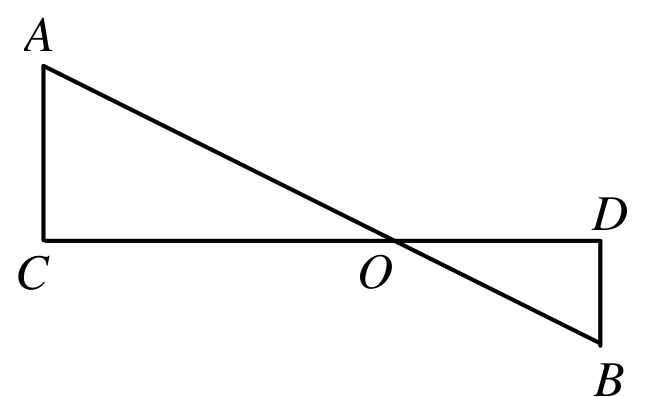
The diagram shows two right triangles $OAC$ and $OBD$. The lengths of three of the segments $AB$, $AC$, $CD$ and $DB$ are 12 cm, 6 cm and 3 cm. What is the number of possible lengths, in cm, of the fourth segment?
For any real number $x$, we denote by $[x]$ the greatest integer not greater than $x$. For example, $[\pi]=3$ and $[-\pi]=-4$. How many positive integers $n$ satisfy $\left[\frac{\left[\frac{100}{n}\right]}{n}\right]=1$?