On an analogue clock, the hour hand is 5 cm long and the minute hand is 10 cm long. It is currently 6:00. After $x$ minutes, the hour and minute hands will form two of the three sides of a right triangle (where the third side is the line segment that connects the tips of the hour and minute hands). If $0<x<60$, how many possible values of $x$ are there?
Alice, Betty, Carl, David and Elva attend the same school. When walking alone, each person moves at a speed of 2.0 m per second. When walking in a group, their speed depends on the group size: any pair walks at 1.5 m/s, any trio at 1.0 m/s and any quartet at 0.5 m/s. One day, Alice and Betty leave the school together at 16:00:00, Carl at 16:01:00, David at 16:02:00 and Elva at 16:03:00. They all walk in the same direction along a straight road and whenever someone catches up with another, they join the group immediately. How far, in m, from the school will they be when all five of them are together?
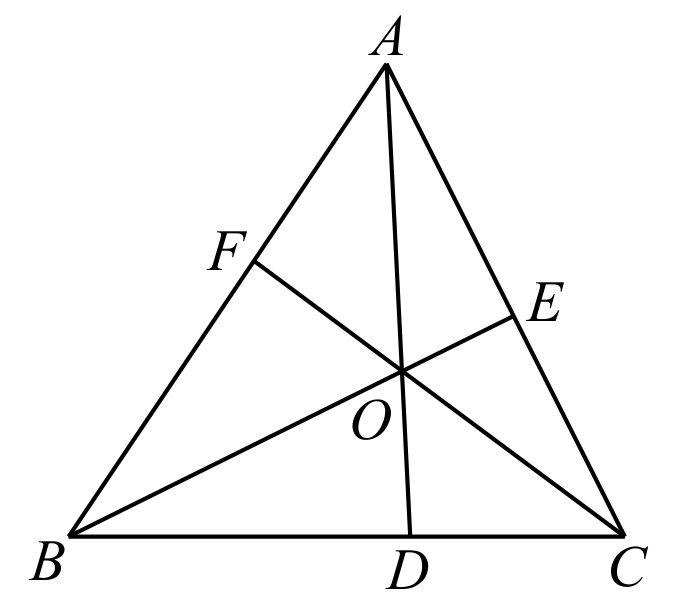
As shown in the diagram below, $ABC$ is a triangle, where $AD$, $BE$ and $CF$ are drawn from the vertices such that all three lines intersect at point $O$. If $\frac{EO}{EB}=\frac14$ and $\frac{FO}{FC}=\frac25$, what is the value of $\frac{DO}{DA}$?
What is the maximum number of integers that can be selected from the twenty numbers $\{1,2,3,\ldots,20\}$ such that the sum of any two distinct selected integers is not included among the selected integers?
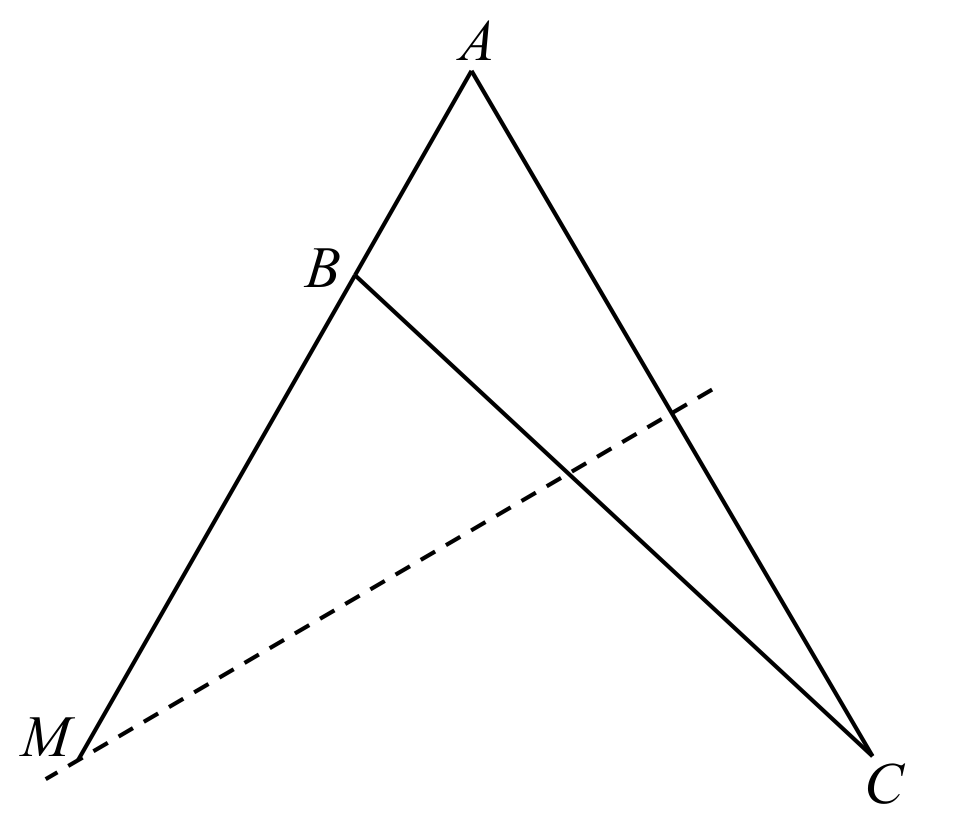
As shown in the diagram below, $ABC$ is a triangle where $\angle ABC>\angle BAC=60^\circ$, $AB=1$ cm and $AC=2\sqrt3$ cm. If the perpendicular bisector of $AC$ intersects line $AB$ at point $M$, what is the length, in cm, of $MB$?
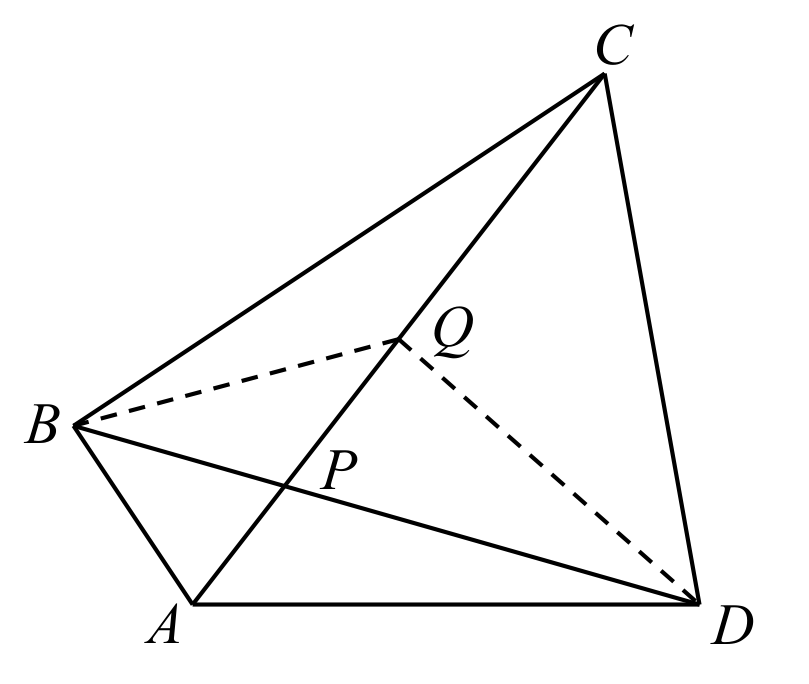
As shown in the diagram below, $ABCD$ is a convex quadrilateral with diagonals intersecting at point $P$. The sum of the areas of triangles $PAB$ and $PCD$ equals the sum of the areas of triangles $PAD$ and $PCB$. If $Q$ is the midpoint of $AC$ and $Q$ does not coincide with $P$, what is the value of $\frac{BP}{DP}$?
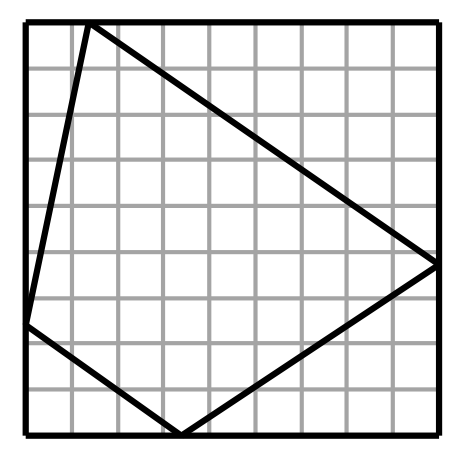
Each vertex of a convex quadrilateral lies on a different side of a $9\text{ cm}\times9\text{ cm}$ square, as shown in the diagram. What is the minimum possible perimeter, in cm, of the quadrilateral?
There are 100 distinct points on a line. The midpoint of every segment determined by any two of these points is painted red. What is the minimum number of red points?
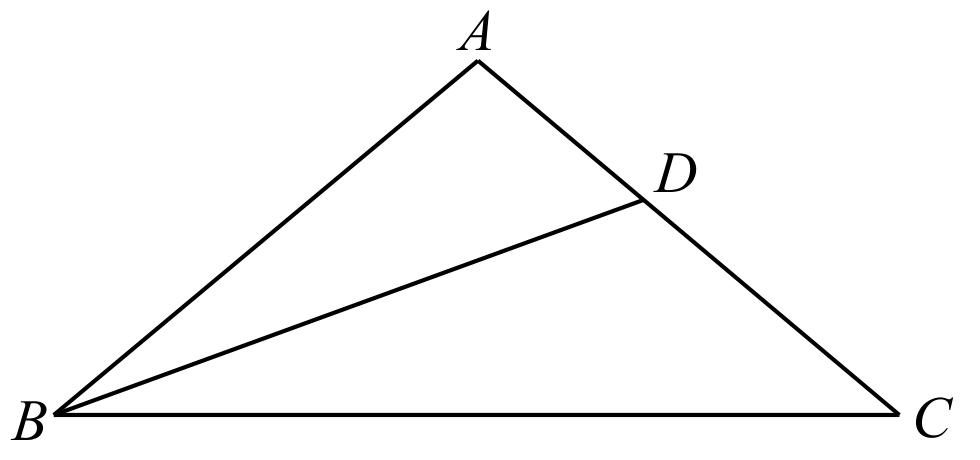
As shown in the diagram below, $ABC$ is a triangle where $AB=AC$ and the angle bisector of $\angle ABC$ intersects $AC$ at $D$. If $BC=BD+AD$, what is the measure, in degrees, of $\angle CBD$?
A sequence consists of six distinct positive integers in strictly increasing order such that each term (excluding the first) is a multiple of the preceding term. If the sum of all six terms is 111, what is the smallest possible value of the largest term of the sequence?
Alex has a 10-faced die with the faces labelled from $1,2,\ldots,10$. The probability of each face appearing is proportional to its number, that is, the corresponding probabilities are in the ratio $1:2:3:4:5:6:7:8:9:10$. If Alex rolls the die twice, what is the probability that the sum of the two rolls is 9?
There are $k$ positive integers, not necessarily distinct, and one of which is 26. If the sum of their reciprocals is 1, what is the minimum possible value of $k$?
There are $k$ distinct positive integers arranged in a circle such that the product of any two adjacent integers is less than 2026. What is the maximum possible value of $k$?
A perfect square greater than 1 is called a “good number” if it can be expressed as a sum of consecutive positive integers starting from 1. For example, 36 is a good number since $36=6^2=1+2+3+4+5+6+7+8$. Including 36, how many good numbers are less than or equal to 2025?
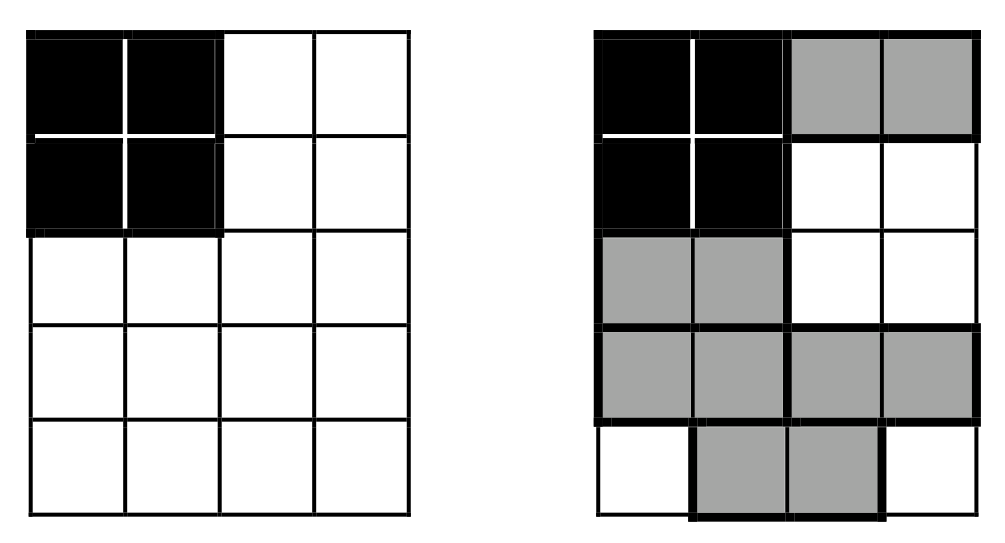
Consider a $5\times4$ grid, in which a $2\times2$ black square has already been placed in the top-left corner, as shown in the diagram below on the left. You are to place five $1\times2$ rectangles onto the remaining unoccupied cells. The rectangles must all be placed horizontally (no rotations allowed), aligned along the grid lines, and cannot overlap with each other or be placed over any of the black squares. One valid arrangement is shown below on the right. How many such arrangements, including the given valid arrangement, are possible?