In a shopping catalog, the cover page is page 1. Betty pulls out a page from this shopping catalog and finds that pages 9 and 24 are on the same sheet. How many pages are there in this shopping catalog?
Each of Alex, Ben and Carl writes down 120 numbers from 1 to 500. If a number appears on more than one list, it is erased from all the lists. In the end, Alex’s list has 81 numbers left and Ben’s list has 70 numbers left. What is the positive difference between the maximum and the minimum possible number of numbers that are left on Carl’s list?
Alice lives in apartment 624 in the seventh building of an apartment complex. Each building has eighteen floors and each floor has the same number of apartments. The apartments are numbered beginning with 1 on the first floor of the first building, and all the apartments in one building are numbered from bottom to top before continuing in the next building. On which floor does Alice live?
In a certain isolated tribe, 15% of males and 35% of females are married. If this tribe allows only marriages between a man and a woman and their spouses are still alive, what percentage of people in this tribe are married?
Alice and Bruce took different trains at same station. The constant speed of Alice’s train is 90 km per hour and the constant speed of Bruce’s train is 72 km per hour. 20 minutes after Bruce’s train departed, Alice’s train has also departed. At a certain moment in their journey, Bruce’s train travelled 15 km more than Alice’s train. What was the total distance, in km, that Bruce’s train had travelled at this moment? (Assume that the speeds of the trains remain the same even when the trains are leaving the station.)
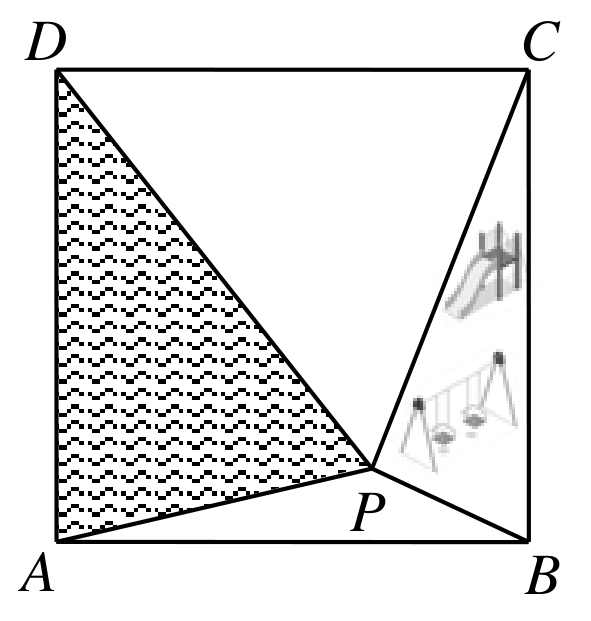
There is a square park, $ABCD$, and a pavilion is built at point $P$, as shown in the diagram below. Triangle $PAD$ is a pond whose area is one-third of the area of the square park. Triangle $PBC$ is a play area for children whose area is 2024 m². What is the area, in m², of the square park? (Assume the area of the pavilion is 0.)
To produce 32 identical brick-shaped jellies, one needs 6400 cm² of paperboard for the boxes and 8000 cm³ of jelly to fill up all these 32 boxes. Now we want to produce jumbo packages, by doubling the length of each side of the brick-shaped boxes. If we have 12800 cm² of paperboard and 16000 cm³ of jelly, what is the largest number of jumbo brick-shaped boxes of jelly we can make?
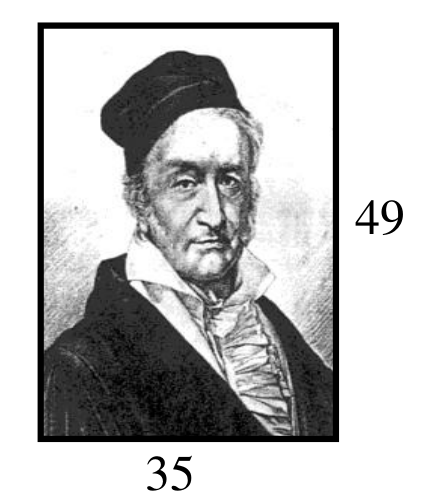
Joe printed a picture on a 35 cm by 49 cm cardboard. Then, holding the position of the cardboard fixed, he cut it into 500 pieces, turning it into a puzzle. If the total length of the cutting done inside the cardboard is 2116 cm, then what is the average perimeter, in cm, of each of the 500 pieces?
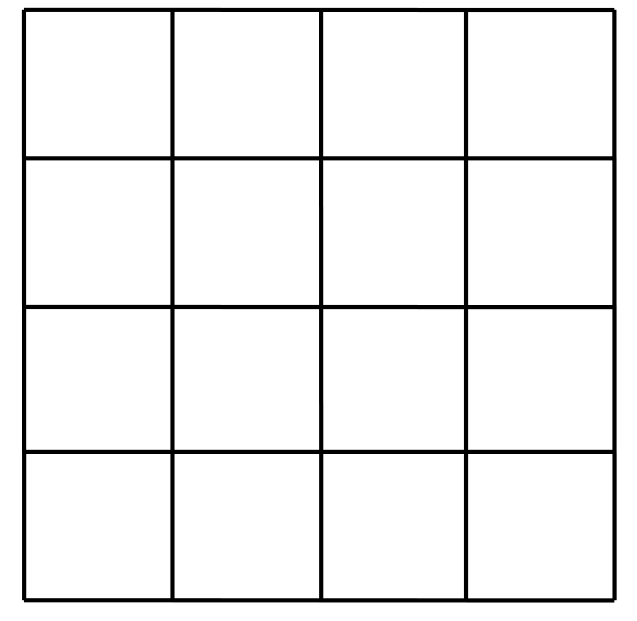
Peter draws a number of straight lines on a $4\times4$ table so that for each square, at least one of the lines passes through an interior point of the square. What is the minimum number of lines drawn by Peter?
Sam listed in ascending order all the four-digit numbers that have the product of their digits equal to 0. The product of the digits of 2024 is $2\times0\times2\times4=0$, so 2024 is a term in Sam’s list. What is the position of the term 2024 in Sam’s list?
There is a row of lights. Every 10 seconds one of the lights, the “active” light, is switched on if it is off, and off if it is on. Then the next light in line becomes the active light. When the last light was active, the next active light was the first light. For example, the row of three lights, with the first and third lights on and the second one off, and the first one active, then after 10 seconds the first one would be switched off and after another 10 seconds the second one would be switched on, and so on. The sequence is illustrated below, where white circle indicates on and black circle indicates off.
Now, there is a row of 10 lights. At start, the first light was active and the switches were
A troupe plans for their performance next month. There are no performances on Mondays or Tuesdays and there are no three consecutive days without performances. If there are 31 days next month, what is the minimum number of performances the troupe can present?
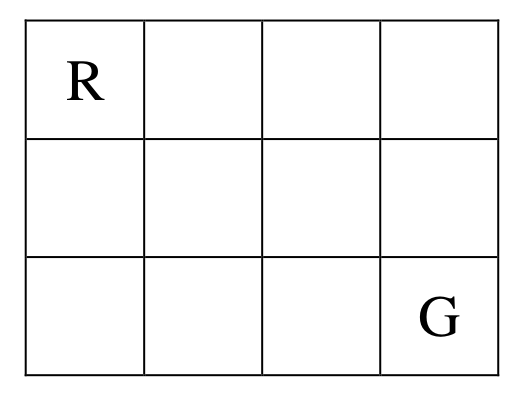
A robot is in a unit square of a table. When the robot moves on the table, it cannot move diagonally. For example, in the diagram below, $R$ is the location of the robot to start and the robot needs to move 5 squares to reach the square marked by $G$.
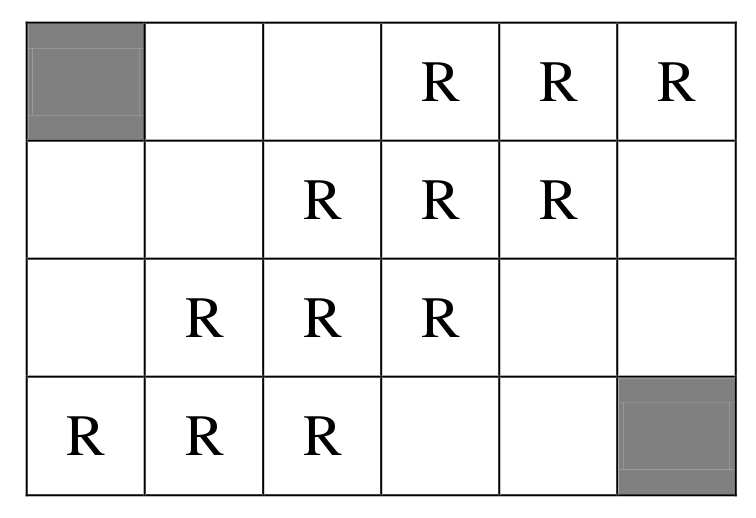
In the following table, there are 12 squares (marked with $R$) starting from which the robot takes up to 5 squares to reach each of the two shaded squares.
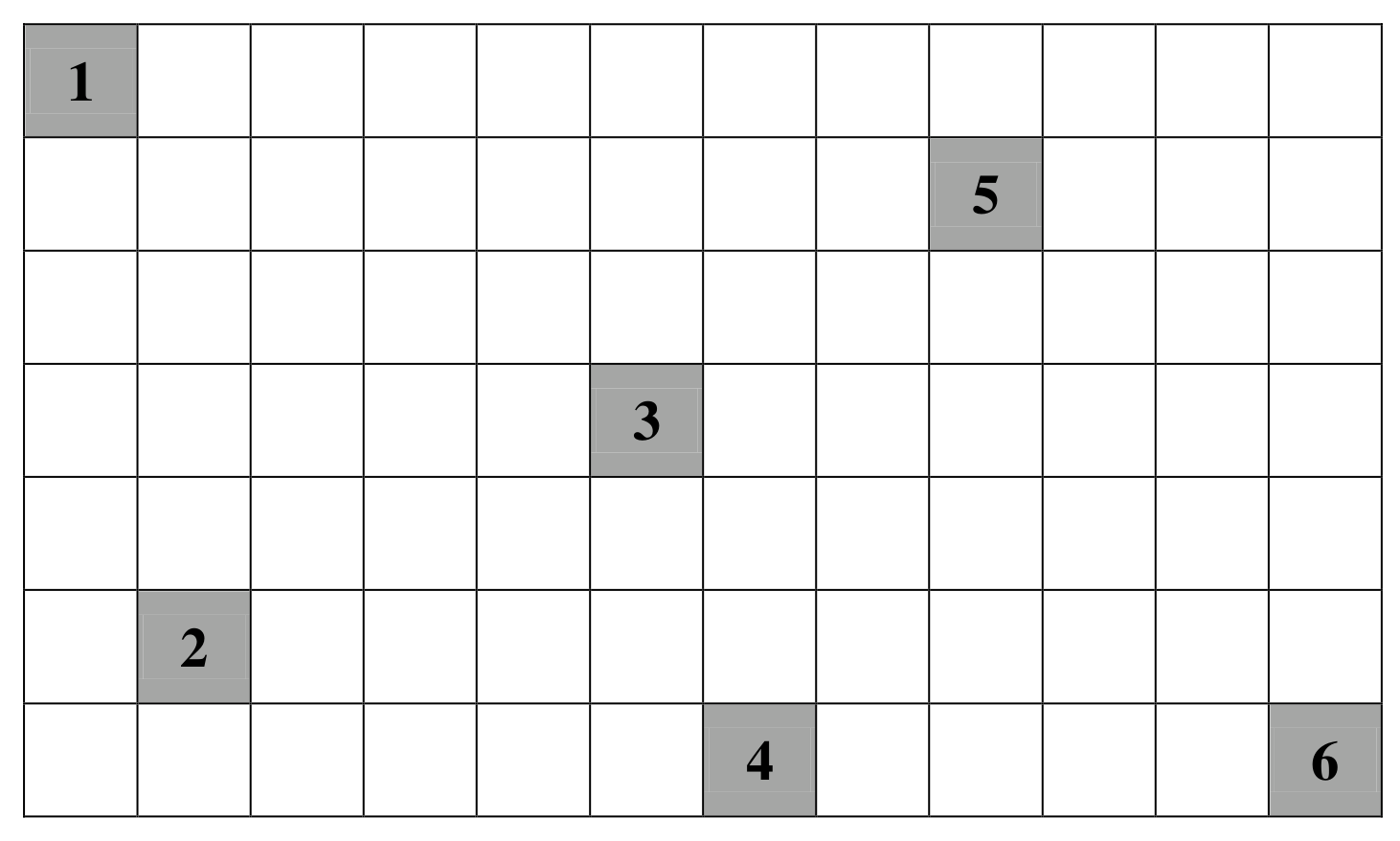
Now, there are 6 shaded squares in the following table. How many squares, except the shaded squares, are there so that it takes the robot up to 4 squares to reach at least two of the shaded squares?
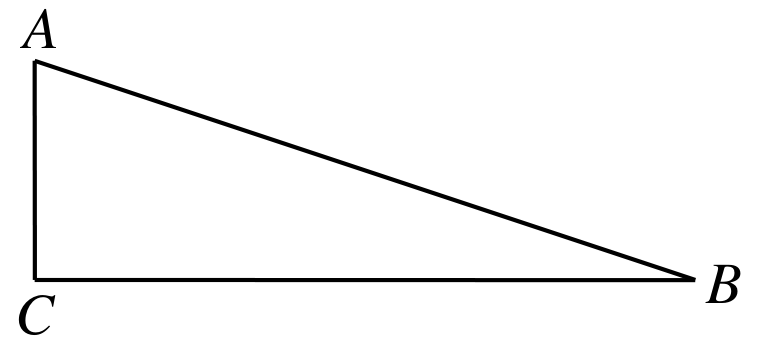
As shown in the diagram below, it is known that triangle $ABC$ is a right triangle so that $\angle ACB=90^\circ$ and $AC \lt BC \lt AB$. Roger wants to make an isosceles triangle by attaching another triangle to it so that the two triangles do not even partially overlap. In how many different ways can Roger make such an isosceles triangle? (Also draw these different ways.)
Warren has 11 coins, 2 are gold coins and the other 9 are silver coins. Warren puts these coins in a line. Then Warren chooses the coins that satisfy one of the following conditions:
(i) choose two silver coins so that there is exactly one gold coin between them;
(ii) choose one gold coin and one silver coin so that the other gold coin does not lie between them;
(iii) just choose exactly one gold coin.
With the different positions of the two gold coins, the number of Warren’s ways to choose are also different. What is the maximum number of different ways Warren can choose?