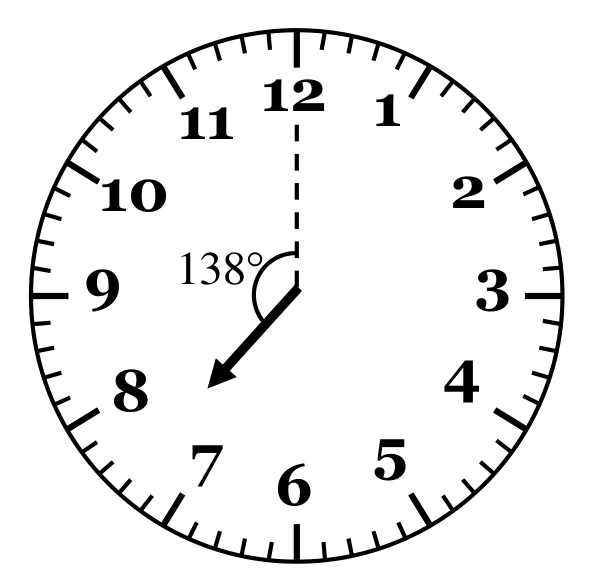
As shown in the diagram, the minute hand of a wall clock is missing. All the other accessories are normal. At a certain moment, the angle between the hour hand and 12 o’clock is measured to be $138^\circ$. What was the exact time of this moment?
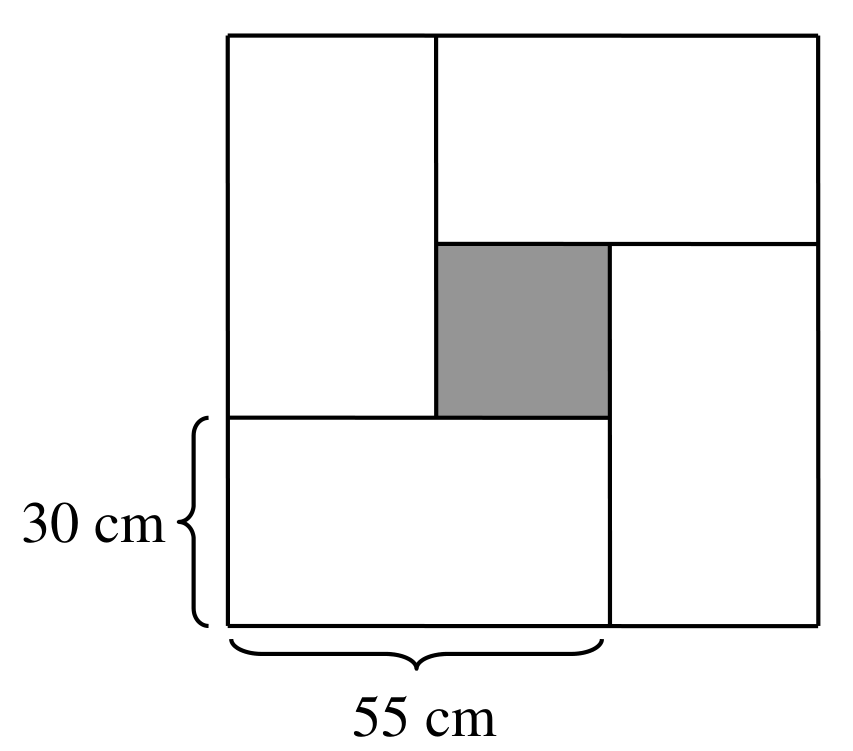
There are four identical rectangles arranged around a shaded square without overlapping, as shown in the diagram below. If the width of the rectangle is 30 cm and the length of the rectangle is 55 cm, what is the area, in square centimetres, of the shaded square?
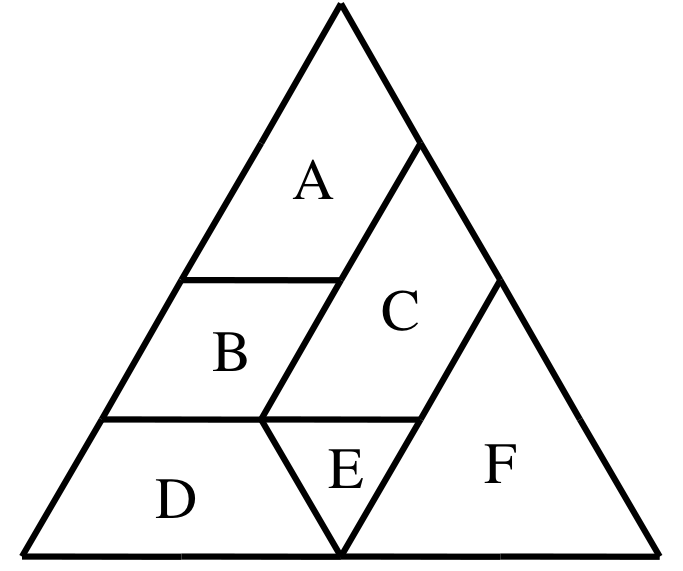
Six identical equilateral triangle pieces, with the same direction, are piled on top of one another, resulting to the diagram shown below. Which is the fifth piece to be removed from the pile, if you remove the pieces in order, starting from the piece on the top to the bottom one?
Some unit squares of a $4\times506$ white grid are coloured in gray, resulting in some patterns, as shown in the diagram below. How many unit squares, out of the total of 2024 squares in this grid, are coloured in gray?
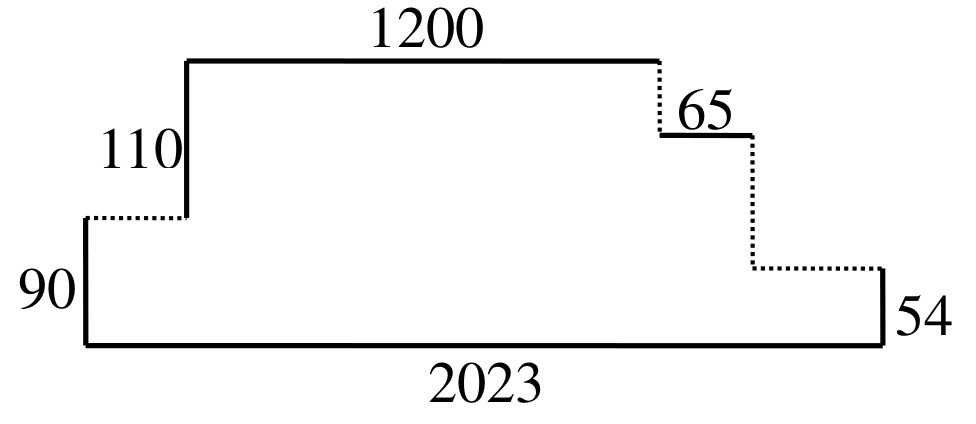
The diagram below shows a decagon where all its adjacent sides form a right angle. The lengths, in cm, of the solid sides are known and written on each side, while the lengths of the dotted sides are not known. What is the perimeter, in cm, of the decagon? Note: the diagram is NOT drawn to scale.
Bob claims that he walks with a speed of 50 metres per minute. But in fact, he does not because he thinks that there are 60 centimetres in a metre and 100 seconds in a minute. What is his real walking speed?
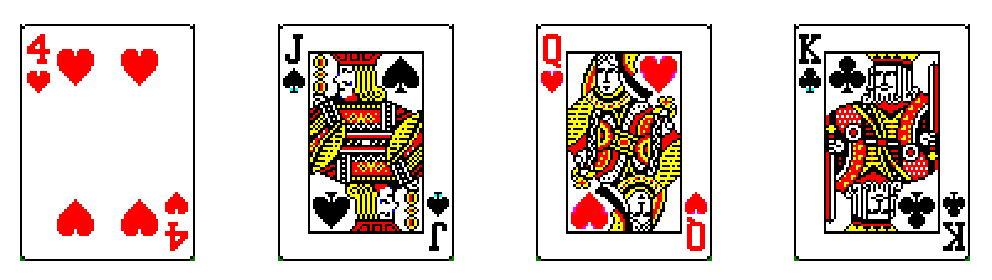
Four poker cards are randomly drawn from a deck. The goal is to combine the values of these cards by using the four arithmetic operators ($+$, $-$, $\times$ and $\div$) to obtain 24. It is assumed that A, J, Q and K have the values of 1, 11, 12 and 13, respectively. For example, if the four cards are shown below, one way to get 24 is $12\div(13-11)\times4=24$.
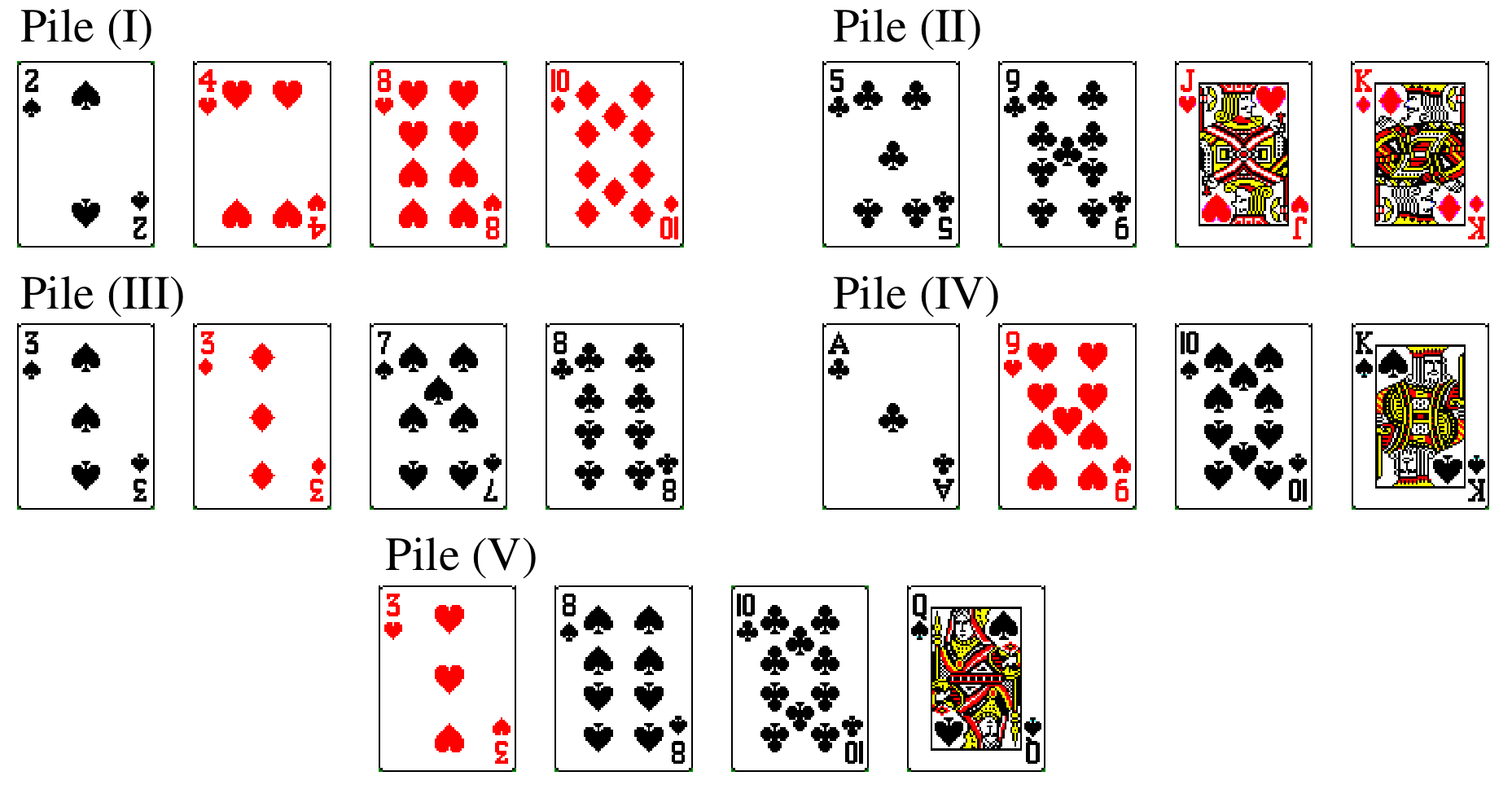
Now, there are five piles of cards, where four cards are in each pile:
For how many of these piles can get 24 by using the conditions stated above?
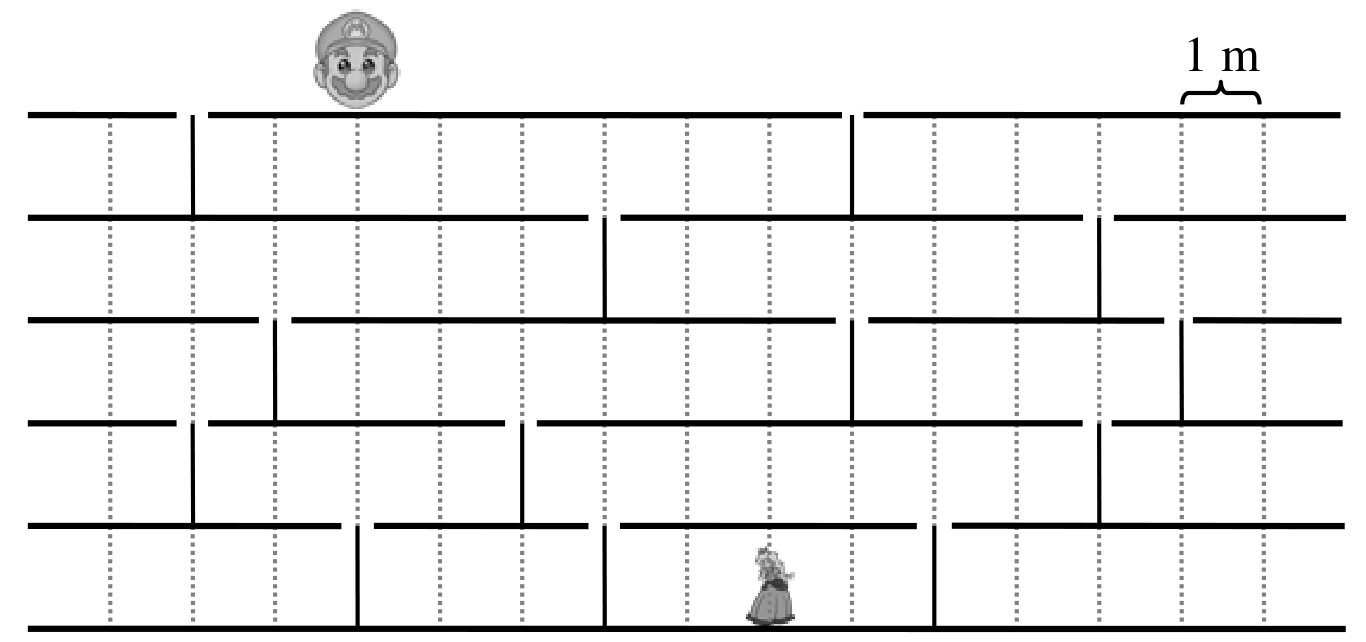
Mario is on the top floor of a castle and wants to get to Princess Peach’s location on the bottom floor. On each floor, there are holes with slider for him to slide down quickly without walking. But he needs to walk to the hole. What is the shortest distance, in m, that Mario has to walk? (The dashed lines are 1 m apart.)
Alice says that Brian is lying. Brian says that Chris is lying. Chris says that Alice and Brian are lying. Suppose a truth teller always tells the truth and a liar always tell lies. Who is telling the truth?
The number of Brian’s candies is 120% that of Alice’s, the number of Brian’s candies is 80% that of Colin’s. Of what percent of the number of Colin’s is that of Alice’s?
The Maths teacher chooses a non-negative integer and tells Alice this number, then tells Bob the sum of the number with 1, and tells Chris the sum of the number with 2. Which of the following numbers cannot be the product of these three numbers?
If 11 apples cost the same as 14 oranges, 22 strawberries cost the same as 21 oranges, 10 strawberries cost the same as 3 papayas and 5 peaches cost the same as 4 papayas, how many apples cost the same as 4 peaches?
In the table below ($a,8,b,34,c,d$ from left to right), every number starting from $b$ equals 6 less than twice the sum of the two previous ones starting from the left. What is the value of $a+b+c+d$?
There are marks on a wooden log that divide it into four sections, and their lengths are shown in the diagram below. What is the total sum of the lengths, in cm, of all line segments with endpoints among the points A, B, C, D and E of this wooden log?
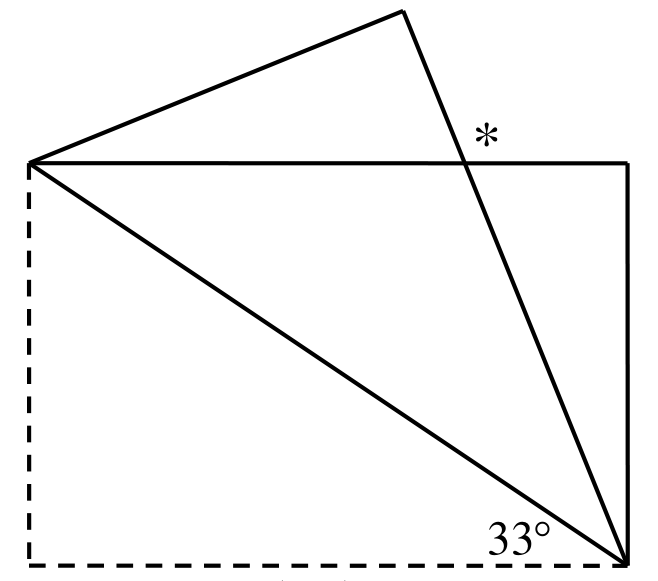
A rectangular piece of paper is folded along one of its diagonals, as shown in the diagram below. What is the measure, in degrees, of the angle marked with “*”?
What is the largest positive integer less than 1000 which leaves a remainder of 5 when divided by 6, a remainder of 6 when divided by 7 and a remainder of 7 when divided by 8?
Two friends, Andrew and Brad, travelled to an isolated village, when they got hungry. All they could buy from a bakery in that village was bread. One loaf of bread costs 1 dollar. Andrew bought 3 loaves of bread and Brad bought 2 loaves of bread. While they were about to eat, another person, Mr. X, came along asking for some food. The two friends decided to share all the bread with Mr. X, so that all three people would eat equally. When all the bread was eaten, Mr. X departed, leaving 5 dollars to share between the two friends. At this time, the two friends got into an argument. Andrew argued that he must receive 3 dollars for buying three loaves of bread, while Brad deserved only 2 dollars for buying only two loaves of bread. So, in his view, the fair split of money would be 3 dollars : 2 dollars. However, Brad claims that all three people shared the bread equally, so the fair split is 2.5 dollars : 2.5 dollars. What is the fair split ratio (Andrew : Brad) of the 5 dollars between the two friends?