Find all positive integer pairs$(m,n)$ such that$m!!=n!$. Here$m!!$ is the product of the positive integers at most$m$ with the same parity as$m$; for example$5!!=15$, $6!!=48$.
A finite collection of radius1 disks is placed in three-dimensional space. Disks may intersect but no disk contains another disk’s center. A lamp at each center emits rays in every direction, and light passes through disks. Can every ray from every lamp meet at least one other disk?
Each cell of an$N\times N$ board contains a number. A cell is good if one side-neighbor contains a number greater by1 and another side-neighbor contains a number greater by3. What is the maximum possible number of good cells?
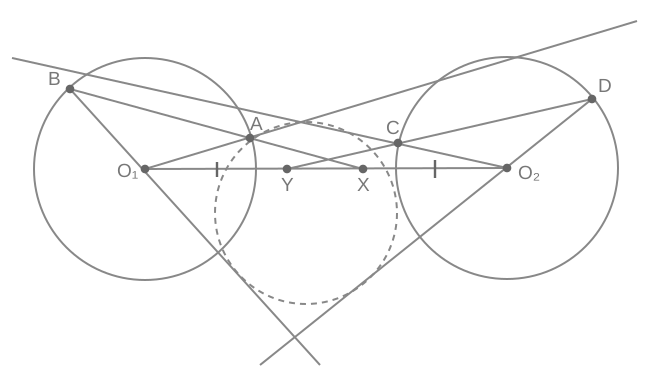
Two equal circles$\omega_1,\omega_2$ have centers$O_1,O_2$. Points$X,Y$ lie on segment$O_1O_2$ with$O_1Y=O_2X$. Points$A,B$ lie on$\omega_1$ and line$AB$ passes through$X$; points$C,D$ lie on$\omega_2$ and line$CD$ passes through$Y$. Prove that a circle tangent to all four lines$AO_1,BO_1,CO_2,DO_2$ exists.
The source’s assertion is preserved. Its unrestricted wording has a counterexample, explained in the editor-authored solution rather than silently adding a hypothesis.
A polynomial of degree$n>0$ has nonzero integer coefficients, and every coefficient is a root of the polynomial. Prove that every coefficient belongs to$\{1,-1,-2\}$.
Harry’s magic flute plays only notes$B,C$. Before he starts, Voldemort forbids one melody of each length5,6,...,30. If any consecutive block of the notes Harry has just played equals a forbidden melody, he loses. Can Harry always play a legal300-note melody, regardless of the forbidden choices?
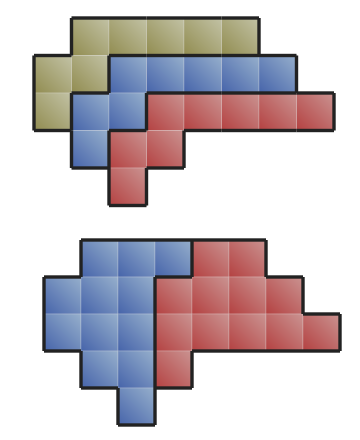
A strip is a grid-cell polygon whose cells can all be visited in a path using only upward or rightward steps between side-adjacent cells. Congruent copies can be fitted together by successive translations by$(-1,1)$. Prove that for every strip with an even number of cells there is an odd$k$ such that the union of$k$ successive translated copies can be cut along grid lines into two congruent parts. Congruence may include reflection or rotation.