Skip to content / Đến nội dung
ThichHocToan.com

VTMO 2026 - Grade 6 - Semifinal - SET 7 - Self-study

Question 1

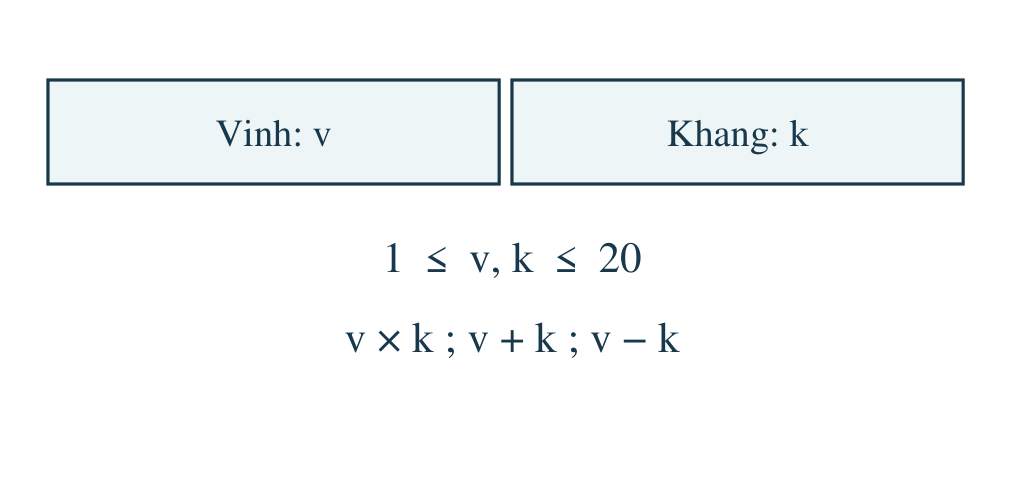
Vinh and Khang have just received their mathematics IQ-test scores, which are natural numbers no greater than 20. They want to find out each other’s scores.

Vinh: “I know that the product of our scores is even.”

Khang: “I know that the product of our scores is divisible by 20.”

Vinh: “Then I am sure that our scores are different and their sum is greater than 20.”

Khang: “I still cannot work out your score, but I am sure that the average of our scores is greater than my score.”

Vinh: “Now I know your score. I can also tell you that the difference between our scores is divisible by 3.”

Khang: “Now I know your score too. You did very well. Congratulations!”

What is Vinh’s score?

Clarification for this version: the scores are positive whole numbers from 1 to 20. Initially each knows only their own score; both reason correctly and speak truthfully, taking account of everything already said.
Question illustration

Question 2

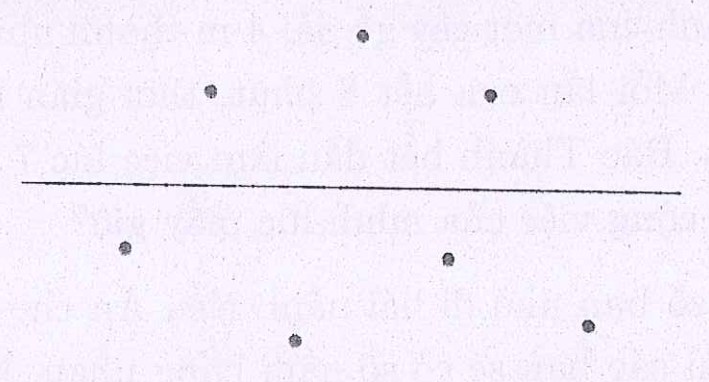
The line $d$ and seven points are shown below. Join every pair of points with a line segment. How many of these segments cross $d$?

Question illustration
  1. 6
  2. 12
  3. 3
  4. 7
  5. 1

Question 3

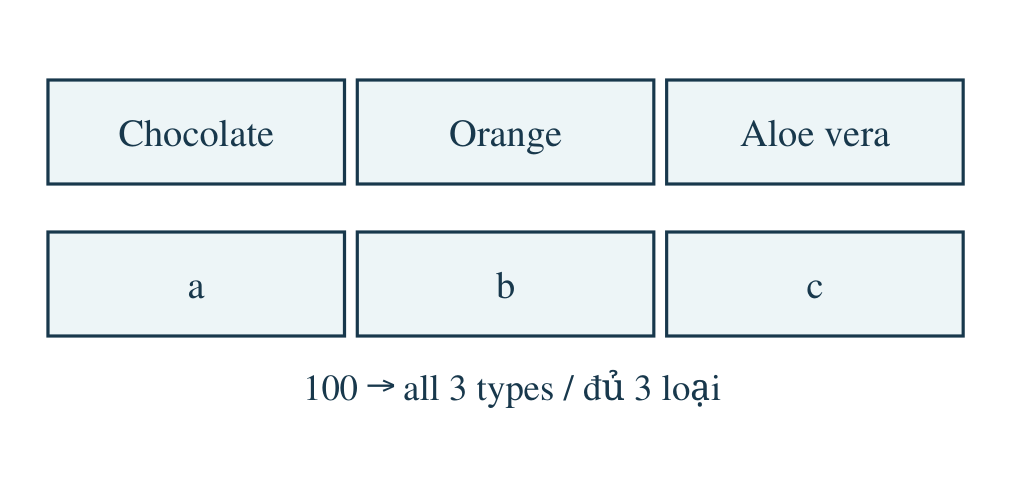
Santa’s basket contains three types of candy: chocolate, orange and aloe vera. Santa knows that any selection of 100 candies from the basket contains all three types. What is the greatest possible number of candies in the basket? Explain your answer.

Question illustration

Question 4

How many positive divisors does 2019 have?

Question illustration
  1. 2
  2. 4
  3. 6
  4. 7
  5. 8

Question 5

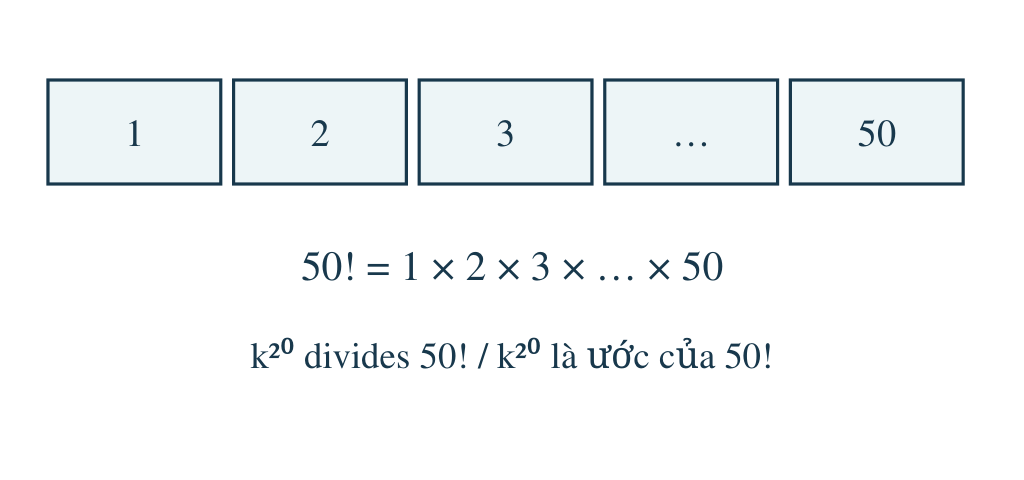
Find the greatest natural number $k$ such that $k^{20}$ divides $50!$. Here $n!=1\times2\times\cdots\times(n-1)\times n$.

Question illustration

Question 6

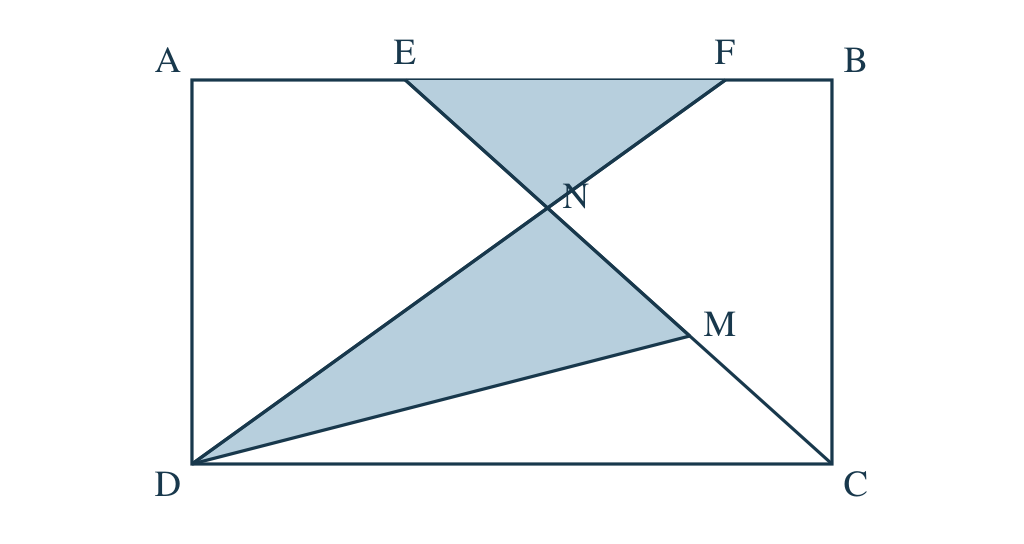
In rectangle $ABCD$, choose $E$ on $AB$. Points $M,N$ lie on $CE$ in the order $C,M,N,E$, with $CM=MN=NE$. The line $DN$ meets the side $AB$ at $F$, as shown. The total shaded area is $12\text{ cm}^2$. Find the area of rectangle $ABCD$ in square centimetres, explaining your reasoning.

Question illustration

Question 7

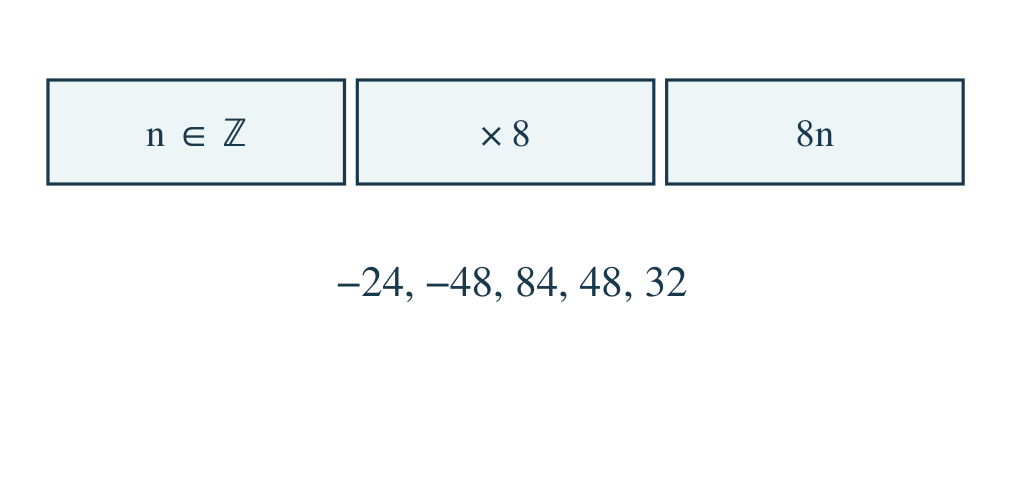
Hoang thinks of an integer and multiplies it by 8. Which of the following cannot be the result?

Question illustration
  1. −24
  2. −48
  3. 84
  4. 48
  5. 32

Question 8

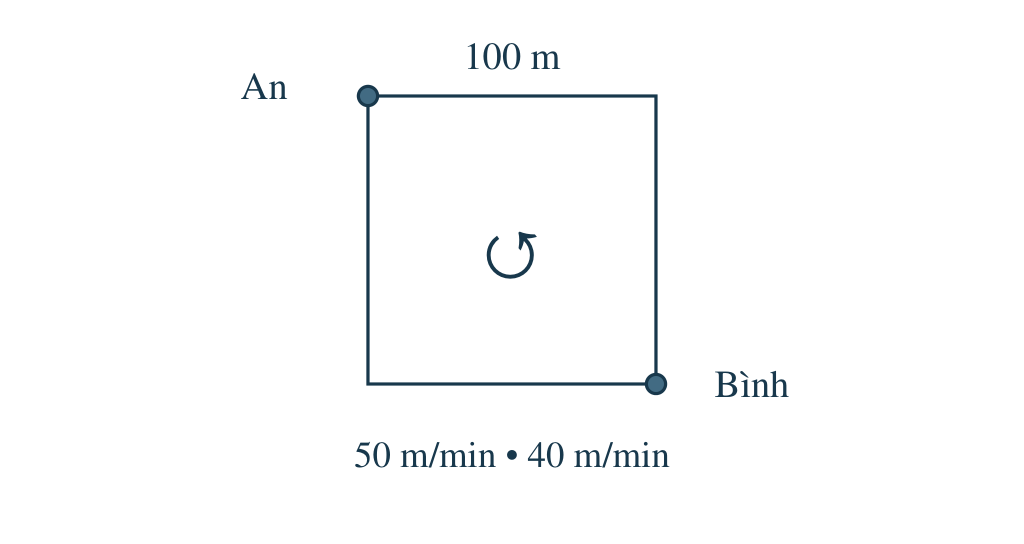
A square has side length 100 m. An and Binh start at the same time from opposite vertices and walk counterclockwise along its sides. An walks 50 m per minute and rests for 1 minute whenever arriving at a vertex. Binh walks 40 m per minute and rests for 2 minutes whenever arriving at a vertex. After how many minutes does An first catch Binh?

Question illustration
  1. 18
  2. 17
  3. 19
  4. 16
  5. 20

Question 9

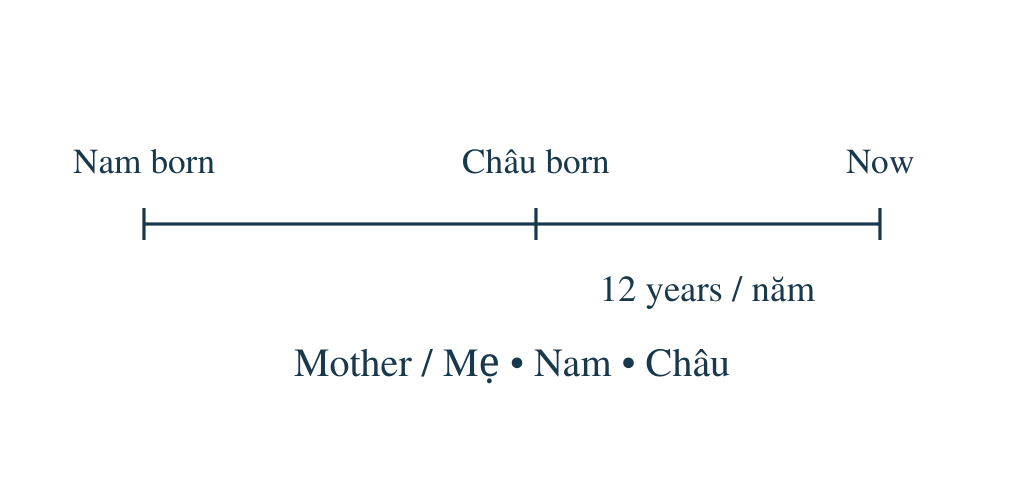
When Nam was born, his mother’s age was half her current age. When his younger sister Chau was born, Nam’s age was half his current age. Chau is now 12 years old. How old was their mother when Chau was born?

Question illustration
  1. 30
  2. 36
  3. 48
  4. 50
  5. 60

Question 10

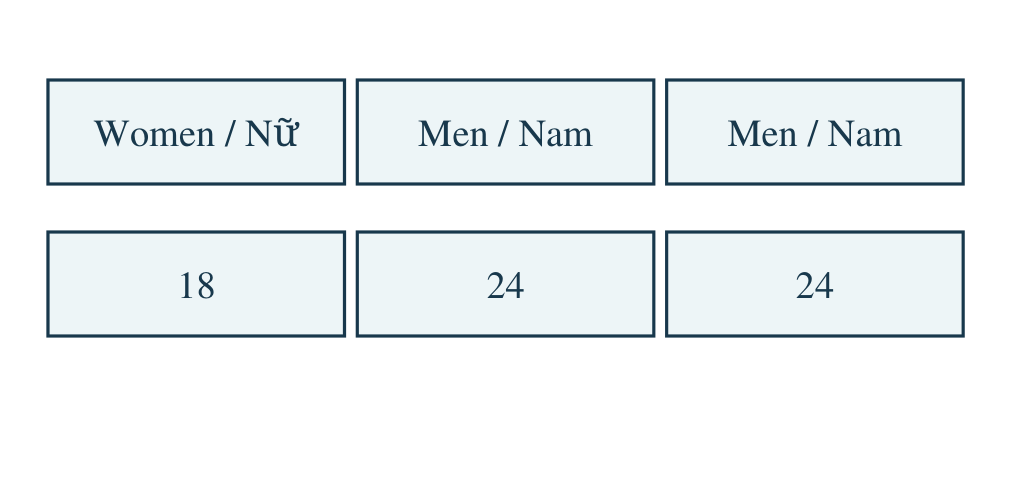
A group contains men and women. The women’s average age is 18 and the men’s average age is 24. There are twice as many men as women. What is the average age of the whole group?

Question illustration
  1. 20
  2. 18
  3. 19
  4. 22
  5. 21

Question 11

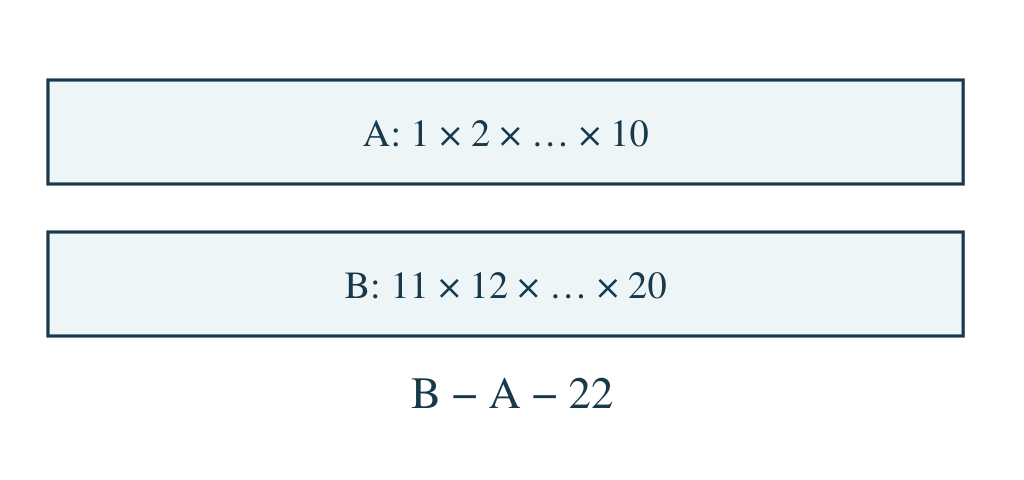
Let $A=1\times2\times3\times\cdots\times10$ and $B=11\times12\times13\times\cdots\times20$. What is the remainder when $B-A-22$ is divided by 21?

Question illustration

Question 12

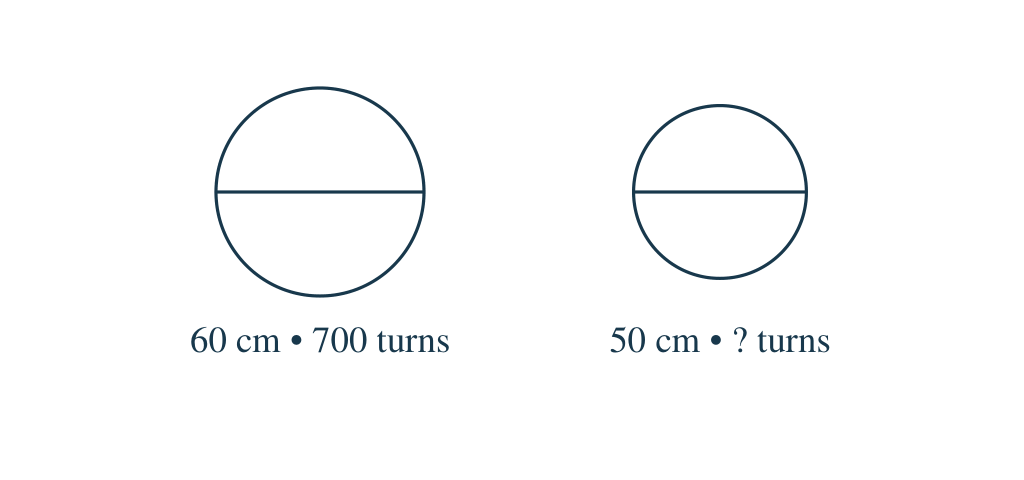
Viet has a special bicycle. Its rear wheel has diameter 60 cm and its front wheel has diameter 50 cm. On a certain journey, the rear wheel makes 700 revolutions. How many revolutions does the front wheel make?

Question illustration
  1. 500
  2. 600
  3. 700
  4. 720
  5. 840

Question 13

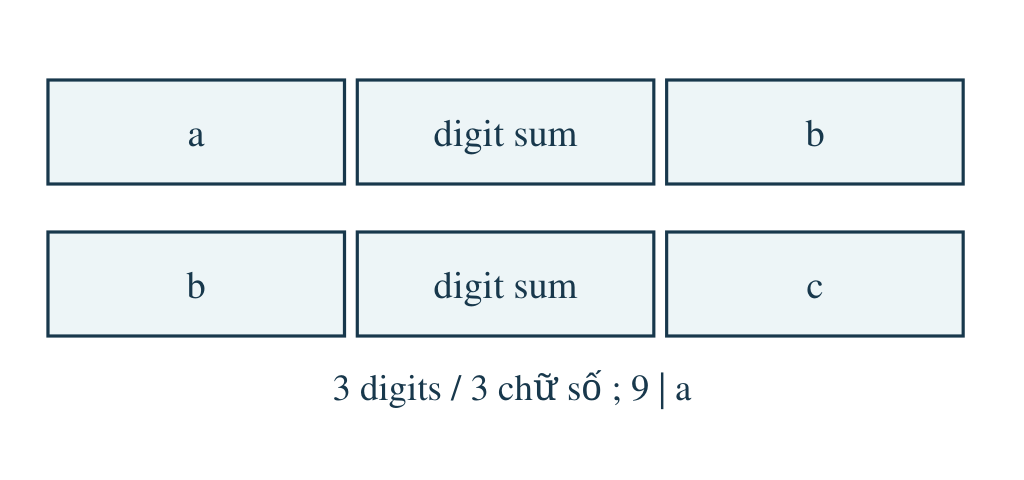
The three-digit number $a$ is divisible by 9. Let $b$ be the sum of the digits of $a$, and let $c$ be the sum of the digits of $b$. What is $c$?

Question illustration
  1. 5
  2. 6
  3. 7
  4. 8
  5. 9

Question 14

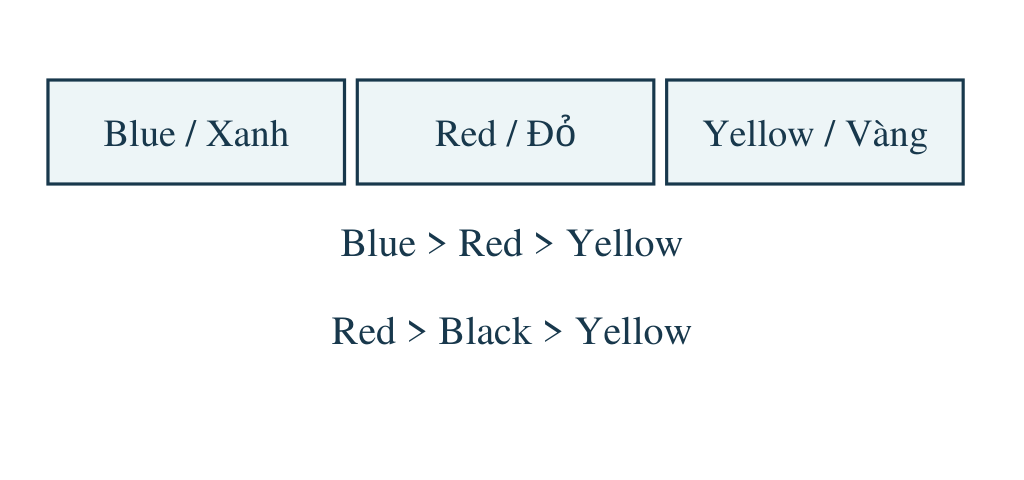
A box contains four balls of different colours: red, yellow, blue and black. The red ball is heavier than the yellow ball but lighter than the blue ball. The black ball is lighter than the red ball but heavier than the yellow ball. Arrange the balls from heaviest to lightest.

Question illustration
  1. Blue, red, yellow, black
  2. Yellow, black, red, blue
  3. Black, yellow, red, blue
  4. Blue, red, black, yellow
  5. Yellow, red, black, blue

Question 15

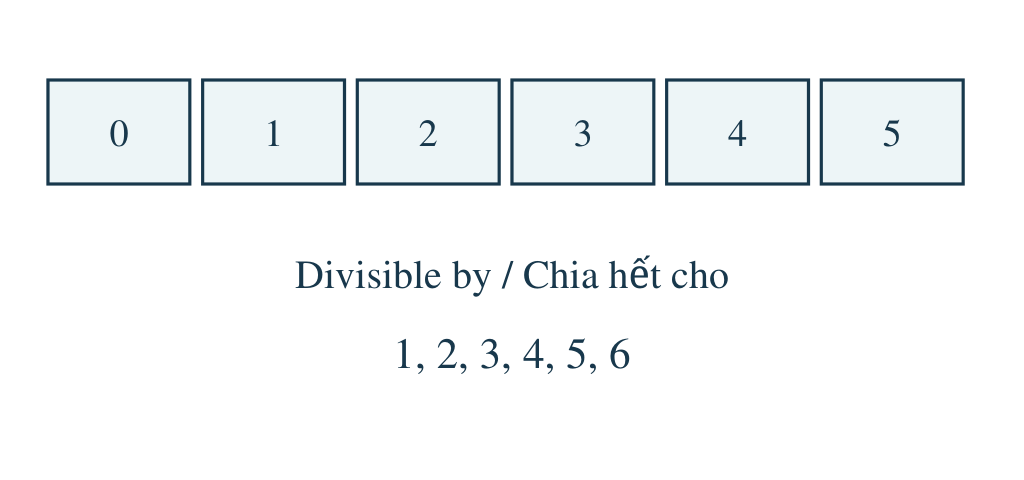
How many six-digit numbers contain all six digits $0,1,2,3,4,5$ and are divisible by each of $1,2,3,4,5,6$?

Question illustration

Question 16

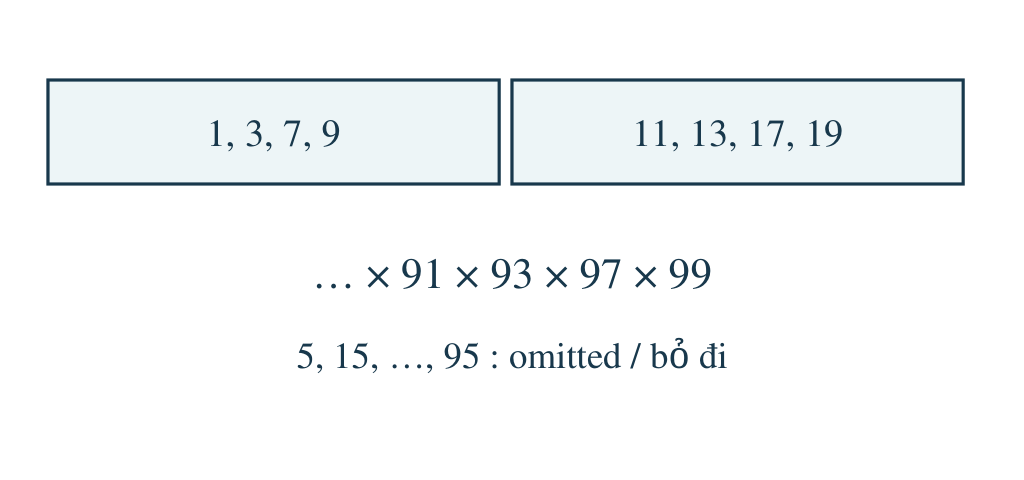
Let $N$ be the product of the odd numbers from 1 to 99, omitting those ending in 5 (that is, 5, 15, and so on):

$N=1\times3\times7\times9\times11\times13\times17\times19\times\cdots\times91\times93\times97\times99$.

What is the units digit of $N$?

Question illustration

Question 17

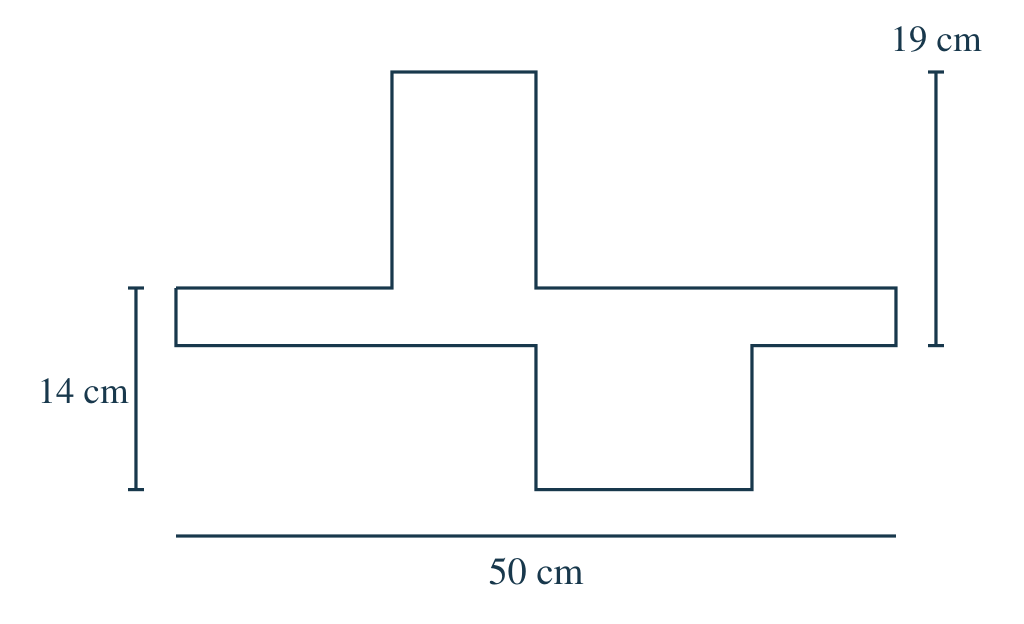
The figure is a net of a rectangular box. The indicated lengths are 14 cm, 19 cm and 50 cm. What is the volume of the box after folding, in cubic centimetres?

Question illustration
  1. 6650
  2. 300
  3. 600
  4. 1800
  5. 1200

Question 18

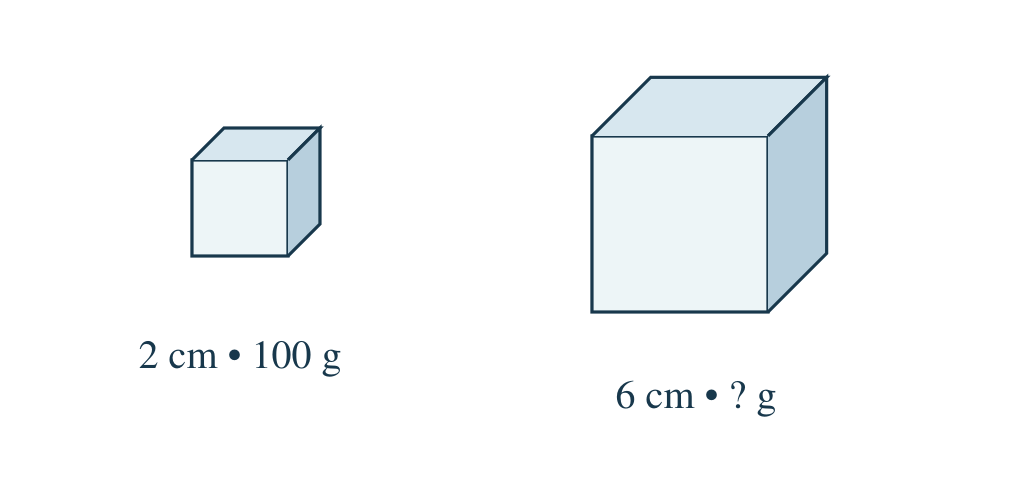
A wooden cube of side 2 cm has mass 100 g. Another cube is made of the same material and has side 6 cm. What is its mass?

Question illustration
  1. 800 g
  2. 1000 g
  3. 2700 g
  4. 300 g
  5. 900 g

Question 19

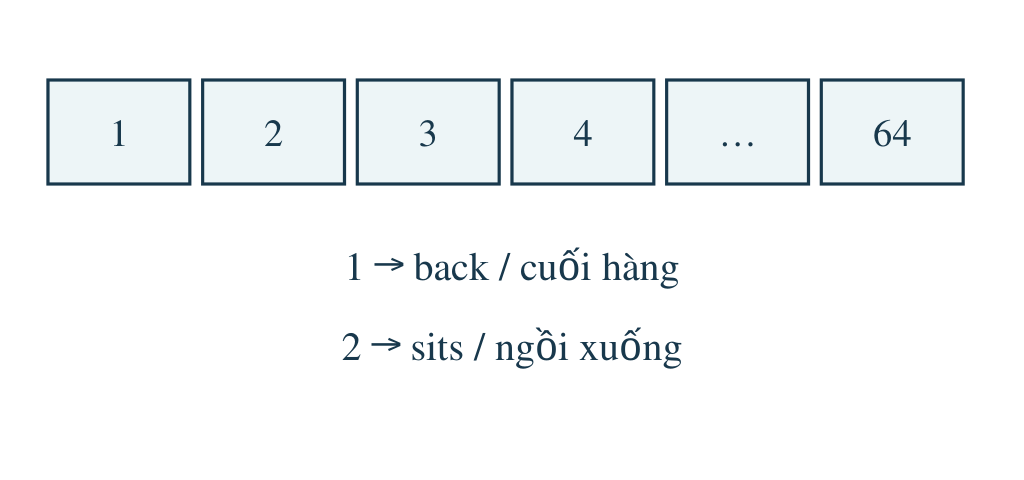
64 people stand in a queue. The first person moves to the back and the second person sits down, so the original third person is now first among those still standing. Repeat: move the first standing person to the back, then have the next person sit down. Continue until one person remains standing. What was that person’s original position?

Question illustration
  1. 1
  2. 32
  3. 35
  4. 64
  5. 63

Question 20

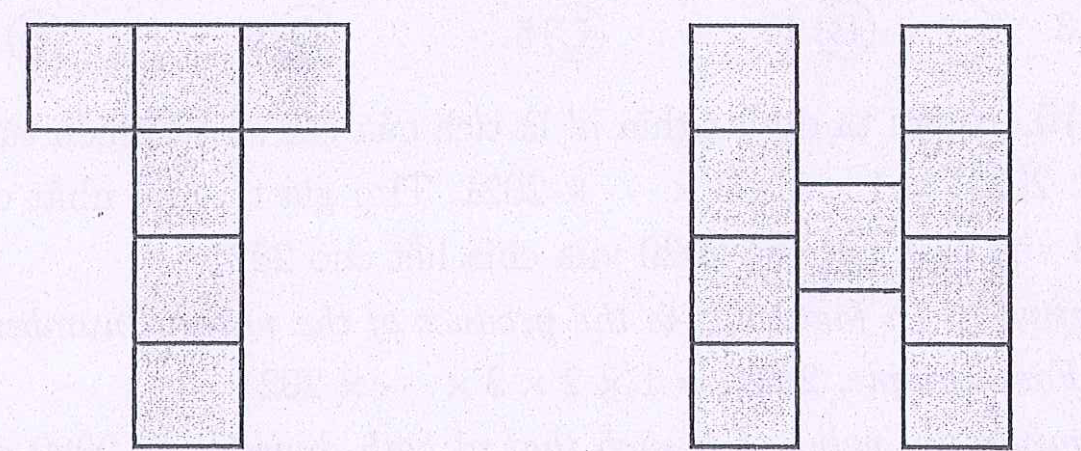
A solid is assembled from identical cubes of side 1 cm. Its front-to-back and right-to-left views are shown below, in that order. What is its greatest possible total surface area, in square centimetres?

Clarification of the pictured model: the cubes have parallel edges and the shown unit-square positions are exact. The middle square of the H-shaped view is halfway between the adjacent horizontal grid levels; half-face contacts are allowed. Count all exposed surface, including the underside.

Question illustration