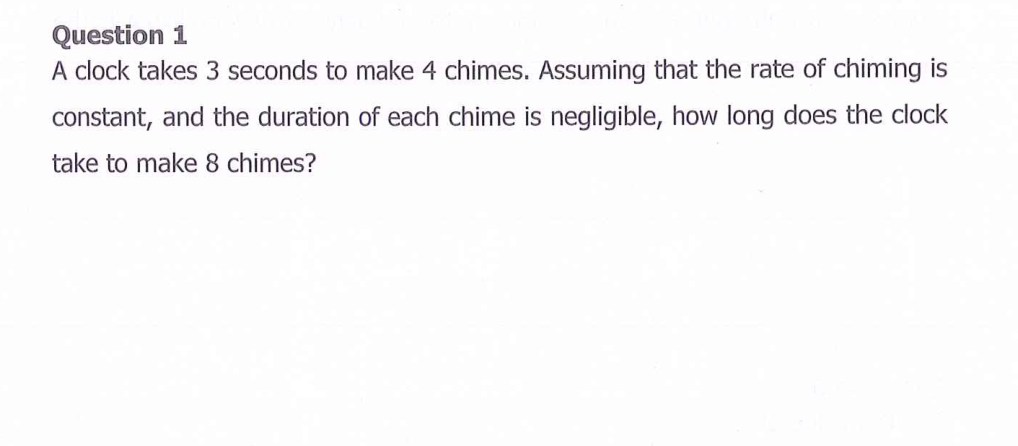
A clock takes 3 seconds to make 4 chimes. Assuming that the rate of chiming is constant and the duration of each chime is negligible, how long does the clock take to make 8 chimes?
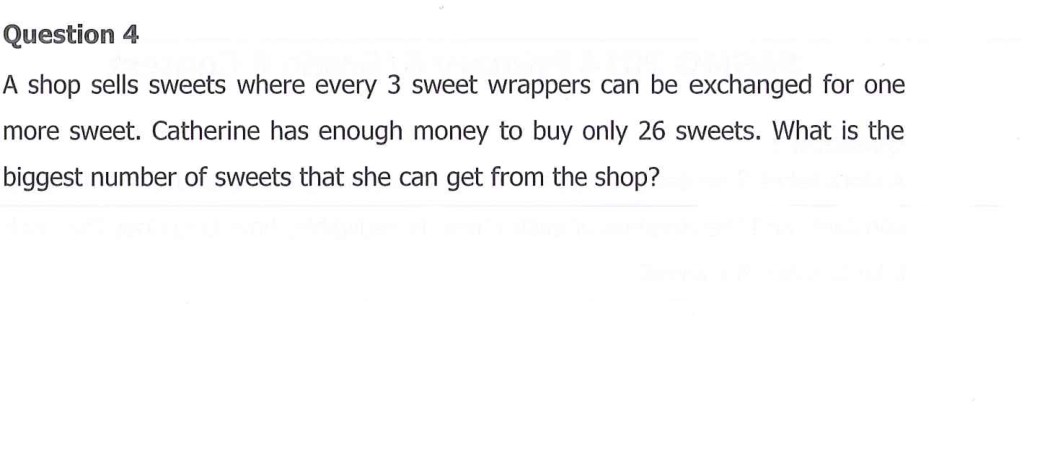
A shop sells sweets where every 3 sweet wrappers can be exchanged for one more sweet. Catherine has enough money to buy only 26 sweets. What is the biggest number of sweets that she can get from the shop?
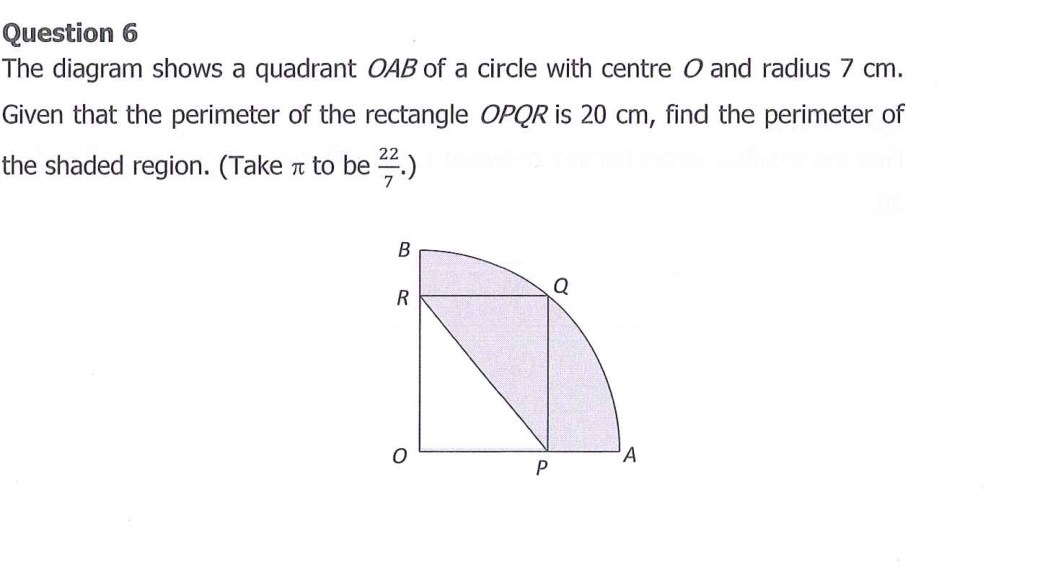
The diagram shows a quadrant $OAB$ of a circle with centre $O$ and radius 7 cm. Given that the perimeter of rectangle $OPQR$ is 20 cm, find the perimeter of the shaded region. (Take $\pi=\frac{22}{7}$.)
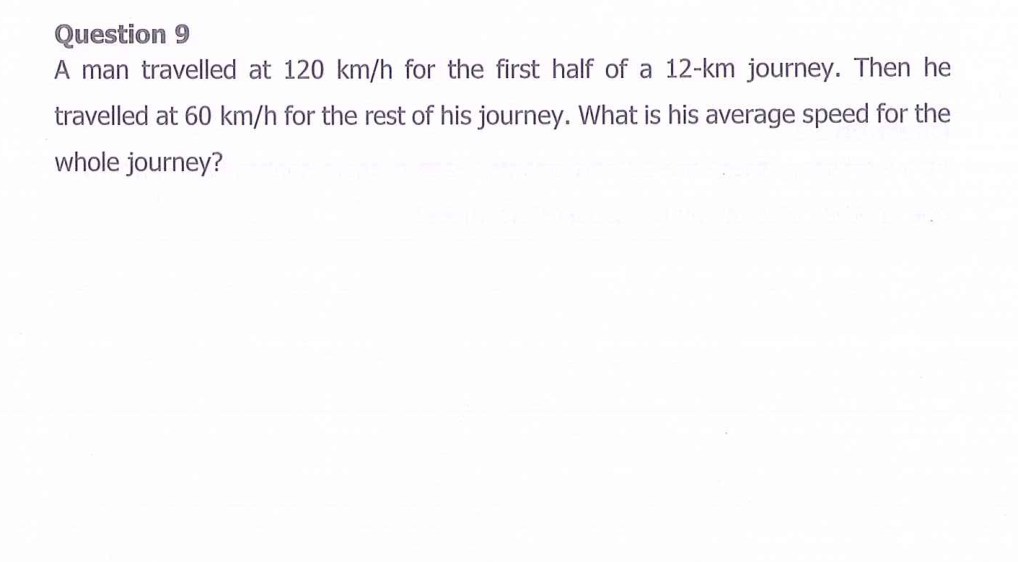
A man travelled at 120 km/h for the first half of a 12-km journey. Then he travelled at 60 km/h for the rest of his journey. What is his average speed for the whole journey?
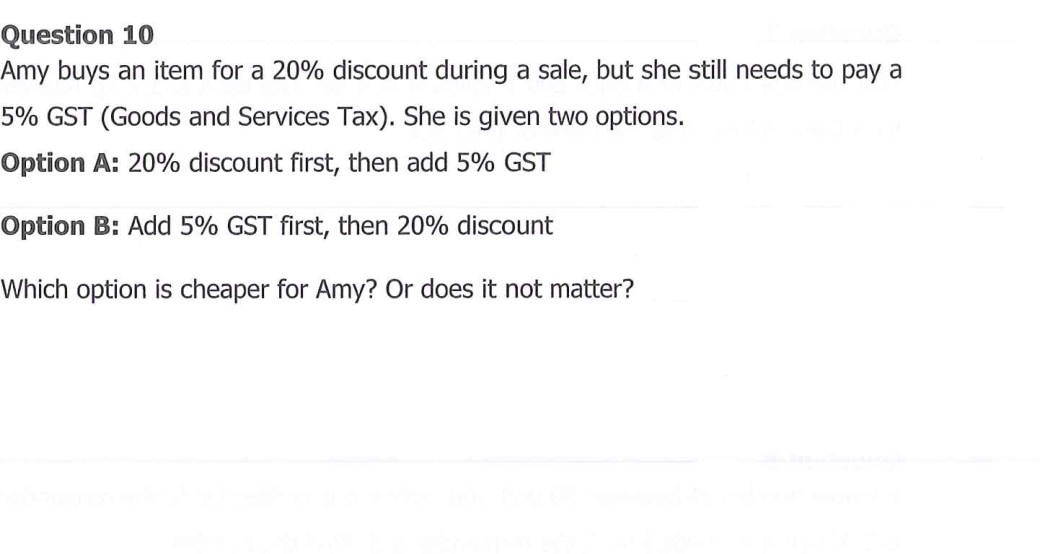
Amy buys an item at a 20% discount during a sale, but she still needs to pay 5% GST (Goods and Services Tax). She is given two options: Option A: 20% discount first, then add 5% GST. Option B: add 5% GST first, then apply the 20% discount. Which option is cheaper for Amy, or does it not matter?
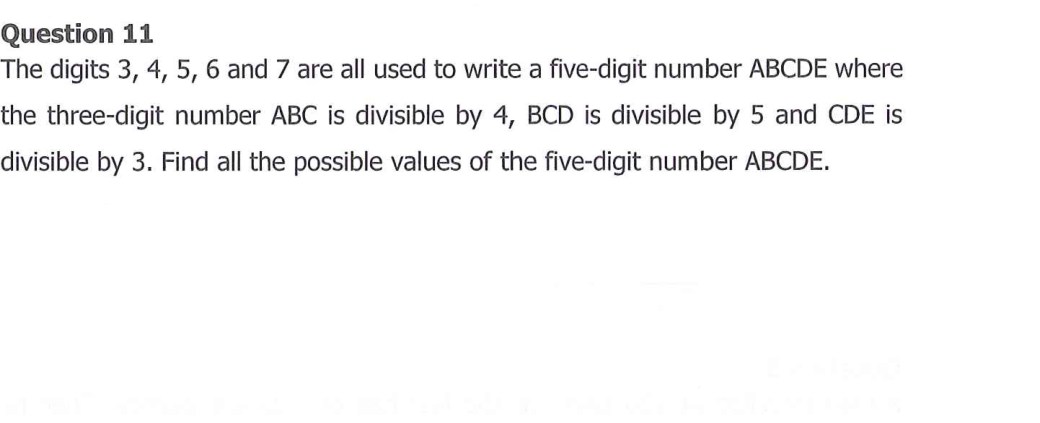
The digits 3, 4, 5, 6 and 7 are all used to write a five-digit number $ABCDE$, where $ABC$ is divisible by 4, $BCD$ is divisible by 5 and $CDE$ is divisible by 3. Find all possible values of $ABCDE$.
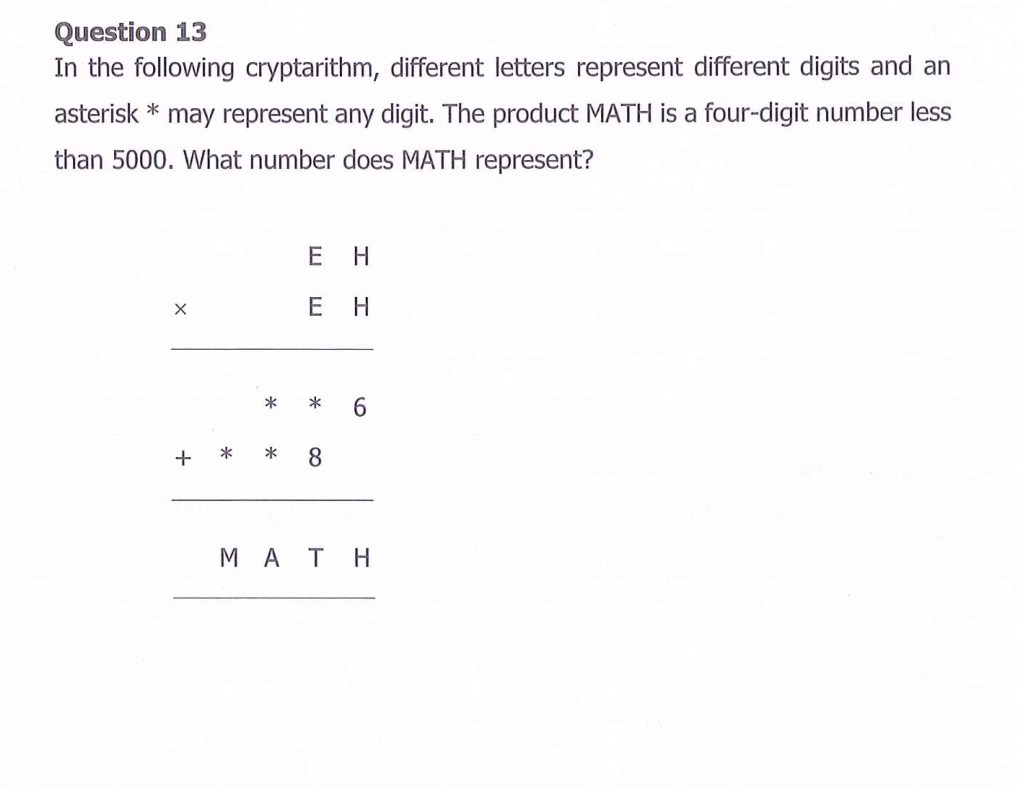
In the cryptarithm shown, different letters represent different digits and an asterisk may represent any digit. The product $MATH$ is a four-digit number less than 5000. What number does $MATH$ represent?
There are 100 buns to be shared among 100 monks, consisting of senior and junior monks. Each senior monk gets 3 buns and every 3 junior monks share 1 bun. How many senior monks are there?
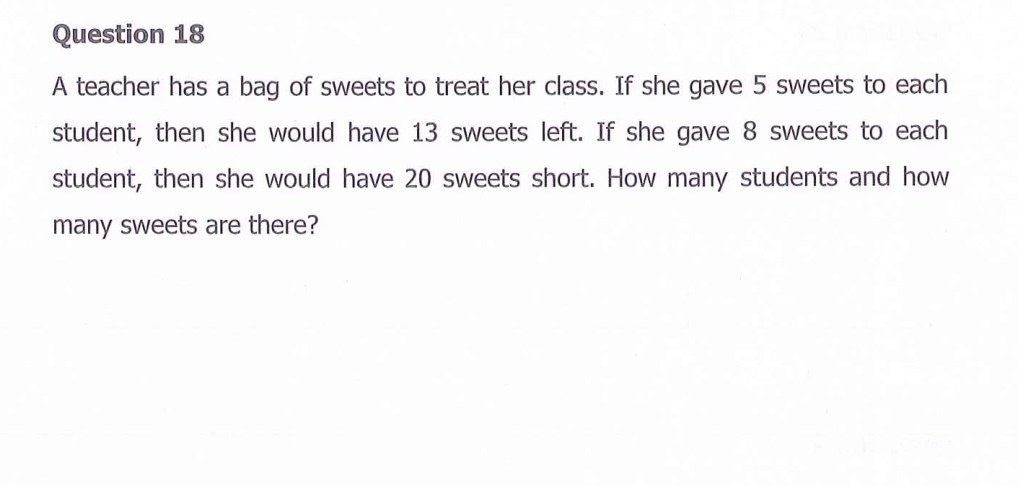
A teacher has a bag of sweets for her class. If she gave 5 sweets to each student, she would have 13 sweets left. If she gave 8 sweets to each student, she would be 20 sweets short. How many students and how many sweets are there?
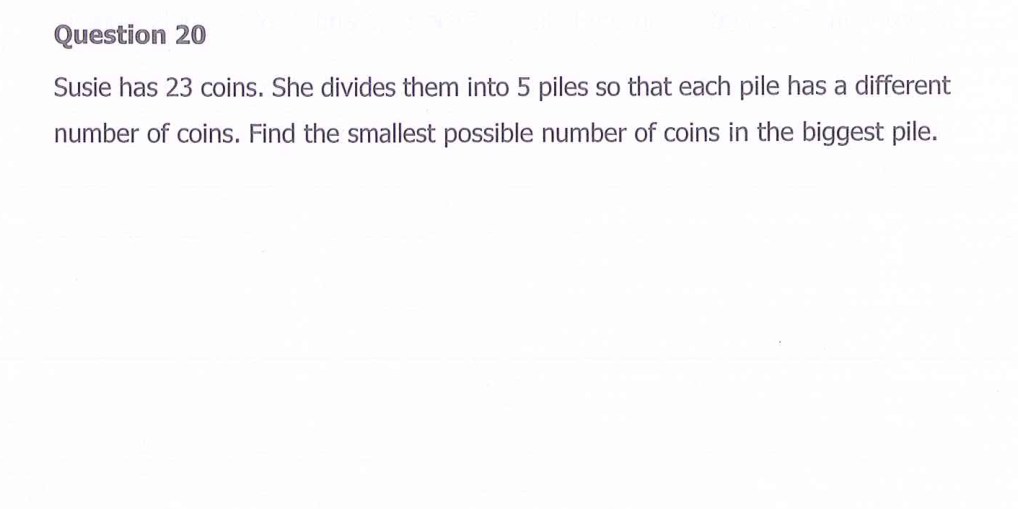
Susie has 23 coins. She divides them into 5 piles so that each pile has a different number of coins. Find the smallest possible number of coins in the biggest pile.