SEAMO self-study edition 2027; not an official 2027 paper. Original source years are retained. 25 questions, 90 minutes; Q1–10: 3 points, Q11–20: 4 points, Q21–25: 6 points, total 100. Original response types and all subparts are preserved. Verified is an editorial convention; source defects, necessary assumptions and unresolved mathematical uncertainty are disclosed.
Suppose $a,b,c,d,e$ are consecutive positive integers with $a\lt b\lt c\lt d\lt e$. The sum $b+c+d$ is a perfect square and $a+b+c+d+e$ is a perfect cube. Find the smallest value of $c$.
Enter the exact number only; fractions are allowed.
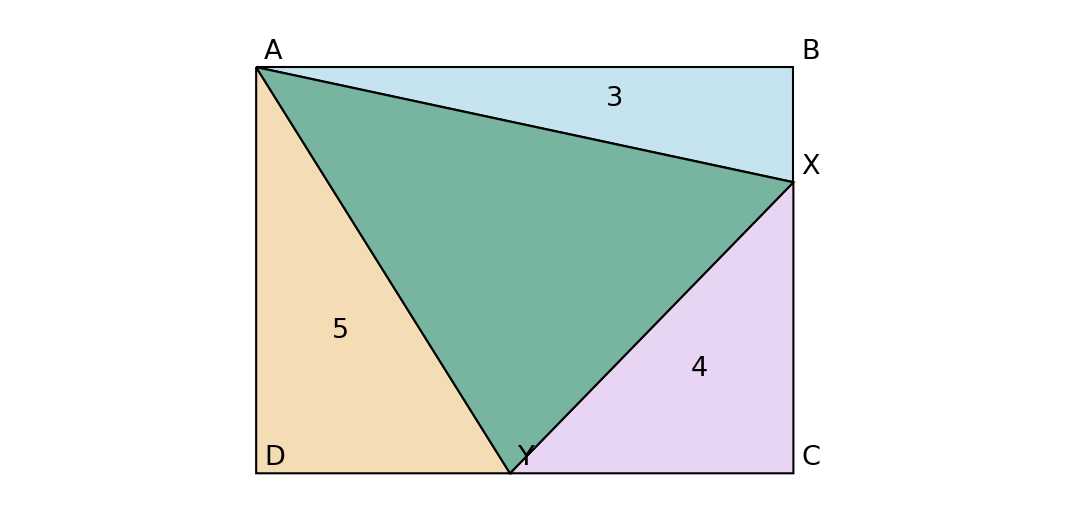
$ABCD$ is a rectangle. Points $X$ and $Y$ lie on $BC$ and $CD$, respectively, and the areas of triangles $ABX,CXY,AYD$ are $3,4,5$, respectively. Find the area of triangle $AXY$.
Goldbach’s conjecture suggests that every even integer greater than $2$ is a sum of two primes. The number $186$ can be so expressed. What is the greatest possible product of the two primes?
Beatrice has some nuggets. Counting them in groups of $5,3,11$ leaves remainders $2,2,3$, respectively. What is the smallest possible number of nuggets?
Enter the exact number only; fractions are allowed.
Neha added the page numbers $1,2,3,\ldots,n$ of a book and obtained $2018$. She then realised that one page number had been added twice. Find that number.
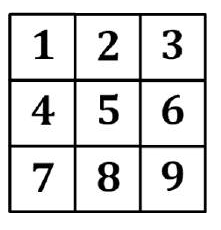
The integers $1$ to $9$ are placed row by row in the $3\times3$ array shown. Its diagonal sum is $15$. If a similar array is constructed with the integers $1$ to $100$, what is its diagonal sum?
Alloys A, B and C contain the following percentages of lead, tin and zinc, respectively: A: $(30,70,0)$; B: $(0,80,20)$; C: $(10,50,40)$. Terry mixes these alloys to obtain alloy T containing $15\%$ lead. If $m,n$ are the maximum and minimum possible tin percentages, find $m-n$.
Allow a zero amount of one starting alloy; percentages refer to mass and mixing preserves mass.
Enter the exact number only; fractions are allowed.
Two fair dice are thrown. Consider these claims about the difference between the numbers: (i) the probability of $2$ is $2/9$; (ii) of $3$ is $1/6$; (iii) of at least $2$ is $1/3$; (iv) of at most $4$ is $7/9$. Which claims are true?
Difference means the nonnegative absolute difference; the two fair dice are independent.
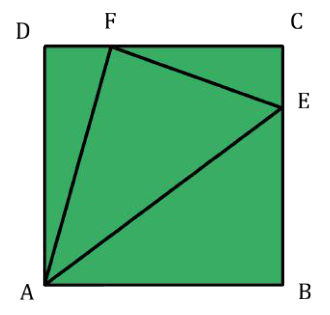
$ABCD$ is a square of side $10\text{ cm}$. Points $E,F$ vary on $BC,CD$, respectively, with $BE=CF$. Find the smallest area of triangle $AEF$, in $\text{cm}^2$.