SEAMO self-study edition 2027; not an official 2027 paper. Original source years are retained. 25 questions, 90 minutes; Q1–10: 3 points, Q11–20: 4 points, Q21–25: 6 points, total 100. Original response types and all subparts are preserved. Verified is an editorial convention; source defects, necessary assumptions and unresolved mathematical uncertainty are disclosed.
The areas of ranches 1, 2 and 3 are $3\frac13$, $10$ and $24$ acres, respectively, where grass grows at constant rates. The first ranch can sustain 12 oxen for 4 weeks; the second can sustain 21 oxen for 9 weeks. For how many weeks will the third ranch sustain 36 oxen?
Practice assumptions: all ranches initially have the same grass quantity per acre and the same constant growth per acre; every ox eats at the same constant rate. These necessary modelling assumptions are not explicit in the source or its general instructions.
Enter the number only (an exact fraction is allowed).
On the $xy$-plane, let $S$ consist of all points $(x,y)$ satisfying $\left|x+\frac12y\right|\le10$, $|x|\le10$ and $|y|\le10$. The largest circle centred at $(0,0)$ that fits inside $S$ has area $k\pi$. Find $k$.
Enter the number only (an exact fraction is allowed).
Let $f(x)=\dfrac{4^x}{4^x+2}$. Find $f\left(\frac1{2025}\right)+f\left(\frac2{2025}\right)+f\left(\frac3{2025}\right)+\cdots+f\left(\frac{2024}{2025}\right)$.
Enter the number only (an exact fraction is allowed).
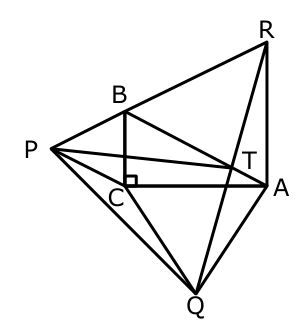
In triangle $ABC$, $\angle A=30^\circ$, $\angle C=90^\circ$ and $AC=1$. Outside $ABC$, draw equilateral triangles $BCP$, $CAQ$ and $ABR$. Let $QR$ meet $AB$ at $T$. Find the area of triangle $PQT$.
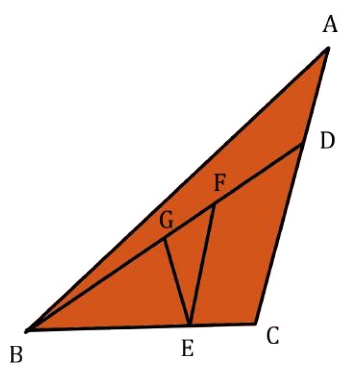
In triangle $ABC$, $AC=3AD$, $BC=3EC$ and $BG:GF:FD=3:1:2$, with the points positioned as shown. Given $[ABC]=2700\text{ cm}^2$, find $[EFG]$ in $\text{cm}^2$.
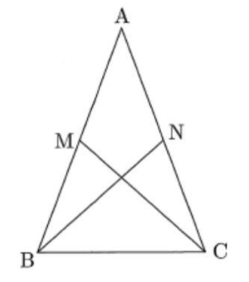
In the diagram, $ABC$ is isosceles with $AB=AC$. Points $M,N$ are the midpoints of $AB,AC$, respectively. Given $CM\perp BN$, $BC=20\text{ cm}$ and $[ABC]=x\text{ cm}^2$, find $x$.
Enter the number only (an exact fraction is allowed).
Two real numbers between 0 and 1 are randomly chosen. What is the probability that the difference between them is greater than $1/4$?
Interpretation for this practice question: the choices are independent and uniform on (0,1), and “difference” means the absolute difference. The source does not spell out these assumptions.
Let $(a_n)$ and $(b_n)$ be arithmetic sequences with $a_1=2019$ and $b_1=1$. Suppose $a_{100}+b_{100}=1010$. Evaluate $a_1+a_2+\cdots+a_{20}+b_1+b_2+\cdots+b_{20}$.
Enter the number only (an exact fraction is allowed).
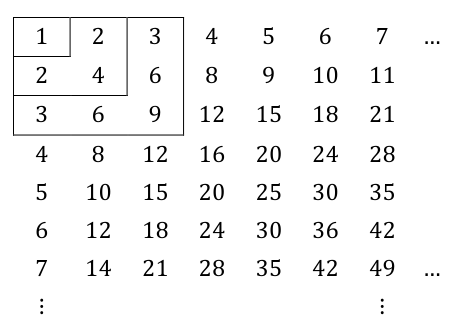
In the array below, define $S_i$ to be the sum of the entries lying in the $i$th row or $i$th column of the upper-left $i\times i$ square, counting their intersection once. For example, $S_1=1$, $S_2=8$ and $S_3=27$. Evaluate $S_{21}$.
Source correction for answering: the original second row prints 9, 10, 11 in columns 5, 6, 7, inconsistent with the multiplication pattern. Use the intended rule that entry (r,c) equals r times c, so those three entries should be 10, 12, 14. The original array is shown unchanged; without a continuation rule, the finite array alone does not determine S21.