SEAMO self-study edition 2027; not an official 2027 paper. Original source years are retained. 25 questions, 90 minutes; Q1–10: 3 points, Q11–20: 4 points, Q21–25: 6 points, total 100. Original response types and all subparts are preserved. Verified is an editorial convention; source defects, necessary assumptions and unresolved mathematical uncertainty are disclosed.
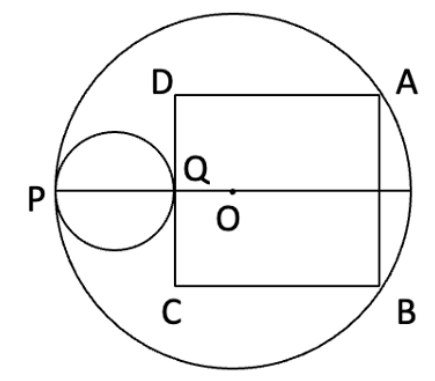
As shown, $PQ=10$ is the diameter of a small circle tangent internally to a circle of radius $20$ and tangent to square $ABCD$. Given $AB=m+\sqrt n$, where $m,n$ are integers, find $m+n$.
Use the configuration shown: A and B lie on the large circle; PQ lies along its diameter through O, and Q is the midpoint of CD.
Consider two machines. The first has three parts and works only if at least two parts do not fail. One part fails with probability $3/5$; each other part fails with probability $p$. The second machine fails with probability $p^2-p+1$. If their probabilities of working are equal, find $p$.
Practice assumption: failures of the three parts of the first machine are mutually independent. The printed problem and surrounding lesson do not explicitly state this necessary assumption.
Find $a+b$ given
$$\left(\frac{1/a}{1/a-1/b}-\frac{1/b}{1/a+1/b}\right)\left(\frac1a-\frac1b\right)\frac1{1/a^2+1/b^2}=\frac23.$$
Original choices: (A) $1$; (B) $2$; (C) $3$; (D) $4$; (E) $5$.
Source-data warning: the printed condition lacks a restriction needed for a uniquely determined requested answer. Keep the original condition and options; explain whether a unique value follows, using valid examples or counterexamples. This item is assessed manually.
Statements $A$ and $B$ are independent. The probability that $A$ is true is $\sqrt3/4$, and the probability that $B$ is true is $1/\sqrt3$. Compute the probability that $A\to B$ is true.
Enter an exact expression, using sqrt(3) for the square root of 3.
A $3\times3$ table is filled randomly with the integers $1$ to $9$, without repetition. What is the probability that the sum in every row and every column is odd?
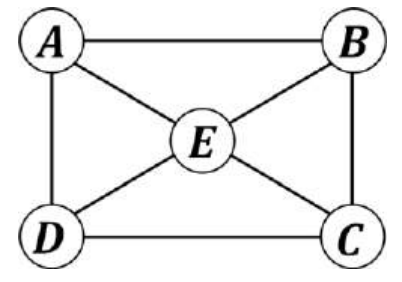
The figure shows five connected circles. Given four distinct colours, how many ways can the circles be coloured so that no two connected circles have the same colour?
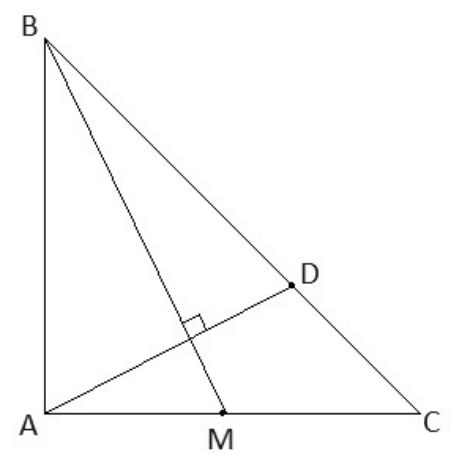
In triangle $ABC$, $\angle A=90^\circ$ and $AB=AC$. Point $M$ is the midpoint of $AC$. The line $AD$ is perpendicular to $BM$ and meets $BC$ at $D$. If $\angle AMB:\angle CMD=m:n$, find $m+n$.
Practice convention: write the ratio m:n in lowest terms with positive integers m,n. The source omits this convention.
Let $[x]$ denote the greatest integer less than or equal to $x$; for example, $[5]=5$ and $[7.2]=7$. Evaluate $S=[\sqrt1]+[\sqrt2]+[\sqrt3]+\cdots+[\sqrt{2019}]$.
Let $\alpha,\beta$ be acute angles satisfying $\sin\alpha=2021\cos(\alpha+\beta)\sin\beta$. Find the maximum value of $\tan\alpha$.
Source-key warning: the printed key conflicts with the equation as printed. Solve the displayed equation, retaining its plus sign and the original options; the discrepancy is explained after answering.
In a badminton tournament, the loser of each match is eliminated and the winner advances; there are no draws. There are $100$ players. Of these, $28$ go directly to Round 2 without playing in Round 1. The remaining $72$ are paired to play in Round 1. Play continues until only one undefeated player remains. How many matches are played in total?