SEAMO self-study edition 2027; not an official 2027 paper. Original source years are retained. 25 questions, 90 minutes; Q1–10: 3 points, Q11–20: 4 points, Q21–25: 6 points, total 100. Original response types and all subparts are preserved. Verified is an editorial convention; source defects, necessary assumptions and unresolved mathematical uncertainty are disclosed.
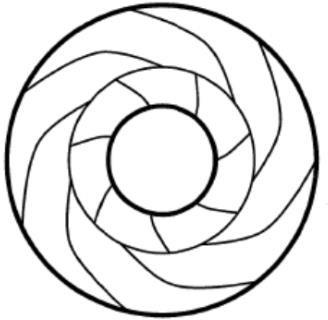
The annulus shown is divided into 14 regions. Each region is painted one colour. What is the minimum number of colours needed so that no two adjacent regions share a colour? Regions are adjacent when they share a boundary segment.
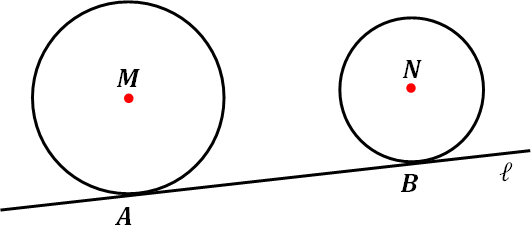
Two circles with centres $M,N$ are tangent to a line $\ell$ at $A,B$, respectively, as shown. Given $AB=25$, $MN=24$, and quadrilateral $ABNM$ has area 300, evaluate the product of the two radii. Original choices: (A) 120; (B) 144; (C) 150; (D) 176; (E) None of the above.
The printed numerical data may be inconsistent. This item is assessed manually: give the product if the configuration exists, or state that no such configuration exists. The original choices and key are retained for source comparison only.
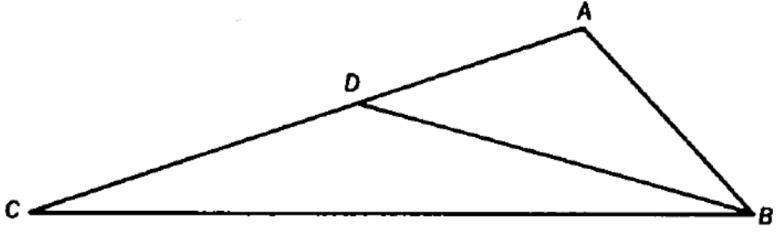
In triangle $ABC$, point $D$ lies on segment $AC$ such that $AB=AD$ and $\angle ABC-\angle ACB=30^\circ$. Find $\angle CAD$.
The target is retained exactly as printed: angle CAD, not another angle in the figure. Answer that literal question; a discrepancy with the source key is discussed in the solution.
Adam has a triangular field $ABC$ with $AB=5$, $BC=8$, $CA=11$. He builds a straight fence from $A$ to a point $D$ on side $BC$ such that $AD$ bisects $\angle BAC$. Find the area of field $ABD$.
For real $x$, let $[x]$ be the largest integer not exceeding $x$, and let $\{x\}=x-[x]$. Let $a,b$ be real numbers with $b$ nonzero and $a=b[a/b]-b\{a/b\}$. Which statement is incorrect?
Notation clarification: the source omits braces in its fractional-part definition. Here {x}=x−[x]. The minus sign in the given equation is retained exactly.
If b is an integer, then a is an integer.
If a is a nonzero integer, then b is an integer.
If b is rational, then a is rational.
If a is nonzero and rational, then b is rational.
If b is an even integer, then a is an even integer.