Skip to content / Đến nội dung
ThichHocToan.com

SEAMO 2027 - Paper D - SET 07 - Self-study

Question 1

SEAMO self-study edition 2027; not an official 2027 paper. Original source years are retained. 25 questions, 90 minutes; Q1–10: 3 points, Q11–20: 4 points, Q21–25: 6 points, total 100. Original response types and all subparts are preserved. Verified is an editorial convention; source defects, necessary assumptions and unresolved mathematical uncertainty are disclosed.

Let $S$ be the smallest positive multiple of 15 that comprises exactly $3k$ digits, with $k$ zeros, $k$ threes and $k$ eights. Find the remainder when $S$ is divided by 11.
  1. 0
  2. 3
  3. 5
  4. 6
  5. 8

Question 2

If $x,y,z\in\mathbb R$ satisfy $x+\frac1y=4$, $y+\frac1z=1$, and $z+\frac1x=\frac73$, find $xyz$.

Question 3

Find $x$ given that $\frac92=2+\cfrac1{0+\cfrac1{2+\frac1x}}$.
  1. 3
  2. 2
  3. 1
  4. 0
  5. None of the above

Question 4

Simplify $\frac{2^{n+4}-2(2^n)}{2(2^{n+2})}$.
  1. $2^{n+1}-\frac18$
  2. $-2^{n+1}$
  3. $\frac78$
  4. $\frac74$
  5. None of the above

Question 5

Determine the number of positive integers less than 1000 which are divisible by neither 7 nor 5.

Question 6

Find the smallest positive integer $k$ such that $2^{91}+k$ is divisible by 127.
  1. 122
  2. 123
  3. 124
  4. 125
  5. 126

Question 7

What is the smallest positive multiple of 15 whose digits consist only of ones and zeros?

Question 8

It is known that $Q_{n+1}=\frac1{1+\frac1{Q_n}}$ for $n=1,2,3,4,\ldots,2017,2018$, with $Q_1=1$. Evaluate $Q_1Q_2+Q_2Q_3+\cdots+Q_{2017}Q_{2018}$.

Question 9

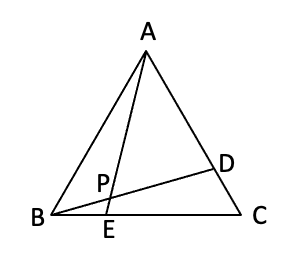
In equilateral triangle $ABC$, $D$ and $E$ lie on $AC$ and $BC$ respectively, with $BE=CD$. As shown, $P$ is the intersection of $AE$ and $BD$. Find $\angle APD$.

Question illustration
  1. $55^\circ$
  2. $60^\circ$
  3. $65^\circ$
  4. $70^\circ$
  5. $75^\circ$

Question 10

Find the remainder when $\left(\underbrace{99\cdots9}_{2021}\right)^{20}-\left(\underbrace{33\cdots3}_{2021}\right)^{20}$ is divided by 11. Each underbrace indicates 2021 digits.
  1. 0
  2. 1
  3. 2
  4. 3
  5. None of the above

Question 11

$a,b,c,d$ are positive integers. Find $abcd$ given $2a+\cfrac1{b+\cfrac1{2c+\frac1d}}=\frac{89}{20}$.
  1. 10
  2. 12
  3. 14
  4. 15
  5. 16

Question 12

Given $\frac{c}{a+b}\lt \frac{a}{b+c}\lt \frac{b}{c+a}$, which of the following is true? Original choices: (A) $c\lt a\lt b$; (B) $b\lt c\lt a$; (C) $a\lt b\lt c$; (D) $c\lt b\lt a$; (E) None of the above.

Source-domain caution: the printed question does not specify the signs of a, b and c. Retain its original choices, state any domain you use, and explain whether a choice follows from the printed conditions. This item requires manual assessment.

Question 13

Solve $2[x]=x+2\{x\}$, where $[x]=\lfloor x\rfloor$ is the greatest integer not exceeding $x$ and $\{x\}=x-\lfloor x\rfloor$ is the fractional part.

Question 14

Simplify $(2\sqrt3-\sqrt{10})(3\sqrt6+2\sqrt5)$.
  1. $4\sqrt2-2\sqrt{15}$
  2. $8\sqrt2-2\sqrt{15}$
  3. $3\sqrt2-3\sqrt5$
  4. $2\sqrt2-3\sqrt5$
  5. $4\sqrt2-3\sqrt5$

Question 15

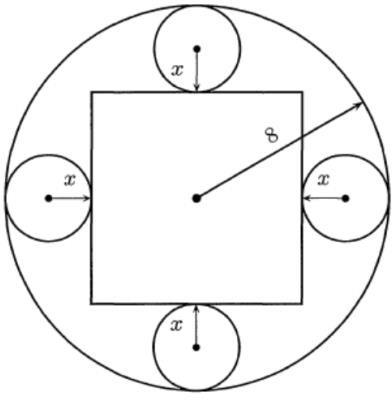
Four circles each of radius $x$ and a square are arranged within a circle of radius 8 as shown. What is the range of $x$? Original choices: (A) $0\lt x\lt 4$; (B) $0\lt x\lt 8(\sqrt2+1)$; (C) $4-2\sqrt2\lt x\lt 4$; (D) $4-2\sqrt2\lt x\lt 8(\sqrt2+1)$; (E) $4-2\sqrt2\lt x\lt 4(\sqrt2+1)$.

Source-geometry caution: the printed options/key and the geometric arrangement require checking, and the source does not state all contact/overlap conventions. For this self-study item, keep the original choices, state your interpretation and justify the resulting bounds; assessment is manual.
Question illustration

Question 16

Find a positive integer $x$ such that $2^6+2^{10}+2^x$ is a perfect square.
  1. 7
  2. 8
  3. 9
  4. 10
  5. None of the above

Question 17

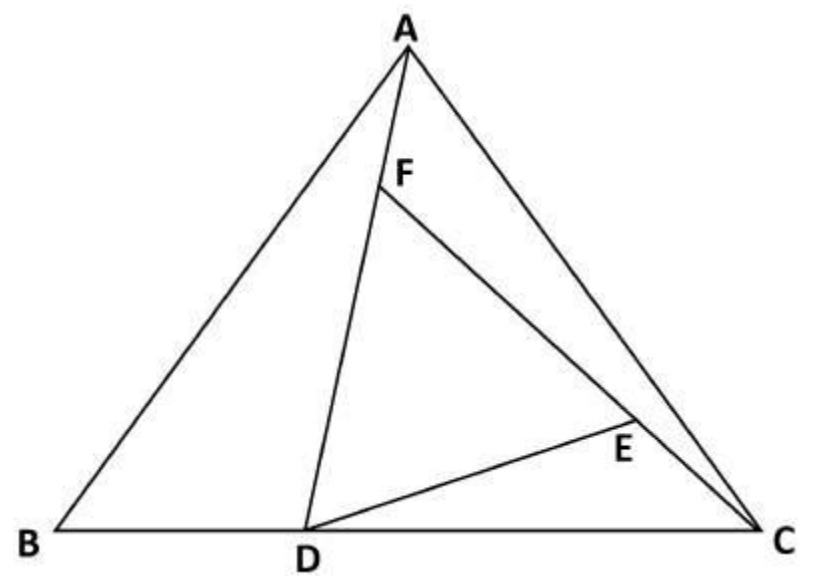
Triangle $ABC$ has area 1. In the arrangement shown, $\frac{BD}{CD}=\frac{CE}{EF}=\frac{AF}{FD}=\frac12$. Find the area of triangle $DEF$.

Question illustration
  1. $\frac7{75}$
  2. $\frac8{75}$
  3. $\frac8{27}$
  4. $\frac13$
  5. $\frac9{21}$

Question 18

Find $\frac{2022}{1\times2}+\frac{2022}{2\times3}+\frac{2022}{3\times4}+\cdots+\frac{2022}{2021\times2022}$.
  1. 2020
  2. 2021
  3. 2022
  4. 2023
  5. 2024

Question 19

For a positive integer $n$, what is the remainder when $n^5-n$ is divided by 5?
  1. 0
  2. 1
  3. 2
  4. 3
  5. 4

Question 20

Find the number of real solutions $(x,y,z)$ of $x+y=\sqrt{4z-1}$, $y+z=\sqrt{4x-1}$, $z+x=\sqrt{4y-1}$.
  1. 1
  2. 2
  3. 3
  4. 4
  5. None of the above