Skip to content / Đến nội dung
ThichHocToan.com

SEAMO 2027 - Paper D - SET 05 - Self-study

Question 1

SEAMO self-study edition 2027; not an official 2027 paper. Original source years are retained. 25 questions, 90 minutes; Q1–10: 3 points, Q11–20: 4 points, Q21–25: 6 points, total 100. Original response types and all subparts are preserved. Verified is an editorial convention; source defects, necessary assumptions and unresolved mathematical uncertainty are disclosed.

Find the last two digits of $9^{2022}$.
  1. 21
  2. 81
  3. 09
  4. 61
  5. 01

Question 2

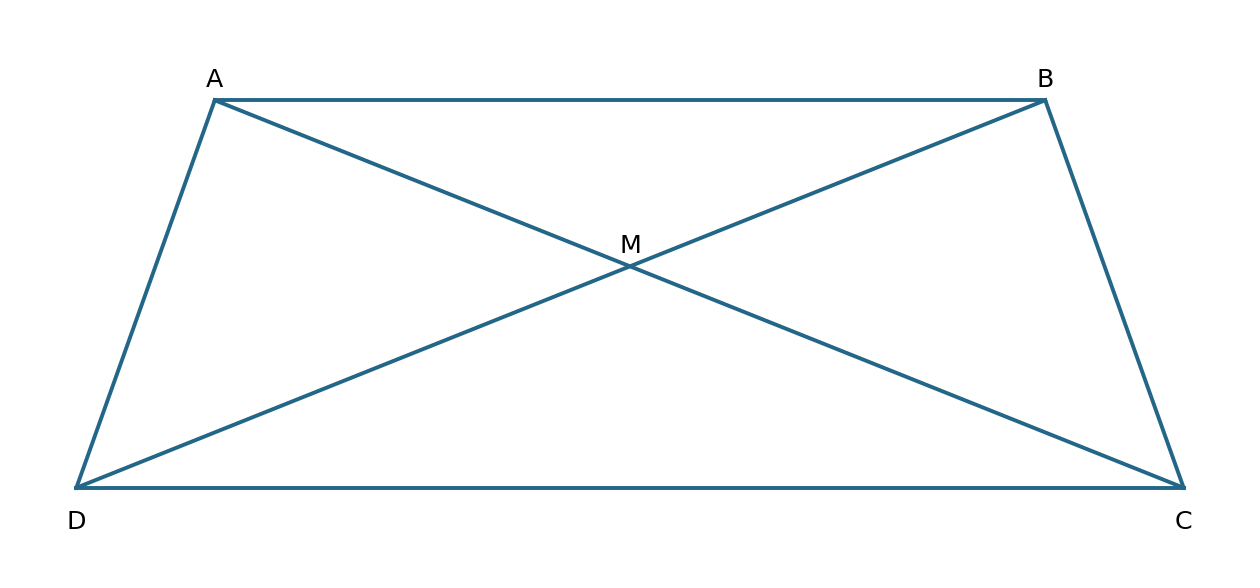
Trapezium $ABCD$ has parallel bases $AB=30$ cm and $CD=40$ cm, with $AD=BC$. Diagonals $AC$ and $BD$ intersect at $M$. If its area is $490$ cm$^2$, find the area of triangle $BCM$ in cm$^2$.

Question illustration

Question 3

Evaluate
$$\frac1{2+\sqrt2}+\frac1{3\sqrt2+2\sqrt3}+\frac1{4\sqrt3+3\sqrt4}+\cdots+\frac1{100\sqrt{99}+99\sqrt{100}}.$$
  1. $5/9$
  2. $44/55$
  3. $4/5$
  4. $99/100$
  5. $9/10$

Question 4

Let $n=2021^2+2022^2$. Find $\sqrt{2n-1}$.

Question 5

Find the four-digit number $\overline{abcd}$ satisfying
$$2\overline{abcd}+1000=\overline{dcba}.$$
  1. 2669
  2. 2699
  3. 2996
  4. 2999
  5. None of the above

Question 6

It is now 3:15 PM. After how many minutes will the minute hand form an angle of $30^\circ$ with the hour hand?

Practice interpretation: find the first time after 3:15 PM when the smaller angle is 30 degrees. The source does not explicitly say “first”.
  1. $5\frac9{11}$
  2. $5\frac3{11}$
  3. $6\frac9{11}$
  4. $6\frac9{12}$
  5. None of the above

Question 7

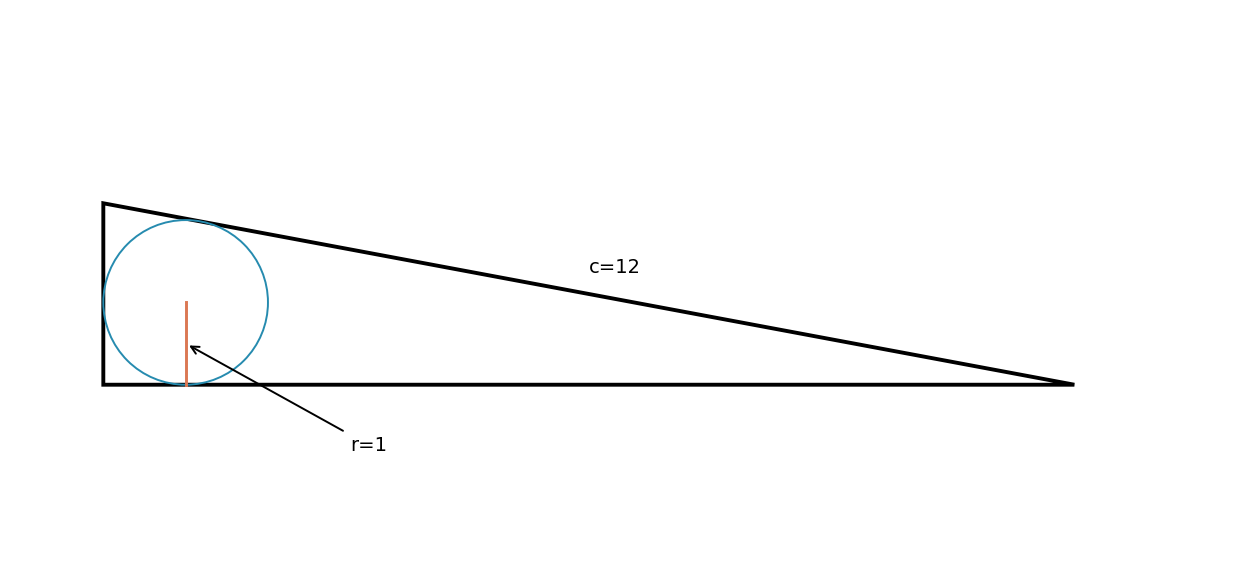
The hypotenuse of a right-angled triangle is 12 and its incircle has radius 1. Find the perimeter of the triangle.

Question illustration

Question 8

Evaluate $\displaystyle\frac{16}{345678^2-345674\times345682}$.
  1. 1
  2. 2
  3. 3
  4. 16
  5. 345678

Question 9

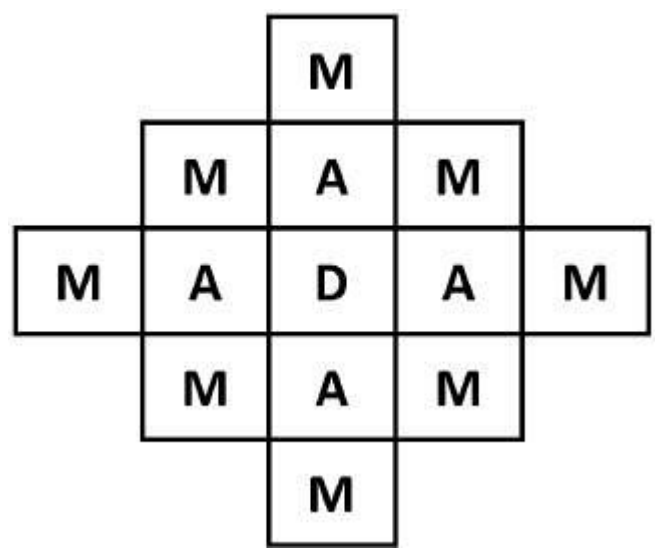
Starting from any letter M in the figure, spell MADAM by moving up, down, left or right to an adjacent letter. How many ways are there?

Practice convention: a route may revisit a cell; different sequences of visited cells count as different routes.

Question illustration
  1. 90
  2. 120
  3. 144
  4. 169
  5. None of the above

Question 10

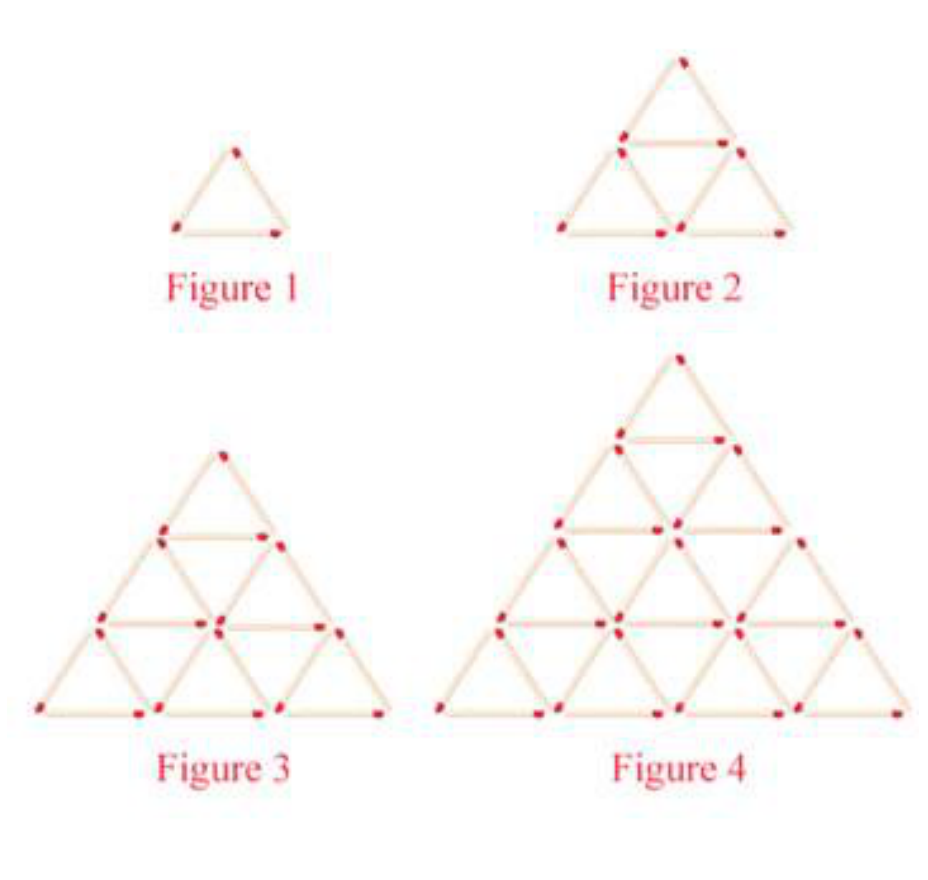
Matchsticks form the triangular patterns shown. Figures 1, 2, 3 and 4 contain respectively 1, 4, 9 and 16 small equilateral triangles. In which figure will there be 16900 small equilateral triangles?

Question illustration

Question 11

A positive integer $m$ has the property that $874m$ is a five-digit number ending in 92. Which of these are possible values of $m$?

(i) 48; (ii) 58; (iii) 68; (iv) 108.
  1. i only
  2. ii only
  3. i and iii
  4. ii and iv
  5. i, ii and iii

Question 12

Given $a=\sqrt6-2$ and $b=2\sqrt2-\sqrt6$, choose the correct statement.
  1. $a>b$
  2. $a=b$
  3. $a<b$
  4. $b=\sqrt{2a}$
  5. $a=\sqrt{2b}$

Question 13

Find the smallest positive integer $k$ such that $2^{69}+k$ is divisible by 127.
  1. 60
  2. 61
  3. 62
  4. 63
  5. None of the above

Question 14

Two thirds of the journey from Lethbridge to Medicine Hat is highway; the remaining one third is country road. St. Paul joins the two sections. A van travels from Lethbridge towards Medicine Hat at 100 km/h on highway and 60 km/h on country road. A car travels in the opposite direction at 70 km/h on country road and 110 km/h on highway. They pass each other 44 km from St. Paul. Find the total distance, in km.

Practice assumption: both vehicles depart at the same time and maintain the stated speeds. Simultaneous departure is not expressly stated in the source.
  1. 248
  2. 339
  3. 441
  4. 453
  5. None of the above

Question 15

Find the last two digits of $1+2+3+\cdots+2017+2018$.
  1. 75
  2. 71
  3. 56
  4. 63
  5. None of the above

Question 16

Miss Mooney has three children. You see her with a little girl, whom she introduces as her middle child. Compute the probability that her other two children are girls, assuming that each child has probability $1/2$ of being a girl.

Practice probability model: the sexes of the three children are independent, each equally likely to be girl or boy; identifying the middle child introduces no further selection bias.
  1. $1/4$
  2. $1/2$
  3. $2/3$
  4. $3/4$
  5. None of the above

Question 17

A fair die has faces numbered 1 to 6. It is thrown twice and the scores are added. Which event has the greatest probability? A perfect number is a positive integer equal to the sum of its positive proper divisors.
  1. The total is odd
  2. The total is a multiple of 3
  3. The total is a perfect number
  4. The total is a prime number
  5. The total is divisible by 4

Question 18

Original material: for digits $a_1,\ldots,a_n\in\{1,2,\ldots,9\}$, the source uses $\overline{a_1a_2\cdots a_n}$ for the decimal numeral and prints
$$10^{n-1}a_1+10^{n-2}a_2+\cdots+10a_{n+1}+a_n.$$
It gives the example $a=2,b=0$, for which $\overline{ab}=20$. Given $\overline{ab}=b^2$ and $\overline{acbc}=(\overline{ab})^2$, it asks for $\overline{ab}$.
Original options: (A) 123; (B) 246; (C) 280; (D) 369; (E) None of the above.

Practice task for manual assessment: use ordinary decimal place value and determine whether any digits $a,b,c\in\{1,\ldots,9\}$ satisfy both equations. Show every possibility arising from the first equation and check the second. Explain whether the printed key D can be justified.

Source warning: the numeral-definition index, digit domain, target/options and answer key are inconsistent. The original content is retained above. Answer the explicit diagnostic practice task with reasoning; there is no automatic numerical grading.
Question 19

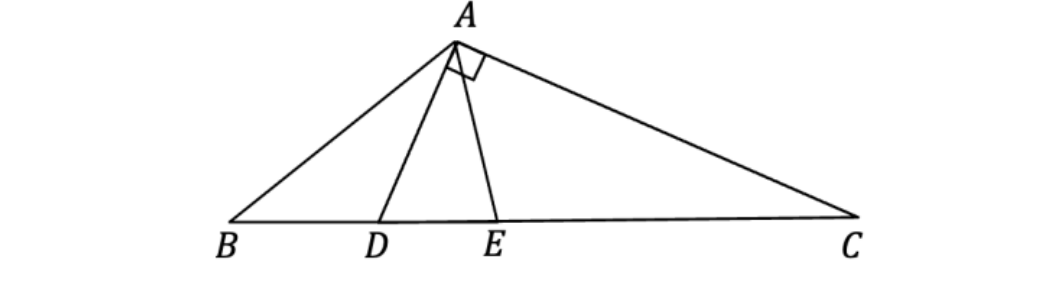
In the figure, $AD\perp AC$ and $\angle BAD=\angle DAE=15^\circ$. If $AB+AE=BC$, find $\angle ABC$ in degrees.

Question illustration

Question 20

Which numbers in $\{1,6,7,9\}$ occur as the last digit of $n^n$ for infinitely many positive integers $n$?
  1. 1, 6, 7 only
  2. 1, 6, 9 only
  3. 1, 7, 9 only
  4. 6, 7, 9 only
  5. 1, 6, 7, 9