SEAMO self-study edition 2027; not an official 2027 paper. Original source years are retained. 25 questions, 90 minutes; Q1–10: 3 points, Q11–20: 4 points, Q21–25: 6 points, total 100. Original response types and all subparts are preserved. Verified is an editorial convention; source defects, necessary assumptions and unresolved mathematical uncertainty are disclosed.
Find the sum of all positive integers $n$ for which $\dfrac{7n+15}{n-3}$ is an integer.
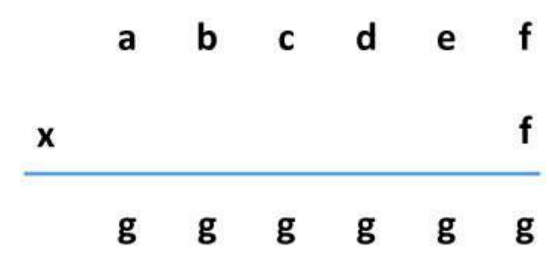
Find the digit $g$ in the multiplication shown: $\overline{abcdef}\times f=\overline{gggggg}$.
Use the standard alphametic convention: different letters stand for different decimal digits; leading digits are nonzero. The source does not state this convention explicitly.
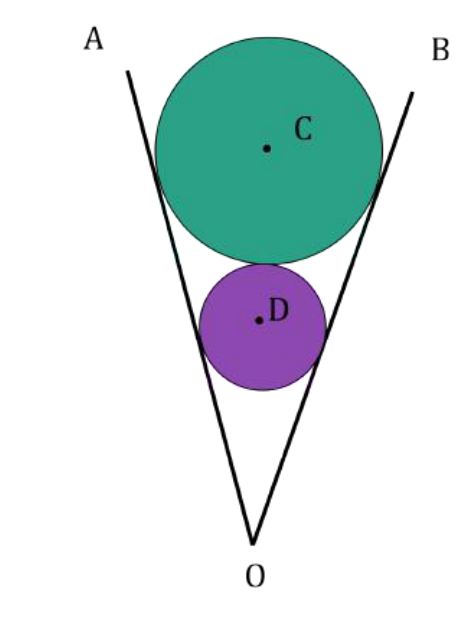
In sector $AOB$, the chord $AB$ has length 18 cm. $OA$ and $OB$ are tangent to both circles, and arc $AB$ is tangent to the circle with centre $C$. The circle with centre $C$ has radius 6 cm. Find the radius, in centimetres, of the circle with centre $D$.
As depicted, the two circles are externally tangent, their centres lie on the angle bisector, and the larger circle is internally tangent to the sector arc. The drawing is not to scale.
$\alpha$ and $\beta$ satisfy $\dfrac{\alpha^2-\alpha\beta+\beta^2}{\alpha^2+\alpha\beta+\beta^2}=\dfrac{31}{43}$ and $\dfrac1\alpha+\dfrac1\beta=\dfrac72$. The quadratic equation with roots $\alpha,\beta$ is $px^2+qx+r=0$, where $p,q,r$ are integers, $p\gt 0$, and $\gcd(p,q,r)=1$. Find $p+q+r$.
The source displays a quadratic expression; it is understood to be set equal to zero. Its printed key conflicts with the displayed algebraic conditions, as explained in the solution.
The source prints: “Let $a_1=3$ and define $a_{n+1}=\dfrac{\sqrt{3a_{n-1}}}{a_n+\sqrt3}$ [for] all positive integers $n$. Find $a$ [no index is printed].” The printed options are (A) 1, (B) 2, (C) 3, (D) 4, (E) None of the above. Explain what can and cannot be determined from this printed information.
Source defect: the requested term has no printed index, and the displayed recurrence at n=1 requires an unspecified a0. No index or initial value has been supplied by the editor. This item is assessed manually.
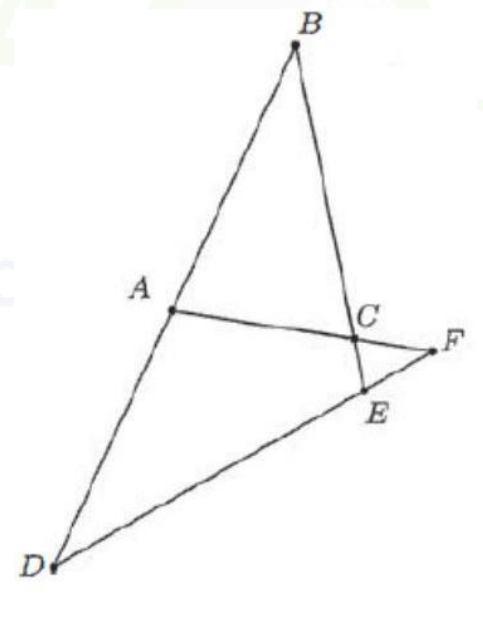
In the figure, $B,A,D$; $B,C,E$; $A,C,F$; and $D,E,F$ are collinear in the displayed orders. Given $BA=BC$, $AD=AF$, $EB=ED$, and $\angle BED=x^\circ$, find $x$.
A teacher selects 4 students from 5 boys and 4 girls to form a debate team. At least one boy and one girl must be selected. How many distinct teams can be formed?
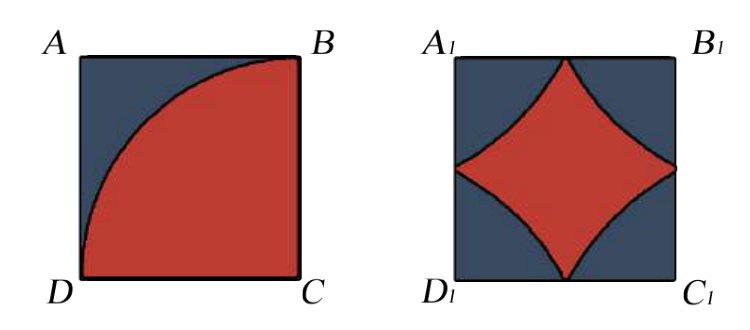
Squares $ABCD$ and $A_1B_1C_1D_1$ have side length $a$. Let $S$ and $S_1$ be the areas of the two red regions respectively. Which statement is true?
Interpret the curves as the quarter-circles indicated by the drawing: radius a at C in the first square, and radius a/2 at each corner of the second square, ending at side midpoints. Compare the actual red regions. The source worked solution has a colour-region mismatch.
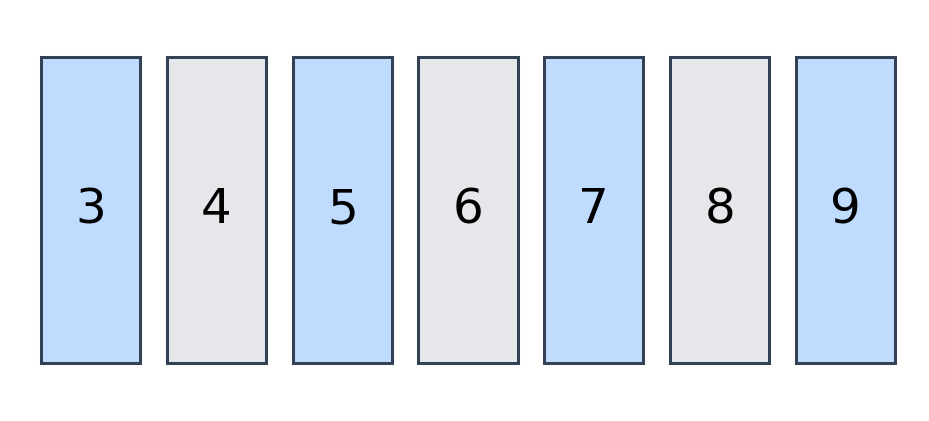
The numbers 3, 4, 5, 6, 7, 8 and 9 are written on separate cards and placed in a hat. Four cards are drawn without replacement. Find the probability that the product of the four numbers is odd.