SEAMO self-study edition 2027; not an official 2027 paper. Original source years are retained. 25 questions, 90 minutes; Q1–10: 3 points, Q11–20: 4 points, Q21–25: 6 points, total 100. Original response types and all subparts are preserved. Verified is an editorial convention; source defects, necessary assumptions and unresolved mathematical uncertainty are disclosed.
A bus was scheduled to travel from Town X to Town Y at constant speed $V$ km/h. If its speed were increased by 20%, it would arrive one hour early. Instead, if it travelled the first 120 km at $V$ km/h and then increased its speed by 25%, it would arrive 0.8 hours early. Find the distance between the towns, in kilometres.
After some water is added to a bottle of sodium chloride solution, its salt content is 15%. The same amount of water is added a second time and the salt content becomes 12%. What is the salt content, in percent, after the same amount of water is added a third time?
Miss Nutcharat drives from Bangkok to Chiang Mai. At a constant 100 km/h she would arrive 30 minutes late; at 120 km/h she would arrive 35 minutes early. What is the distance between the cities?
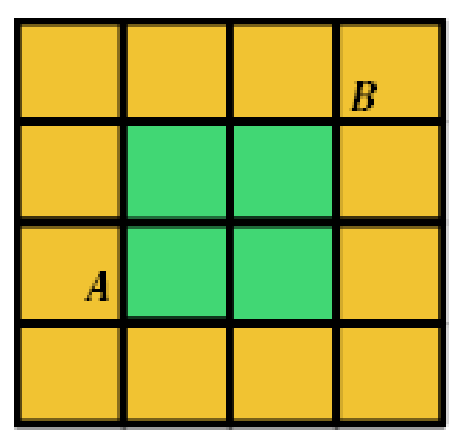
In the $4\times4$ grid shown, each small line segment is 1 unit long. What is the longest distance a beetle can travel from $A$ to $B$ if each segment may be traversed at most once? Original choices: (A) 24; (B) 26; (C) 28; (D) 30; (E) 31.
The printed choices are retained, but a choice-list inconsistency requires manual assessment. Give the longest distance itself. Vertices may be revisited; only reusing a line segment is forbidden, exactly as in the printed restriction.
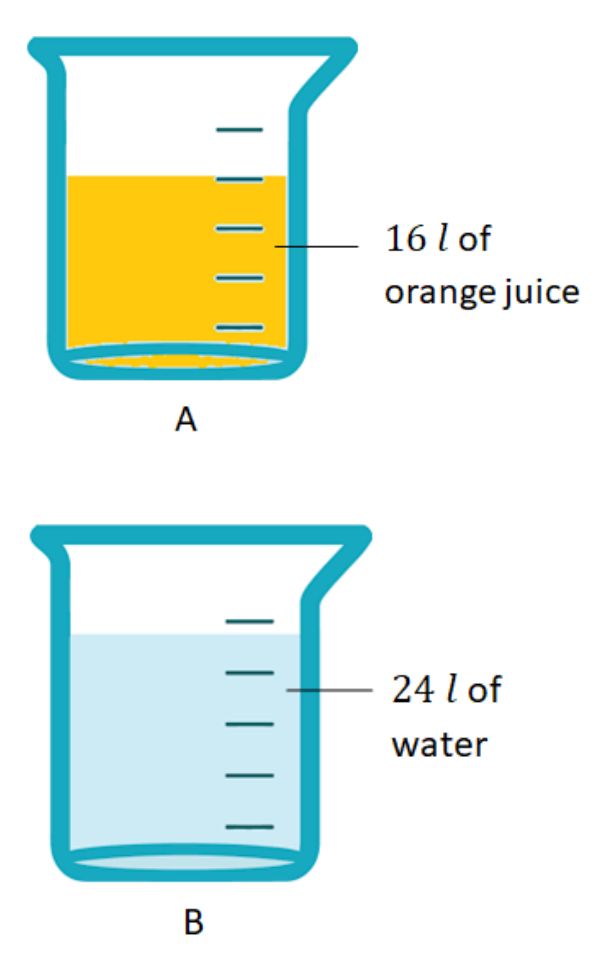
Container A holds 16 litres of orange juice and container B holds 24 litres of water. Some water is poured from B into A so that 60% of the mixture in A is orange juice. Some mixture is then poured from A back into B so that 20% of B is orange juice. How many litres of mixture are now in A?
Assume the contents are mixed uniformly before pouring back, and no liquid is lost.
At a party, each guest draws 2 balls from a bag containing many balls in five colours: red, yellow, white, blue and green. The host knows that at least two guests must have drawn the same colour combination. What is the minimum number of guests that guarantees this?
Colour combinations are unordered, and drawing two balls of the same colour is allowed.
A queue builds at a constant rate outside a museum that opens at 10:30 AM. If 3 entrances open, the queue clears at 10:39 AM; if 5 entrances open, it clears at 10:35 AM. At what time did the first visitor start queueing?
Use the usual continuous-rate model: all entrances have equal constant admission rates, and arrivals continue at the same rate after opening.
Given $3\star2=6$, $4\star3=24$ and $7\star2=42$, evaluate $8\star4$.
For this pattern exercise, use a product of consecutive descending integers, as intended by the source key. The source gives examples rather than a complete definition.
There are 198 buses at a terminal, each carrying the same number of passengers. The total number of passengers is the four-digit number $\overline{A37B}$, with $A$ nonzero. How many passengers are on each bus?
The product of the numerator and denominator of a proper fraction is 420. How many such proper fractions are there?
Use positive integer numerator and denominator, with numerator smaller than denominator. The printed question does not require the fraction to be in lowest terms; this practice item likewise does not add that condition.
Find the possible digits $m$ for which the 101-digit number $\underbrace{66\cdots6}_{50\text{ digits}}m\underbrace{55\cdots5}_{50\text{ digits}}$ is divisible by 7.
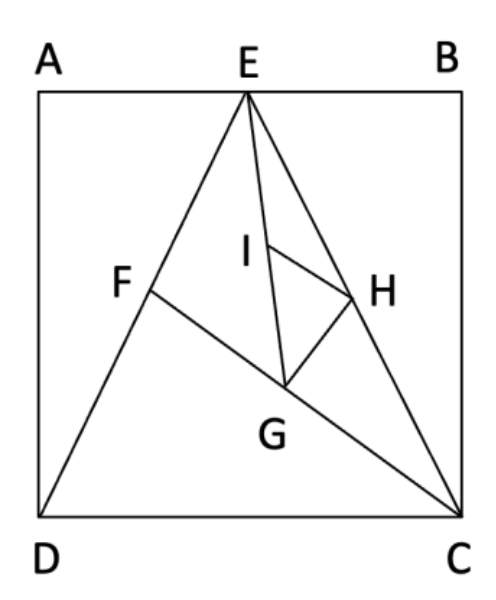
Square $ABCD$ has area $24\text{ cm}^2$. Point $E$ lies on $AB$ with $AE:EB=4:3$. Points $F,G,H,I$ are the midpoints of $DE,CF,CE,EG$, respectively. Find the area of triangle $GHI$ in $\text{cm}^2$.