SEAMO self-study edition 2027; not an official 2027 paper. Original source years are retained. 25 questions, 90 minutes; Q1–10: 3 points, Q11–20: 4 points, Q21–25: 6 points, total 100. Original response types and all subparts are preserved. Verified is an editorial convention; source defects, necessary assumptions and unresolved mathematical uncertainty are disclosed.
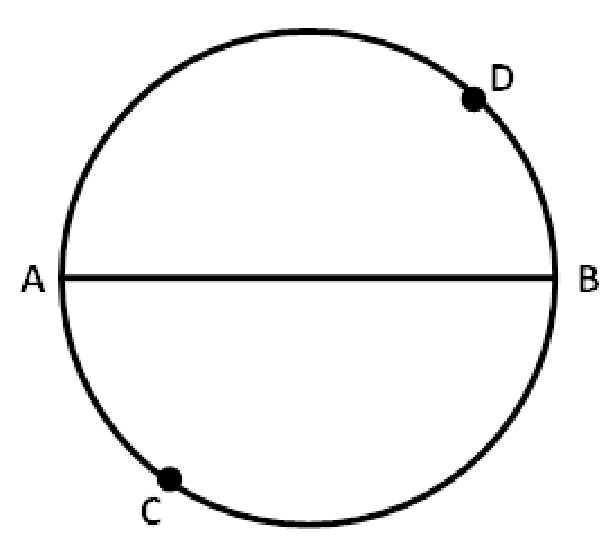
The diagram shows a circular track with diameter $AB$. Alejandro starts at $A$ and Behzod at $B$. They walk towards each other around the track, first meeting at $C$, 80 m from $A$, then meeting again at $D$, 60 m from $B$. Find the circumference in metres.
Use the usual constant-speed model: both keep walking in their original directions, and the stated distances are along the indicated shorter arcs.
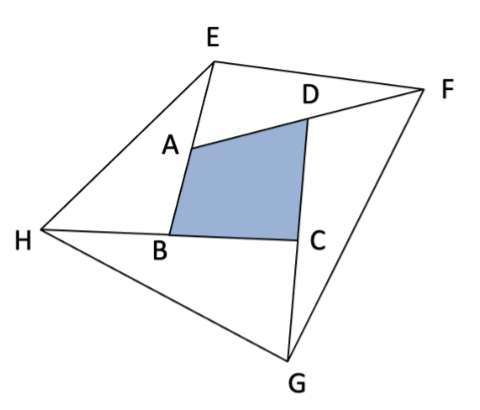
Each side of quadrilateral $ABCD$ is extended to twice its original length as shown, forming quadrilateral $EFGH$. If the area of $ABCD$ is $5\text{ cm}^2$, find the area of $EFGH$ in $\text{cm}^2$.
Uncle Sam woke between 5:00 AM and 6:00 AM. The number 6 on the clockface was exactly midway between the hour and minute hands. He woke at exactly $5:3A\frac{B}{C}$ AM. Find $A^B-C$.
Here $3A$ is a two-digit minute number, and $B/C$ is a proper fraction in lowest terms. The hands lie on opposite sides of 6.
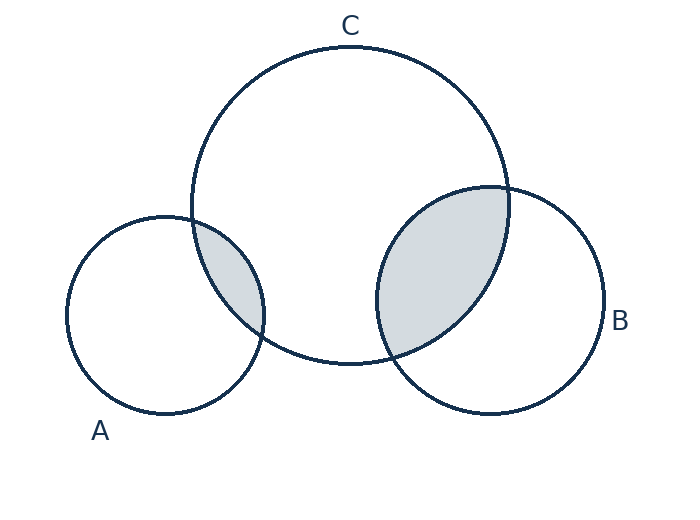
The diagram, not to scale, shows circles $A$, $B$ and $C$. One third of $A$, one half of $B$, and one quarter of $C$ are shaded. The total area of $A$ and $B$ is $3/5$ of the area of $C$. Find the ratio of the area of $A$ to the area of $B$.
Find the remainder when the product of 2019 factors, each equal to 2, is divided by 11: $\underbrace{2\times2\times\cdots\times2}_{2019\text{ factors}}$.
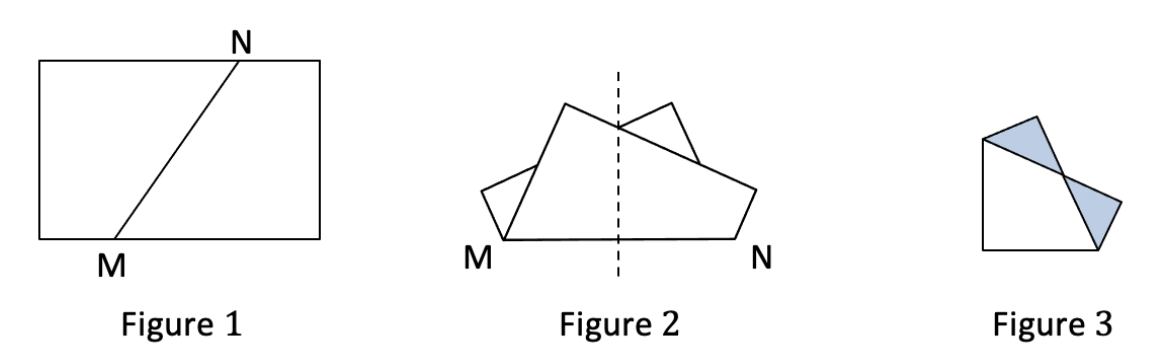
A rectangular sheet is folded as shown. The area of Figure 3 is $3/10$ of the area of Figure 1. The shaded region has area $6\text{ cm}^2$. Find the area of the original rectangle in $\text{cm}^2$.
Water flows into a pond at a constant rate. Eight identical outflow pipes empty it in 3 hours; five empty it in 6 hours. How many pipes are needed to empty it in 4.5 hours?
Assume all pipes have the same constant outflow rate, as intended by this standard pond model.
It is 8:00 PM. After how many minutes will the hour and minute hands next be equidistant from the number 9?
To match the intended source question, interpret this as the hands being on opposite sides of 9 with equal angular distances; coincident hands are excluded.
Alison and Bella leave a mall for a dance studio at the same time that Courtney leaves the studio for the mall. Courtney meets Alison 2 minutes after passing Bella. Their walking speeds are respectively 50, 60 and 70 m/min. How far, in metres, is the studio from the mall?
If James spends 100 dollars daily and Betty 50 dollars daily, James has 1300 dollars left when Betty runs out. If James spends 50 dollars daily and Betty 100 dollars daily, he has 3700 dollars left when she runs out. How many dollars did James have initially?
People join a concert-hall queue at a constant rate. Gates open at 7:35 PM. Three admission gates would clear the queue by 7:44 PM; five would clear it by 7:40 PM. If the first person began queueing at $A:BC$ PM, find $A-B+C$.
Use the standard continuous-rate model, with identical admission rates at every gate.
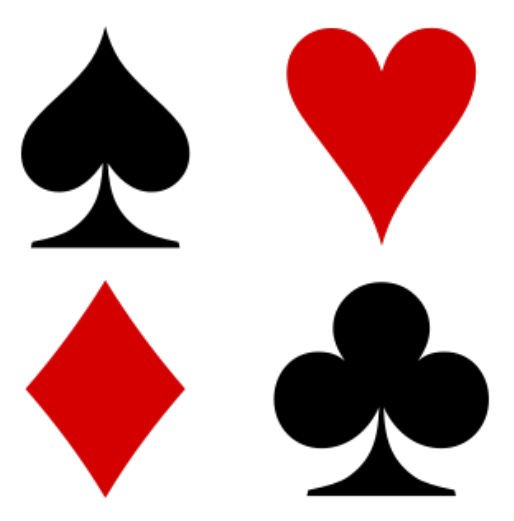
A deck has four suits: spades, hearts, clubs and diamonds, with 13 cards in each suit. What is the minimum number of cards a player must draw to guarantee at least one card of every suit?
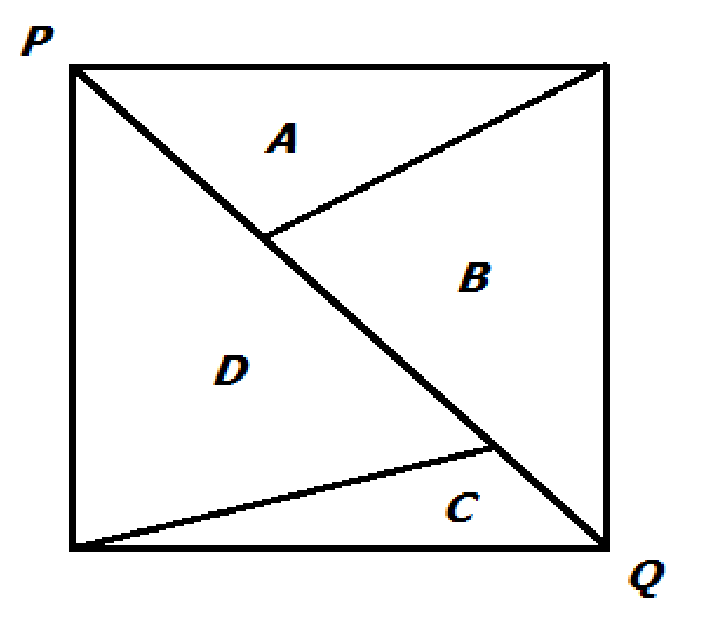
A square is divided into four triangles $A,B,C,D$ as shown. Their areas satisfy $A:B:C=3:5:2$. Triangle $D$ has area $96\text{ cm}^2$. Find the area of $B$ in $\text{cm}^2$.
Four distinct digits satisfy $a>b>c>d$. The sum of the largest and smallest four-digit numbers formed using each digit exactly once is 11469. Find the smallest possible value of the smallest four-digit number formed from these digits.